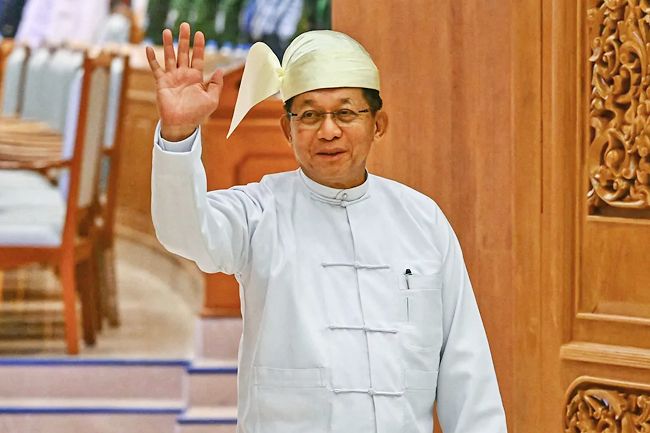
Myanmar's junta leader Min Aung Hlaing will travel to Bangkok for high-level talks with Thai Prime Minister Anutin Charnvirakul on August 6 and 7, according to Thailand's Foreign Minister Sihasak Phuangketkeow. The visit represents a significant diplomatic development in the troubled Southeast Asian bloc's attempts to manage the fallout from Myanmar's 2021 military coup, which deposed the democratically elected government of Aung San Suu Kyi and triggered widespread civil unrest that continues to destabilise the region.
Sihasak disclosed the planned engagement after participating in discussions with fellow ASEAN foreign ministers in Manila, where delegates engaged in what he characterised as direct and forthright exchanges regarding how best to shepherd Myanmar back into the regional grouping's mainstream activities. The conversations reflected ongoing tensions within the ten-member organisation over the appropriate strategy toward a nation whose military rulers consolidated power through force, subsequently dismantling democratic institutions and facing mounting international criticism for alleged human rights violations and political repression.
Although Myanmar formally retains membership in the Association of Southeast Asian Nations, the bloc has systematically sidelined it from key gatherings and decision-making forums since the coup took place. This suspension represents an unprecedented action within ASEAN's history, signalling member states' collective disapproval whilst simultaneously creating friction over how long such measures should remain in effect and what conditions should govern their eventual removal. The diplomatic exclusion underscores the organisation's struggle to balance principles of non-interference with mounting pressure from international powers and civil society to respond meaningfully to governance crises within its borders.
Thailand occupies a unique position in this regional standoff. As Myanmar's immediate neighbour and home to approximately two million Burmese refugees and migrant workers, Bangkok faces direct consequences from instability across the border. The country has emerged as the most vocal advocate for Myanmar's eventual readmission into ASEAN's full proceedings, a stance that has exposed deep philosophical and strategic disagreements among member governments about engagement versus isolation. Thailand's willingness to host high-profile meetings with Myanmar's leadership reflects its conviction that dialogue offers a more productive path than continued ostracism, though this approach remains contested within the bloc.
The visit will reportedly address a dual-track diplomatic strategy that combines bilateral concerns with broader regional objectives. Thailand's foreign minister indicated that pressing practical matters require immediate attention, particularly the growing menace of organised crime networks operating across their shared border. Transnational smuggling operations, human trafficking syndicates, and increasingly sophisticated scam networks targeting regional residents have created urgent security challenges that neither country can adequately address alone. Additionally, the persistent drug trafficking problem, a traditional plague affecting the Golden Triangle region, demands coordinated action between Myanmar's authorities and Thai law enforcement, offering a pragmatic foundation for sustained engagement.
Yet Sihasak stressed that pursuing bilateral cooperation does not signal abandonment of ASEAN's established framework for addressing Myanmar's political crisis. The bloc's five-point peace plan, formulated in 2021, remains the official regional position, though disagreements persist over its utility and enforcement. Thailand's approach attempts to thread this needle by simultaneously maintaining commitment to collective ASEAN principles whilst developing practical working relationships that might gradually create conditions favourable to broader reconciliation. This delicate balancing act reflects the reality that purely punitive measures have produced limited results, whilst complete normalisation remains politically untenable for many member states.
A critical element of Thailand's reengagement strategy involves establishing clearer benchmarks for measuring progress toward political reform in Myanmar. Sihasak posed several concrete questions during recent discussions with ASEAN colleagues: whether granting the regional special envoy access to imprisoned former leader Suu Kyi would constitute meaningful advancement, or whether demonstrated reductions in violence along border regions should factor into assessments of improvement. These inquiries suggest recognition that Myanmar's transformation will not occur rapidly or comprehensively, requiring instead an incremental approach that acknowledges genuine obstacles to immediate democratisation whilst identifying achievable intermediate steps.
Thailand has also pinned hopes on the controversial elections conducted earlier this year, which resulted in Min Aung Hlaing's elevation to the presidency. Though international observers raised concerns about the voting process's credibility and the restrictions placed on democratic participation, Thai officials expressed cautious optimism that the military's formal transition to civilian governmental structures might create openings for dialogue with armed ethnic minority groups and pro-democracy opposition forces. This perspective reflects a pragmatic assessment that the junta, having consolidated institutional control through elections, may prove more willing to negotiate with various stakeholders than when purely military governance prevailed.
Thailand has also signalled potential willingness to facilitate discussions between Myanmar's armed ethnic organisations and the central government, positioning itself as an intermediary in conflicts that have displaced hundreds of thousands along the border regions. The country's geography and existing relationships with diverse Burmese groups provide practical advantages for such mediation efforts. Sihasak characterised these potential dialogues as building blocks toward broader political resolution, suggesting that progress need not follow a linear path but could develop through multiple simultaneous channels addressing distinct grievances and stakeholder interests.
Parallel to Thailand's bilateral engagement initiatives, ASEAN more broadly is reassessing its institutional approach to the Myanmar crisis. The Philippines' Foreign Minister Theresa Lazaro disclosed deliberations over appointing a permanent, long-term special envoy to replace the current system of annual rotating representatives. This administrative reform implicitly acknowledges that Myanmar's political transition will extend well beyond a single calendar year, requiring sustained attention and continuity of effort that the existing rotation mechanism cannot provide. The current arrangement, which has seen ambassadors cycling through the position based on the rotating ASEAN chairmanship, has demonstrably failed to generate meaningful progress or leverage sufficient influence over Myanmar's authorities.
The appointment of a dedicated envoy would represent a significant institutional investment signalling the bloc's long-term commitment to engaging Myanmar's rehabilitation, though disagreements undoubtedly persist over the envoy's mandate, authority, and the strategies that person should pursue. The proposal gains context from frustrations among member states that annual transitions disrupt continuity and reduce the special envoy's ability to develop relationships or execute sustained pressure on the junta. A permanent appointment would allow for deeper engagement and more sophisticated diplomatic approaches than the current system permits, though it would also require consensus on objectives and methods that has proven elusive among ASEAN's diverse membership.
These diplomatic manoeuvres carry implications extending far beyond Myanmar's borders. ASEAN's response to the coup and subsequent governance crisis tests the organisation's foundational principle of non-interference whilst raising fundamental questions about the bloc's coherence and capacity to address serious regional challenges. How the group manages Myanmar's eventual reintegration, and on what terms, will shape ASEAN's trajectory for years to come. For Malaysia and other member states, Myanmar's situation remains consequential whether through refugee flows, regional stability concerns, or questions about how ASEAN's fundamental operating principles adapt to modern governance crises.

