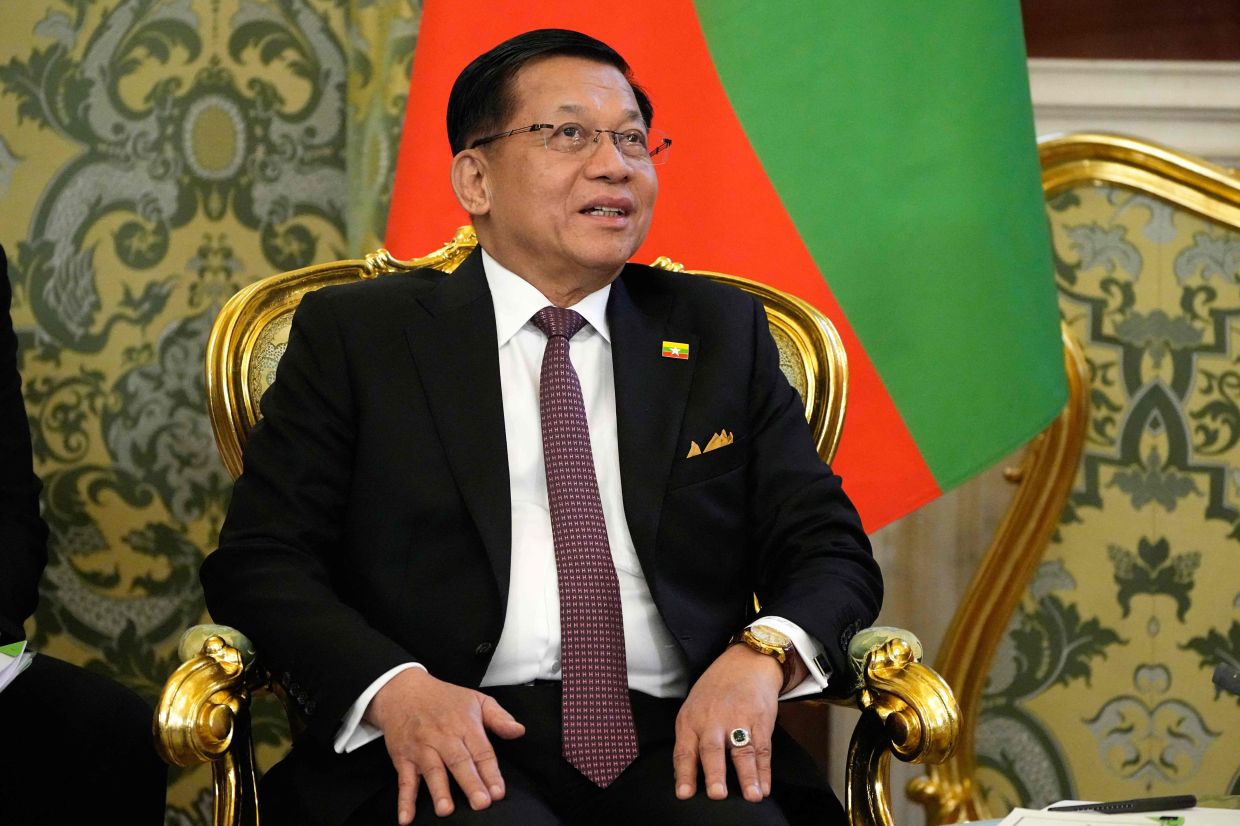
Myanmar's military leader Min Aung Hlaing will undertake an official visit to Cambodia in early September, according to an announcement confirmed by the Cambodian Senate. The trip aims ostensibly to deepen ties between the two neighbouring nations and represents the latest stop on an extended international tour that observers and rights advocates increasingly view as a calculated effort to shore up his political legitimacy both domestically and regionally.
Cambodia's Senate confirmed the visit through senior officials, with Kuy Sophal, the Minister of the Royal Palace, and Chin Ketna, permanent deputy chairman and secretary-general of the National Committee for Organising National and International Festivals, already conducting inspections of potential venues to accommodate the Myanmar delegation. Chea Thyrith, spokesperson for the Senate president, characterised the engagement as an opportunity to strengthen bilateral friendship and deepen cooperation between two countries with long-standing historical and cultural connections. The framing emphasises mutual benefit and shared interest in regional stability.
The Cambodia visit forms part of a systematic diplomatic campaign undertaken by Min Aung Hlaing since his election as president in April, a political transition that drew widespread international scepticism and accusations of electoral irregularities. Within months of that contested election, he has already visited India, China, Laos, Thailand, and Russia, each visit carefully choreographed to present him as a legitimate head of state worthy of official recognition. These journeys stand in stark contrast to Myanmar's current status within Asean, where the bloc has increasingly marginalised the country owing to concerns about the 2021 military coup that deposed civilian leader Aung San Suu Kyi and her subsequent detention.
The geopolitical significance of Min Aung Hlaing's regional tour cannot be overstated for observers tracking Myanmar's isolated position in Southeast Asia. Asean has historically resisted interventionism in member states' internal affairs, yet the scale and nature of Myanmar's political upheaval prompted unprecedented measures, including the suspension of the country from high-level summit participation. This constraint has effectively diminished Myanmar's voice in regional decision-making and created a diplomatic imperative for the junta leadership to rebuild bilateral relationships as a foundation for eventual reintegration into Asean's mainstream forums. Cambodia's willingness to host Min Aung Hlaing therefore signals both bilateral goodwill and, potentially, sympathy with Myanmar's isolation.
Criticism of these diplomatic efforts has intensified among human rights organisations, pro-democracy networks, and international observers who argue that the tour functions as a legitimacy-laundering exercise. Under Min Aung Hlaing's military administration, Myanmar has documented significant human rights abuses extending beyond the coup itself. Thousands of political activists, civil society members, and dissidents have reportedly faced arbitrary detention, with credible reports of torture, extrajudicial violence, and restrictions on fundamental freedoms including expression and assembly. The detention of Aung San Suu Kyi, the democracy icon and former civilian leader, remains particularly emblematic of the junta's repressive character and motivates continued pressure from international quarters.
Cambodia's own historical trajectory provides complex context for its engagement with Myanmar. Kin Phea, president of the International Relations Institute of Cambodia, has suggested that the bilateral relationship encompasses mutual opportunities for dialogue and learning. During Cambodia's tenure as Asean chair in 2022, the government pursued mediation efforts aimed at easing Myanmar's crisis, reflecting a regional philosophy emphasising dialogue over confrontation. Phea acknowledged that Min Aung Hlaing's Cambodia visit aligns with efforts to consolidate the junta leader's presidential standing internationally, yet he also proposed that Cambodia might offer valuable perspectives drawn from its own experience navigating post-conflict reconciliation, nation-building, and social cohesion. Such an exchange, he suggested, could prove instructive for Myanmar's domestic stakeholders, though external diplomatic initiatives alone cannot substitute for internal political reform.
The distinction between bilateral state visits and Asean-level recognition remains critical to understanding the limits of such diplomatic outreach. Phea cautioned that individual country visits, while symbolically important, do not automatically translate into Myanmar's readmission to Asean summit participation or restoration of full diplomatic standing within regional structures. That determination ultimately rests on implementation of Asean's five-point consensus, the framework adopted to guide Myanmar's path toward compliance with regional norms and democratic principles. The consensus conditions Myanmar's reintegration on measurable progress toward ceasefire, humanitarian access, political dialogue, and eventual democratic transition, criteria that cannot be satisfied through bilateral tourism alone.
For Malaysian observers and regional analysts, Min Aung Hlaing's Cambodia visit underscores the ongoing tension within Asean between principles of non-interference and concern about governance legitimacy. Malaysia has maintained consistent positions on democratic standards and human rights accountability, making Myanmar's trajectory a test case for Asean's collective values. The Cambodia engagement highlights how individual member states navigate their bilateral interests with Myanmar alongside broader regional consensus, a delicate balancing act that has defined Asean's internal debates since 2021.
The strategic implications extend beyond bilateral relations. Myanmar's geographic position linking South Asia, Southeast Asia, and China grants its political stability significance for regional trade routes, security architectures, and geopolitical balance. A junta-led Myanmar isolated from mainstream Asean participation potentially creates vacuums exploitable by external powers, complicating the bloc's autonomy and strategic coherence. Conversely, premature normalisation risks appearing to validate authoritarian consolidation at odds with Asean's nominal commitment to democracy and human rights. Cambodia's calculated hospitality toward Min Aung Hlaing thus reflects this broader dilemma facing the region.
The September visit will likely generate considerable scrutiny regarding whether Cambodia explicitly designates it as a state visit and the ceremonial protocols extended to Min Aung Hlaing. Such procedural details carry symbolic weight in diplomatic practice, signalling the degree of legitimacy conferred. Observers will also monitor statements emerging from the bilateral discussions for any indication of Cambodia's position on Myanmar's Asean reintegration and the implementation of the five-point consensus. These elements will collectively indicate whether the Cambodia engagement functions primarily as courtesy extended between neighbours or as a more substantive diplomatic initiative with ramifications for Myanmar's broader international standing.

