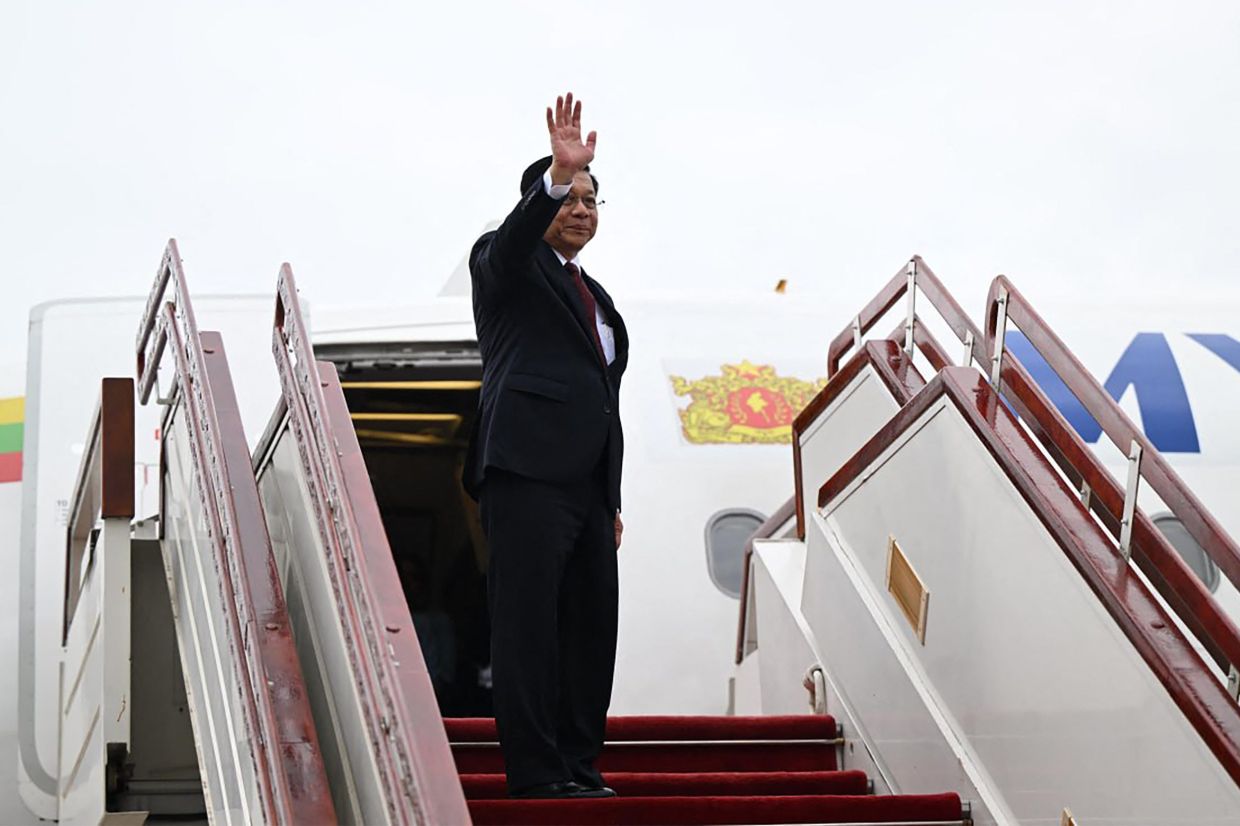
Myanmar's leader Min Aung Hlaing embarked on a journey to Russia on Monday, August 17, for high-level discussions with President Vladimir Putin in what marks his inaugural visit to Moscow since taking on the role of civilian president. The departure, confirmed by the Myanmar government, signals continued strengthening of ties between Naypyidaw and Moscow at a time when Myanmar faces international isolation following the turbulent political upheaval of recent years.
Russia's strategic importance to Myanmar cannot be overstated. As one of the handful of nations that extended diplomatic support following the 2021 military coup that dismantled the elected administration led by Aung San Suu Kyi, Moscow has positioned itself as a crucial ally for the Southeast Asian nation. The aftermath of that coup has been devastating for Myanmar, with an estimated death toll exceeding 100,000 people as armed conflict has engulfed the country between government forces and various opposition movements demanding the restoration of democratic governance.
Min Aung Hlaing assumed office as president in April after elections that were widely criticized as lacking legitimacy. Western democracies and international human rights organisations dismissed the electoral process as a carefully choreographed performance designed to provide a veneer of civilian governance to what remains fundamentally military rule. Despite this international scepticism regarding the legitimacy of his position, he has embarked on an extensive diplomatic campaign to rehabilitate Myanmar's standing on the global stage.
The stated objective of the Moscow visit centres on consolidating the historical partnership between the two nations and broadening cooperation in critical domains. Myanmar's presidential office highlighted in an official statement the importance of deepening relations across security matters and economic collaboration. These dual pillars of engagement reflect Naypyidaw's strategy to secure both military support and investment as it navigates international pressure and domestic instability.
The military dimension of Myanmar-Russia cooperation has already become visible on the ground. Myanmar's armed forces operate Russian-manufactured fighter jets in operations against various armed opposition groups and ethnic insurgencies. However, these military campaigns have been mired in controversy. Conflict monitoring organisations have documented numerous instances where these aerial strikes and ground operations have affected civilian populations, with some observers suggesting the scale and nature of civilian casualties may constitute war crimes under international humanitarian law.
The deepening military partnership was formalised earlier in the year when Myanmar and Russia concluded a five-year military cooperation agreement in February. Although the specifics of this pact remained largely undisclosed, the arrangement signals Moscow's willingness to provide sustained military assistance to Myanmar's junta-dominated government. This agreement represents a significant commitment to bolster Naypyidaw's military capabilities over the medium term.
Min Aung Hlaing's delegation during the visit comprises other high-ranking government officials, underscoring the significance Myanmar places on this engagement. During his time in Moscow, he is scheduled to hold meetings with Russia's prime minister and the speaker of the State Duma, the lower house of the Russian parliament. Beyond bilateral discussions, the delegation will participate in a Myanmar-Russia economic forum, signalling an intention to explore commercial opportunities and strengthen trade relationships between the two nations.
This Moscow journey represents one component of Min Aung Hlaing's broader international diplomatic offensive. Since assuming the presidency in April, he has undertaken multiple overseas visits, including trips to fellow regional powers China and India, as well as to neighbouring Thailand. These travels demonstrate a calculated approach to recovering Myanmar's international credibility and breaking out of the isolation that has characterised Myanmar's position since the 2021 coup.
The timing of the visit reflects the evolving geopolitical landscape in Southeast Asia and beyond. Myanmar's alignment with Russia comes as the latter faces international sanctions and diplomatic isolation stemming from its invasion of Ukraine. For Naypyidaw, Russian support provides a crucial counterweight to Western pressure and offers a model for how authoritarian governments can maintain international engagement despite widespread international criticism. Similarly, Russia views Myanmar as an important strategic asset in Asia, particularly given the country's geographic proximity to China and India, two major regional powers.
The visit also underscores the limited options available to Myanmar's military leadership as it seeks international rehabilitation. With Western nations maintaining a largely hostile stance toward the government and implementing targeted sanctions, Russia and China have emerged as the primary sources of diplomatic recognition and material support. This dependency on authoritarian powers shapes Myanmar's foreign policy calculus and may further entrench the military government's resistance to democratic reform.
For Southeast Asia and the wider international community, Myanmar's deepening ties with Russia illustrate how geopolitical competition and authoritarian solidarity can transcend geographical boundaries. The country's internal conflict continues to generate humanitarian concerns, with displacement and economic collapse affecting millions of citizens. Min Aung Hlaing's diplomatic mission to Moscow, however, suggests the military leadership prioritises international engagement and strategic partnerships over addressing the fundamental governance questions that precipitated the 2021 crisis and the subsequent civil war.

