Myanmar's military government is banking heavily on a tourism renaissance to demonstrate economic recovery and regional normalisation following this year's elections. The ambitious push represents one of the first tangible efforts to signal that parts of the nation are stabilising and welcoming international visitors again after the devastating impact of the 2021 coup that triggered civil war and isolation. Officials have set an aggressive target of 1.8 million foreign arrivals this year, nearly double the 973,263 visitors recorded in 2025, by streamlining visa procedures and strategically targeting travellers from neighbouring China and Thailand.
The tourism initiative carries significant weight beyond simple revenue generation. It functions as a confidence-building measure aimed at convincing both tourists and international investors that sufficient stability exists in key regions to justify travel and business engagement. Success would provide visible proof that Myanmar's new leadership under President Min Aung Hlaing, sworn in during April, can deliver on promises of recovery and regional reintegration after years of international pariah status.
Progress through the first five months of the year has been modest but encouraging. Arrivals totalled 448,205 through May, representing approximately five per cent growth compared to the same period previously. This trajectory means the government must achieve significantly stronger results in the second half to realise its 1.8 million target, making the coming months critical for assessing whether the tourism strategy will gain genuine momentum. Maung Maung Kyaw, permanent secretary at the Ministry of Hotels, Tourism and Culture, emphasised that Chinese and Thai visitors will be essential catalysts, acknowledging that growth prospects depend substantially on sustained interest from these two nations.
Despite optimistic forecasts, Myanmar's tourism aspirations remain dwarfed by its regional competitors. Even achieving the 1.8 million target would fall significantly short of the approximately 4.7 million visitors welcomed in 2015, when Myanmar first opened to international travel following years of isolation under military rule. Thailand, a neighbouring benchmark, attracted roughly 33 million tourists last year and maintains comparable targets, highlighting the immense distance Myanmar must travel to recapture its previous trajectory as an emerging Asian destination.
Chinese travellers have emerged as Myanmar's dominant source of international arrivals, particularly through air transport, followed by Thai and South Korean visitors. Chinese arrivals expanded by twelve per cent during the first five months, while Thai visitors increased seven per cent, validating the government's strategic focus on these two markets. However, officials acknowledge that visa policy adjustments will remain responsive to specific market demand rather than uniformly applied. Myanmar has already expanded its visa-on-arrival programme to include China, India, Japan, and South Korea, while Russia and most Southeast Asian nations already enjoy visa-free access privileges.
The tourism revival strategy operates within a complicated security and reputational context. While official statistics track legitimate international arrivals, they exclude the undocumented movement of individuals trafficked into online scam compounds, a phenomenon that has drawn intensive regional scrutiny and resulted in significant repatriation efforts involving thousands of Chinese nationals. This distinction matters considerably for understanding true visitor patterns and for reassessing the credibility of government tourism figures when evaluating genuine sector recovery.
Since assuming the presidency, Min Aung Hlaing has pursued deliberate diplomatic engagement aimed at restoring regional standing. State visits to China and India, coupled with efforts to normalise relations with Southeast Asian neighbours, signal determination to position Myanmar as a functional regional partner rather than an isolated pariah state. Thailand, as Myanmar's closest economic ally, has reciprocated with measured re-engagement, including a ministerial visit in April by Foreign Minister Sihasak Phuangketkeow. More tellingly, popular Thai travel influencers including Farose and Go Went Go's Bas have recently created content featuring Yangon, introducing the city to regional audiences after years of absence from travel narratives.
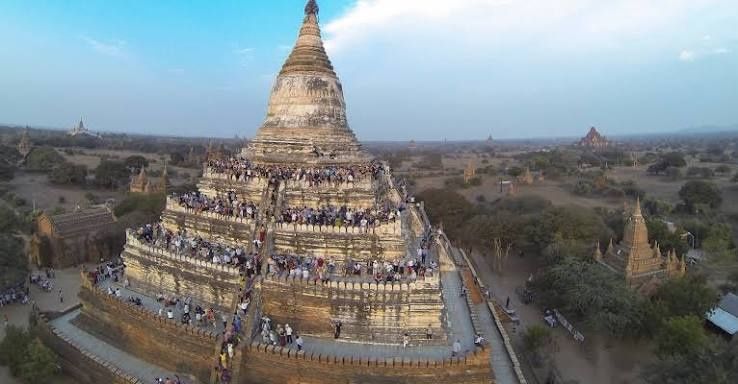
Myanmaran tourism authorities emphasise that Yangon, Mandalay, Bagan, Inle Lake, and the Golden Rock Pagoda remain the primary attractions for international travellers. These destinations represent the country's historical and cultural heritage, positioning Buddhist pilgrimage sites and ancient temples as cornerstones of the recovery strategy. Aung Aye Han, director general of the Directorate of Hotels and Tourism, stressed the importance of trust-building initiatives, recognising that sustainable recovery depends on genuine confidence restoration among potential visitors and investors rather than promotional spectacle alone.
Tour operators report encouraging signs suggesting tourist interest extends well beyond Myanmar's immediate neighbours. Although international flight availability remains limited, inquiries from Europe, the United States, and India have noticeably increased, according to Thet Lwin Toh, managing director of Myanmar Voyages International Tourism Co. This geographic diversification of interest indicates that Myanmar's appeal as a frontier destination with distinctive colonial architecture, ancient temples, and relatively untouched landscapes retains potency across multiple markets, even amid restricted travel infrastructure.
Luxury hotel properties are experiencing early indicators of recovery, with occupancy rates in Yangon rising approximately ten per cent since the recent election. May Myat Mon Win, general manager of Chatrium Hotel Royal Lake and adviser to the Myanmar Tourism Federation, reports that current guests increasingly consist of business travellers, religious pilgrimage groups, and individuals exploring investment possibilities rather than traditional leisure tourists. This composition reflects the broader economic transition strategy wherein tourism interconnects with business development and capital investment objectives.
Interest from Japan represents an emerging opportunity, driven primarily by business expansion and investment exploration rather than conventional tourism motivation. This pattern suggests Myanmar's recovery strategy operates across multiple simultaneous tracks—cultural tourism, religious pilgrimage, business travel, and investment scouting—each appealing to distinct visitor segments with varied motivations and economic implications.
Western governments maintain cautious public positions regarding Myanmar travel safety. The United States State Department continues its "Do Not Travel" advisory citing ongoing armed conflict and civil unrest, yet official figures paradoxically show American arrivals increased seventeen per cent through May. Individual travellers like Liam Martinez, a 34-year-old from Texas, report feeling secure despite international headlines, attributing their decision to visit to YouTube content that contradicts mainstream news coverage. This divergence between official advisories and ground-level visitor experience raises important questions about information asymmetries and the extent to which conventional news narratives accurately reflect conditions in areas designated for tourism activities.

