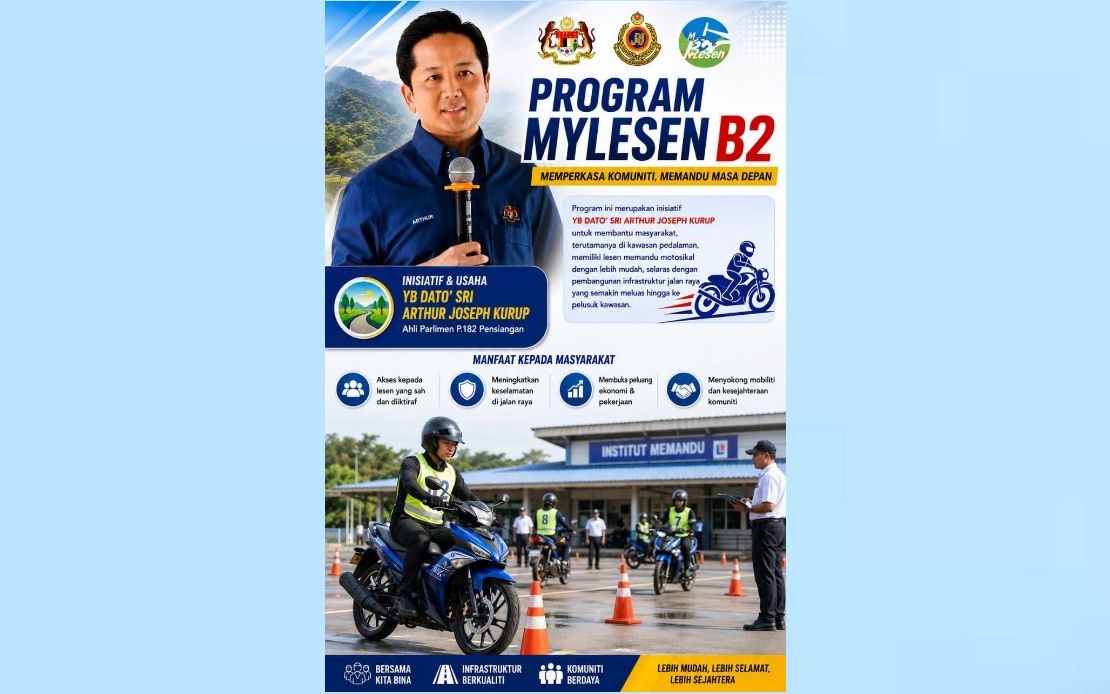
Malaysia's MyLesen B2 initiative has made its way back to Pensiangan in Sabah, addressing a long-standing accessibility gap for rural motorcyclists seeking valid riding credentials. The decentralised licensing programme removes geographical barriers that have historically forced residents of remote constituencies to undertake costly journeys to urban driving schools simply to formalise their right to operate motorcycles on public roads. By bringing the licensing framework directly to Pensiangan, the scheme acknowledges the practical realities of peninsular Malaysia's less densely populated regions, where transport infrastructure and commercial services concentrate in urban centres.
The initiative carries the backing of Datuk Seri Arthur Joseph Kurup, Pensiangan's Member of Parliament and current Natural Resources and Environmental Sustainability Minister. Kurup framed the programme as fundamentally serving rural youths and working-age residents who might otherwise remain unlicensed due to distance and logistics. His emphasis on assisting those who have never previously held a driving licence suggests the programme targets a demographic that motorcycles, often the primary personal transport in rural Sabah, represent an essential economic tool rather than recreational equipment. This focus reflects understanding of how transport credentials directly enable employment and livelihood generation in communities where alternative mobility options remain limited.
Participants entering the MyLesen B2 stream must complete mandatory coursework and pass prescribed examinations, maintaining the regulatory standards that govern Malaysia's road safety framework. The programme does not circumvent licensing requirements or lower competency thresholds; rather, it relocates the delivery infrastructure to eliminate transportation friction. Kurup's public commitment to guide participants through every stage of the licensing journey suggests a hands-on political investment in programme success, positioning the initiative as more than bureaucratic procedure but as a genuine constituent service with ministerial accountability.
Road safety considerations underpin the scheme's design. By formalising motorcyclist credentials through standardised testing and legal licensing, the programme aims to elevate rider competency and awareness of Malaysian traffic regulations. Rural motorcyclists operating without valid licences represent both a personal liability and a public risk factor. Pensiangan's incorporation into MyLesen B2 therefore addresses safety deficits while simultaneously expanding economic opportunity—unlicensed riders cannot legally earn income through delivery, logistics, or transport services, creating a shadow employment market where neither riders nor employers assume proper liability. The regulatory formality that MyLesen B2 introduces thus serves dual objectives of risk reduction and economic formalisation.
Eligibility spans from age 16 to 63, capturing both youth riders entering the workforce and older residents who may have deferred licensing previously. This broad age range acknowledges that rural motorcycle adoption does not follow conventional urban age patterns; economic necessity and transport availability shape rider demographics differently in less developed regions. The lifelong validity of issued licences, contingent on regulatory compliance, provides permanent documentation that participants can leverage across employment, financial services, and other credentialing contexts where valid identification documents carry weight.
The economic implications extend beyond individual riders. Access to legally sanctioned employment in motorcycle-dependent sectors—delivery services, agricultural logistics, rural commerce—creates formalised income streams that contribute to household stabilisation and community economic development. For young women and men in Pensiangan, a valid motorcycle licence transforms an informal necessity into a documented credential, opening pathways to employment that would otherwise remain inaccessible. This particularly benefits young women, for whom licensed employment in transport sectors may offer independence and income security that local economies do not otherwise provide.
Registration infrastructure has been established at two service points: the Pensiangan Parliamentary Service Centre and the Sook State Assemblyman's Service Centre. This dual-location strategy anticipates that residents across the constituency may find different centres more convenient, reducing registration barriers further. The placement of intake points within existing political service infrastructure suggests integration with existing constituent-support networks, enabling greater visibility and accessibility than standalone licensing facilities might achieve.
MyLesen B2's return to Pensiangan reflects broader Malaysian policy recognition that decentralisation of government services can meaningfully expand access to credentials that determine formal economic participation. The scheme acknowledges that rural-urban service gaps are not abstract development issues but concrete barriers preventing entire populations from obtaining documents necessary for legal employment. By bringing licensing administration to where people actually live and work, the programme operationalises equity not through subsidy or relaxed standards but through spatial accessibility—making legitimate pathways to formalised work genuinely available to communities that distance and infrastructure have historically excluded.
For Malaysian policymakers observing rural development challenges across Peninsular Malaysia and East Malaysia, MyLesen B2 offers a replicable model for extending regulatory frameworks beyond urban concentrations. Similar constituency-level initiatives could theoretically address credential access gaps across numerous sectors—commercial driving, vocational qualifications, business registration—wherever geographic distance currently forces rural residents toward informal arrangements or unlicensed operation. Pensiangan's participation in the scheme thus carries significance beyond Sabah, testing and validating approaches that other rural constituencies might adopt to narrow formalisation gaps and integrate dispersed populations into Malaysia's mainstream economic and regulatory systems.

