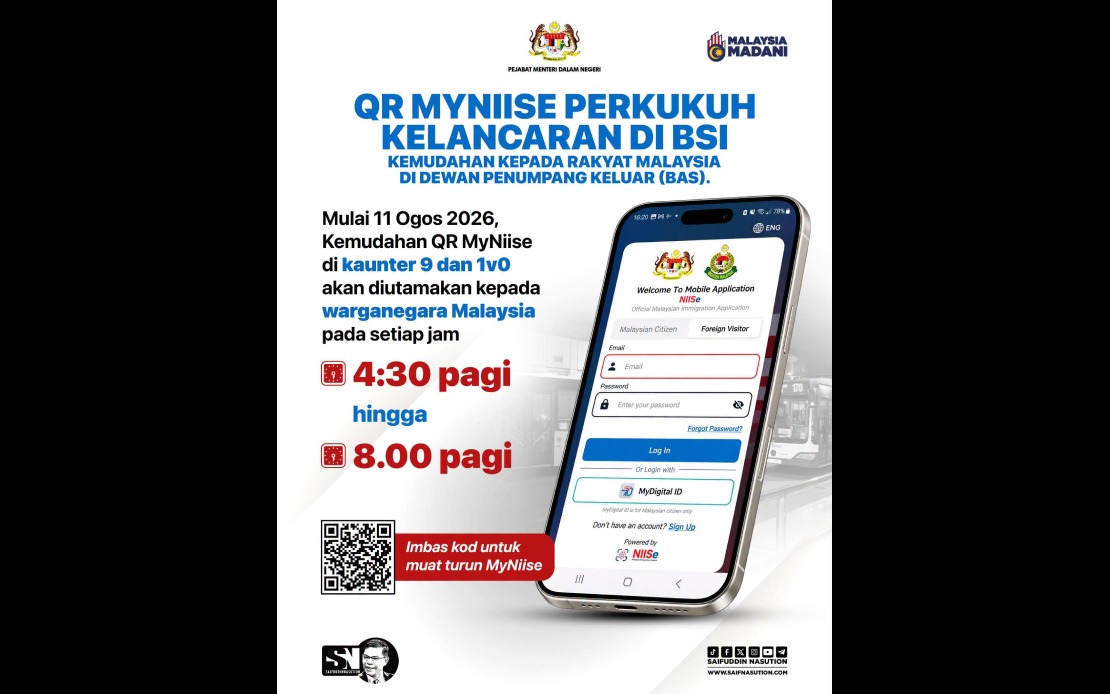
Starting from August 11, travellers departing Malaysia for Singapore through Bangunan Sultan Iskandar will encounter a streamlined immigration process if they utilise the MyNIISe QR system. The Home Ministry, through Minister Datuk Seri Saifuddin Nasution Ismail, has designated dedicated lanes at the facility's Bus Departure Hall to accelerate clearance procedures, particularly during the congested early morning hours when thousands of Malaysian workers rush to cross the border.
The initiative targets the window between 4.30 am and 8 am, when the volume of cross-border commuters peaks substantially. Two dedicated counters—specifically counters 9 and 10 in the Bus Departure Hall—have been allocated exclusively for MyNIISe QR code holders. This represents a tangible effort to address the perennial bottlenecks that have characterised the Malaysia-Singapore border crossing, especially for the substantial workforce that travels daily between the two nations for employment.
The implementation underscores the government's broader push to digitalise immigration processes. MyNIISe, the National Integrated Immigration System, represents a cornerstone of Malaysia's modernisation agenda in border management. By incentivising adoption through concrete efficiency gains, policymakers hope to accelerate the transition from traditional manual processes to digital verification systems. The priority lane strategy essentially rewards early adopters and demonstrates tangible benefits of embracing government digital infrastructure.
Daily commuters from Malaysia represent a critical economic constituency. Tens of thousands cross into Singapore each weekday for employment, education, and business purposes, with many departing before sunrise to accommodate Singapore's working hours. The accumulated delays across all travellers during peak periods have long frustrated commuters and created operational challenges at border facilities. By carving out faster lanes, the government acknowledges this constituency's practical needs while testing efficiency improvements that could eventually expand across other border crossings.
Downloading and adopting MyNIISe remains straightforward, with the application available across major platforms including the Apple App Store, Google Play Store, and Huawei App Gallery. The broad availability ensures accessibility for diverse smartphone users regardless of manufacturer preference. However, successful implementation depends substantially on awareness and adoption rates among the target demographic. Home Minister Saifuddin's public announcement through Facebook represents one mechanism for disseminating information, though sustained communication campaigns will likely prove necessary to achieve meaningful penetration among the broader commuting population.
The efficiency gains promised by MyNIISe extend beyond merely reducing queue times. Digital verification systems create data infrastructure that facilitates border management analytics, security screening optimisation, and capacity planning. Immigration authorities gain real-time visibility into traveller flows, enabling dynamic resource allocation and predictive staffing. For commuters, the practical benefit translates to reduced uncertainty—knowing that their journey through immigration will consume minutes rather than potentially half an hour or more during peak periods fundamentally changes the calculus of border crossing.
This development carries particular significance for Malaysia's relationship with Singapore and the broader regional labour mobility framework. Singapore's economy depends substantially on Malaysian cross-border workers, particularly in lower-wage sectors where labour scarcity remains persistent. Conversely, Singapore's prosperity generates employment opportunities that make daily commuting economically rational for many Malaysians. Efficient border processing thus serves mutual economic interests, and improvements benefit both nations' productivity and competitiveness.
The MyNIISe initiative also reflects evolving security and public health considerations that modern border management must navigate. Digital systems enable more sophisticated risk assessment, reducing reliance on time-consuming manual document verification while potentially enhancing security outcomes. Post-pandemic, border facilities have renewed interest in contactless processing systems. QR code verification aligns with these objectives by minimising physical interaction between travellers and immigration personnel.
Expanding the MyNIISe system to other major crossing points represents the logical next frontier. Bukit Kayu Hitam, other peninsular land borders, and potentially airport facilities could adopt similar priority mechanisms. Regional harmonisation across ASEAN borders remains aspirational but increasingly feasible as individual nations modernise their respective systems. Malaysia's experience with MyNIISe at Bangunan Sultan Iskandar will generate valuable implementation data and lessons that could inform broader regional initiatives.
Successful rollout depends equally on sustained government investment and user education. Initial enthusiasm must translate into habitual usage patterns among the target commuter population. Integration with other travel-related digital systems—vehicle registration, customs documentation, and travel insurance—could enhance the value proposition. Additionally, expanding priority benefits beyond immigration clearance to encompass related services could strengthen incentives for adoption and create a more comprehensive digital ecosystem around cross-border movement.
The announcement demonstrates how targeted digital interventions can address persistent infrastructure challenges without requiring massive capital expenditure on physical expansion. Rather than constructing additional border facilities, the government leverages existing infrastructure more efficiently through technology. This approach offers lessons for addressing congestion at other Malaysian transport nodes, from airport terminals to seaport facilities, where digital prioritisation could supplement or defer expensive physical expansion projects.
Looking forward, the success metrics for MyNIISe at Bangunan Sultan Iskandar will inform future border management policy. If the system achieves its intended efficiency gains while maintaining security standards, the political momentum for similar initiatives will strengthen. Conversely, implementation challenges or adoption shortfalls would signal necessary adjustments to either the technology or the incentive structure. Regardless, the initiative represents government responsiveness to a constituency's genuine frustration with border crossing delays, translating a policy commitment into practical service improvement.

