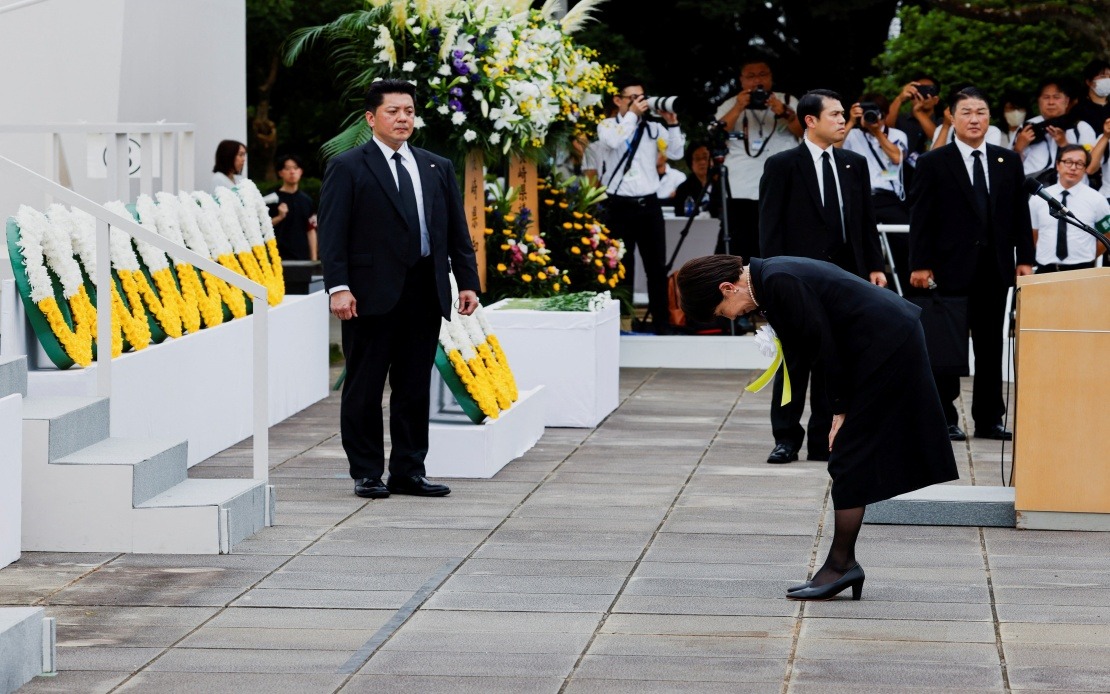
Japan's southwestern city of Nagasaki paused on Sunday to remember the devastating atomic bombing of August 9, 1945, an event that killed approximately 74,000 residents by the end of that year and remains the only instance of nuclear weapons use in armed conflict. The 81st anniversary ceremony arrived at a moment of renewed international tension surrounding nuclear weapons, with observers noting that discussions about deterrence have grown more prominent in recent months, particularly in East Asia where geopolitical rivalries are intensifying.
The commemorative service featured a moment of silence at 11:02 a.m., the precise time when the "Fat Man" plutonium device detonated over the city following its deployment by an American bomber. This timing carries particular significance as the attack occurred just three days after the Hiroshima bombing on August 6, effectively introducing the world to the destructive potential of nuclear weapons on a catastrophic scale. Nagasaki's position as the last city to endure nuclear attack lends its annual commemoration outsized symbolic weight in global conversations about atomic weapons.
Mayor Shiro Suzuki addressed the gathering with a message emphasizing that coexistence between humanity and nuclear weapons remains impossible, urging world leaders to pursue genuine disarmament rather than merely maintaining existing arsenals. His remarks reflected a longstanding position held by survivors and civic leaders in both Nagasaki and Hiroshima, who view nuclear weapons as fundamentally incompatible with human survival. Prime Minister Sanae Takaichi attended to represent Japan's national government, while United Nations Secretary-General Antonio Guterres submitted a prepared statement underscoring the international dimension of this annual remembrance.
The ceremony's timing proves significant given Japan's own evolving relationship with nuclear weapons policy. For decades, Japan has adhered to three fundamental principles: it will not produce nuclear weapons, will not possess them, and will not allow their introduction into Japanese territory. These principles have anchored Japan's post-war identity and reflected widespread public opposition to nuclear armament stemming from the devastating experiences at Hiroshima and Nagasaki. However, recent geopolitical developments have prompted some Japanese policymakers to reconsider these constraints, particularly as China's nuclear arsenal expands and North Korea continues developing weapons capabilities.
When ceremonies commenced in Hiroshima three days earlier, Prime Minister Takaichi faced questions about whether Japan might alter its three non-nuclear principles. She responded by affirming that the government remains committed to these longstanding policies, a statement designed to reassure both domestic constituencies concerned about nuclear proliferation and international partners wary of regional destabilization. Nevertheless, the need for such explicit reaffirmation suggests the principles face real pressure from strategic thinkers concerned about Japan's security posture in an increasingly multipolar and unstable Asia-Pacific region.
The international nuclear non-proliferation framework has simultaneously weakened, undermining hopes for coordinated global action on disarmament. The Nuclear Non-Proliferation Treaty's review conference, convened once every five years in principle, concluded its most recent session in New York in May without reaching consensus on key provisions. This represents the third consecutive failure to produce agreed outcomes, indicating that the fundamental rifts between nuclear-armed states and non-nuclear nations have become more entrenched rather than bridged. For countries like Japan seeking to maintain non-nuclear status while navigating security challenges, this institutional deterioration removes crucial diplomatic support.
The aging of Japan's atomic bomb survivor community adds urgency to these debates about nuclear weapons' future. Those officially recognized as hibakusha—survivors of the bombings—have an average age exceeding eighty-six years, meaning that firsthand testimony about nuclear weapons' human costs grows increasingly rare. Survivors and advocacy organizations recognize they face a narrowing window to convey the visceral reality of atomic warfare to younger generations who lack direct experience. This intergenerational transmission of memory has become a central concern, as historical understanding erodes when mediated solely through documentary sources rather than personal accounts.
For Malaysian and broader Southeast Asian audiences, Nagasaki's 81st anniversary holds particular relevance given the region's role in international non-proliferation efforts and its vulnerability to potential nuclear escalation in nearby waters. Southeast Asian nations have collectively embraced the Southeast Asian Nuclear-Weapon-Free Zone, established in 1995 through the Bangkok Treaty, demonstrating regional commitment to preventing nuclear weapons proliferation. However, the tensions now evident in Northeast Asia—involving nuclear-armed powers including China, Russia, and potentially Japan's security partners—create spillover risks that could undermine the carefully constructed non-proliferation consensus across the broader Asian continent.
The symbolic power of Nagasaki's commemoration extends beyond historical reflection into contemporary security calculations. As Japan contemplates adjusting its security posture in response to evolving threats, and as other non-nuclear states face similar pressures to reconsider their commitments to non-proliferation, the city's annual remembrance serves as a counterweight to strategic arguments favoring nuclear acquisition. The survivor community's continued advocacy for disarmament represents an alternative to the logic of deterrence increasingly dominating policy discussions in Tokyo, Washington, and other capitals.
Ultimately, the divergence between public commitment to non-proliferation principles and behind-closed-doors strategic debates reveals a fundamental tension within Japan's post-war framework. While government officials like Prime Minister Takaichi explicitly reaffirm dedication to the three non-nuclear principles, the very nature of such reaffirmations—coupled with simultaneous discussions about security threats—signals that these principles face genuine scrutiny. Nagasaki's 81st anniversary commemoration thus operates simultaneously as memorial to historical tragedy and warning about the nuclear future humanity continues building, even if incrementally and reluctantly.

