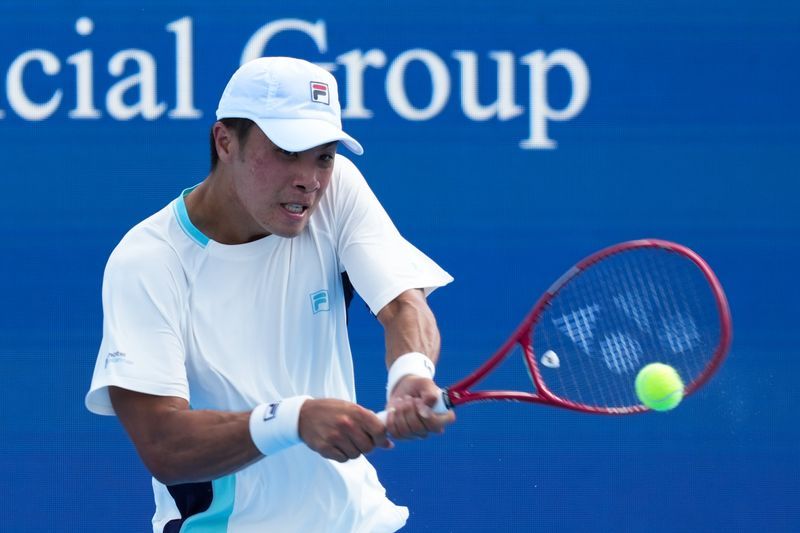
Brandon Nakashima has established himself as a formidable presence on the North American hard court circuit, delivering a compelling comeback against sixth-seeded Taylor Fritz on Friday to advance to the Cincinnati Open semifinals. The 25-year-old American produced a performance that underscores his rapid ascent through tennis's elite ranks, recovering from adversity to secure a 7-6(9) 4-6 6-3 victory and extend his remarkable recent form into back-to-back Masters 1000 semifinals. His progression through consecutive weeks at Montreal and now Cincinnati represents a significant breakthrough for a player who came into this stretch with considerable room for growth at sport's highest levels.
The match itself exemplified the kind of mental resilience and tactical adaptation that distinguishes top performers under pressure. Nakashima's first set encounter with Fritz remained supremely competitive throughout, with both competitors displaying the serving prowess that characterises modern men's tennis at the elite level. The opening set ultimately hinged on a dramatic tiebreak where both players exchanged mini-breaks and crucial points before Nakashima finally prevailed when Fritz's shot sailed long. That first-set conversion proved psychologically significant, particularly given Nakashima's pre-match record of 1-4 against his compatriot.
Fritz responded with the kind of tactical aggression that had served him well in previous encounters. Rather than abandoning his approach, the American doubled down on returning with intensity and reaped immediate dividends by breaking Nakashima's serve early in the second set. Fritz consolidated this advantage methodically, closing out the set with an ace that reflected his growing confidence and forced the encounter into a decisive third set. At this juncture, momentum appeared to favour the sixth seed, whose experience and recent performances suggested he might dictate the decider.
Yet the third set revealed Nakashima's developing mastery of pressure situations. When Fritz broke serve to move ahead 3-2, it appeared the sixth seed might surge to victory. However, the pivotal moment arrived when Nakashima recovered from 30-0 down in the subsequent game to convert his second break point of the match and restore parity at 3-3. This recovery proved transformative, as Fritz's confidence visibly wavered whilst Nakashima's momentum became increasingly palpable. The accumulation of unforced errors on Fritz's part coincided precisely with Nakashima's growing self-assurance, creating a decisive swing in the match's trajectory.
Nakashima's closing sequence demonstrated the clinical finishing that separates Masters 1000 contenders from pretenders. By winning the final three games consecutively, he delivered a performance that reflected both tactical improvement and psychological fortitude. For a player ranked 27th in the world, achieving four top-10 victories in a single season whilst simultaneously reaching multiple Masters semifinals represents genuine progress toward contention status. These achievements gain additional significance when assessed within the context of American tennis depth, where a crowded field of talented competitors perpetually competes for limited opportunities at sport's highest levels.
This Cincinnati breakthrough arrives at an opportune moment in the seasonal calendar, with the U.S. Open commencing later in August. The tournament provides American players with unique circumstances—home advantage, local crowd support, and the psychological benefits of competing on familiar surfaces. Nakashima's current trajectory suggests he approaches Flushing Meadows with considerably stronger form than many anticipated at season's outset. The confidence derived from consecutive Masters semifinals, combined with demonstrated capacity to overcome quality opponents and recover from match situations requiring mental resilience, positions him as a genuine threat to deeper tournament runs.
Nakashima's semifinal opponent will emerge from the matchup between Italy's tenth-seeded Lorenzo Musetti and fellow American Frances Tiafoe. Regardless of which player prevails, Nakashima faces another competitive examination that will further test his credentials as an ascending force in professional tennis. The depth of American male talent means such encounters routinely feature multiple players of substantial capability, creating elevated competitive standards that benefit all participants through regular exposure to quality opposition.
From a regional perspective, Nakashima's emergence merits attention as evidence of sustained American competitiveness in men's professional tennis. Southeast Asian tennis development programmes frequently benchmark themselves against American systems and success metrics. Nakashima's pathway—gradual progression through lower-ranked tournaments, breakthrough performances at Masters level, and successful adaptation to hard court conditions that favour particular playing styles—reflects patterns that coaching academies throughout Asia study intently. His tournament success provides instructive models for developing nations seeking to improve their rankings and international visibility through targeted talent cultivation.
The trajectory evident in Nakashima's Cincinnati performance also reflects broader changes within American tennis, where younger players increasingly challenge the dominance of established stars. His capacity to recover from difficult positions and maintain composure against quality opposition demonstrates the technical refinement and mental conditioning required for sustained success. These qualities, combined with his hard court aptitude during the North American summer swing, position him advantageously for the demanding schedule ahead.
Nakashima's path through consecutive Masters semifinals within seven days represents more than isolated tournament success; it indicates sustained elevation of performance across multiple competitive opportunities. As the U.S. Open approaches, his form trajectory suggests capacity to maintain this standard through demanding consecutive matches and extended competition. The Cincinnati victory over Fritz, particularly the manner in which he recovered momentum in the decisive set, provides compelling evidence that this American player possesses both the technical arsenal and psychological resources necessary for further ascent through professional tennis's hierarchy.

