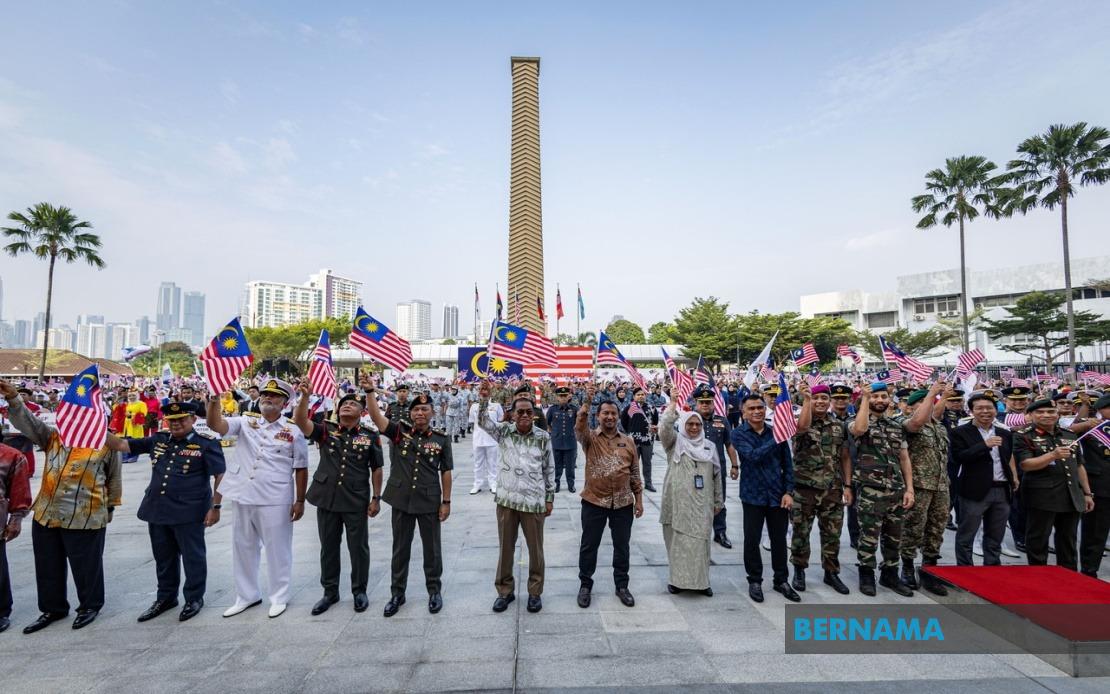
Defence Minister Datuk Seri Mohamed Khaled Nordin has urged Malaysians to approach the upcoming National Day and Malaysia Day celebrations with a spirit of genuine patriotism rather than allowing emotional responses to contemporary issues to dominate the proceedings. Speaking at the Defence Ministry's launch of the National Month and Fly the Jalur Gemilang campaign, Mohamed Khaled drew a distinction between celebrating the nation's founding with authentic love for the country and weaponising the occasion to advance specific political or social agendas.
The minister's remarks appear directed at calls from activist groups and civil society organisations to boycott National Day festivities in response to Malaysia's handling of the Rohingya refugee situation and related humanitarian concerns. Mohamed Khaled explicitly singled out such boycott campaigns as misguided, arguing that they undermine the unifying purpose of national celebrations and inject unnecessary division into occasions meant to strengthen collective identity.
Mohamed Khaled framed the National Day and Malaysia Day observances as an opportunity for Malaysians across all backgrounds to demonstrate their attachment to the nation and to send a clear message to both domestic and international audiences. He contended that when citizens rally around national symbols and celebrations with genuine feeling, they signal that Malaysia will not tolerate attempts to weaponise the country as a stage for political controversy or factional disputes, whether originating from within or outside its borders.
The Defence Minister emphasised that Malaysia's founding principle rests on a commitment to mutual respect and coexistence among its diverse racial and religious communities. This social contract, he suggested, provides the essential foundation upon which the nation's peace, stability, and sovereignty depend. By extension, Mohamed Khaled implied that allowing contemporary political disagreements to spill over into National Day observances risks corroding the very principles of tolerance and understanding that keep Malaysia functioning as a cohesive state.
Mohamed Khaled's intervention reflects broader concerns within the government about the politicisation of national symbols and public occasions. The timing of his remarks, delivered as Malaysia approaches the annual August 31 National Day and September 16 Malaysia Day, underscores the sensitivity surrounding these commemorations. Both dates carry profound historical significance—the former marking Malaysia's independence from British colonial rule, the latter acknowledging the formation of the Malaysian federation through the incorporation of Sabah and Sarawak.
For Malaysian readers, the debate highlighted by Mohamed Khaled touches on fundamental tensions within the nation's democracy. The right to peaceful protest and to raise humanitarian concerns represents a cornerstone of democratic practice; simultaneously, the government's perspective holds that certain occasions should be preserved as moments of collective national affirmation rather than venues for factional contestation. This tension between dissent and unity remains unresolved within Malaysian political culture.
The minister called on all citizens to display the Jalur Gemilang, the national flag, as an expression of pride and gratitude toward the nation. Beyond the symbolic act of flag-flying, he urged Malaysians to remember in their prayers the country's security personnel who serve at its borders, often in challenging and dangerous circumstances, and to extend good wishes toward all fellow citizens. These framing choices position patriotism not merely as political loyalty but as a practice encompassing gratitude, remembrance of sacrifice, and care for national wellbeing.
Mohamed Khaled's speech sits within the broader contemporary conversation about how multicultural democracies navigate the balance between protecting space for dissent and maintaining social cohesion. Southeast Asian nations, including Malaysia, have grappled with this challenge as globalisation and social media amplify both expressions of patriotism and critiques of government policy. The polarisation evident in debates over how to mark national holidays suggests that reaching consensus on this question remains elusive.
The Rohingya issue, which Mohamed Khaled referenced, represents one of the region's most pressing humanitarian challenges. Malaysia has absorbed one of the world's largest Rohingya refugee populations, creating complex social, economic, and security dimensions that extend well beyond foreign policy considerations. The tension between acknowledging this humanitarian reality and maintaining National Day as an occasion focused on national unity rather than contemporary grievances illustrates the genuine dilemma facing policymakers attempting to honour both democratic expression and national solidarity.
Looking forward, Mohamed Khaled's remarks suggest the government will continue emphasising the unifying purpose of national celebrations while implicitly questioning the appropriateness of using such occasions for political protest or organised boycotts. This position reflects a particular understanding of how democracies ought to manage the relationship between dissent and national identity—one that prioritises harmony and collective affirmation during designated ceremonial moments, even as space for political expression exists elsewhere in the democratic system.
For Malaysia as a young multicultural nation still working to consolidate national identity across deep communal lines, the stakes surrounding how to commemorate founding moments remain high. Whether citizens can be persuaded to bracket contemporary grievances during National Day celebrations, or whether doing so represents an unacceptable suppression of legitimate concerns, will likely remain contested terrain in Malaysian political discourse.

