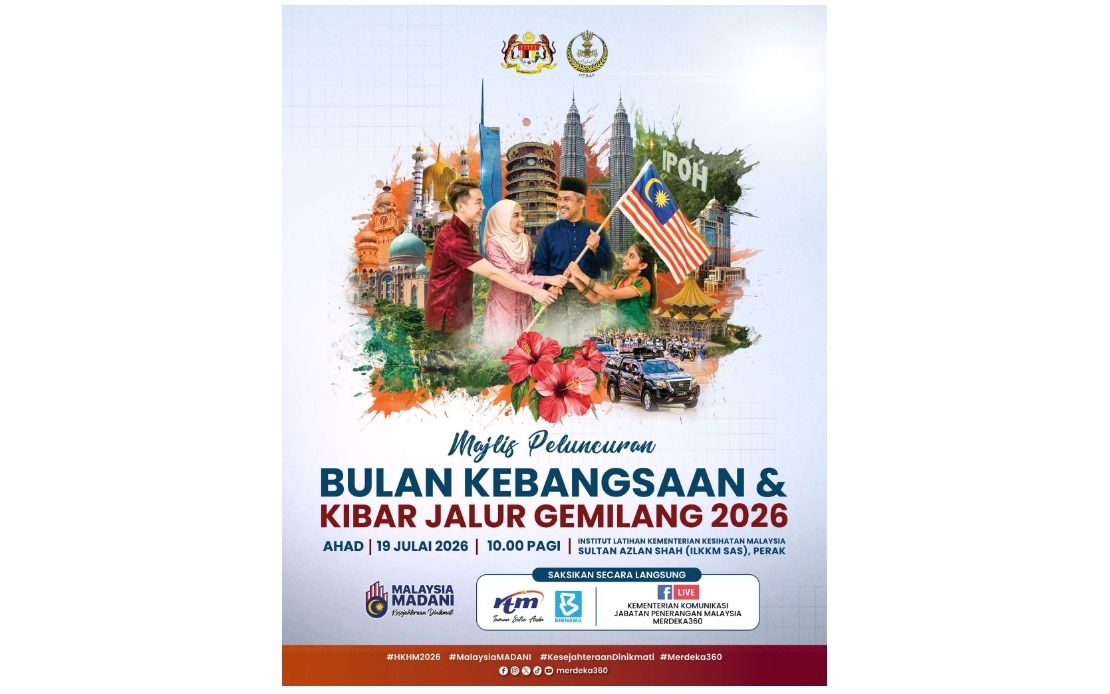
The ceremonial launch of Malaysia's National Month 2026 campaign will take place on July 19 at the Institut Latihan Kementerian Kesihatan Malaysia Sultan Azlan Shah in Perak, officially inaugurating what is set to be a month-long series of patriotic celebrations across the nation. The event, commencing at 10 am, represents the government's formal activation of this year's independence-themed programming and will be simultaneously broadcast across multiple platforms including Radio Televisyen Malaysia, BERNAMA TV, and Facebook Live streams hosted by Merdeka360 and the Ministry of Communications, ensuring accessibility for Malaysians nationwide.
Central to this year's campaign is the theme "Malaysia MADANI: Kesejahteraan Dinikmati," which translates to shared and inclusive prosperity enjoyed by all citizens. This overarching message reflects a deliberate policy shift toward emphasising equitable distribution of the nation's economic and social benefits rather than growth metrics alone. The Malaysia MADANI logo, which has served as the visual identity for government initiatives since its introduction, will continue as the official emblem through 2026, providing continuity and reinforcing the administration's commitment to this developmental philosophy.
The underlying framework of Malaysia MADANI draws heavily from principles of justice, humanity, and public welfare, positioning the national narrative around inclusive development. Rather than framing prosperity as an abstract economic indicator, the government is attempting to anchor celebrations around the lived experiences of ordinary Malaysians, suggesting that independence commemorations should emphasise tangible benefits reaching all segments of society. This represents a conscious move away from purely ceremonial patriotism toward a governance model that links national pride to material improvements in citizens' lives.
To facilitate participation and grassroots engagement, organisers have made campaign materials freely available through the Merdeka360.my portal, which will host the official logo, patriotic songs, and comprehensive promotional resources. This digital-first approach recognises that modern national celebrations require multimedia engagement strategies and acknowledges the central role social media plays in reaching younger demographics. By placing these resources online and encouraging widespread sharing, authorities aim to distribute the responsibility for fostering national spirit beyond government institutions to communities, schools, and civic organisations.
Communications Minister Datuk Seri Fahmi Fadzil has previously outlined the structure of upcoming festivities, with the primary National Day celebration scheduled for August 31 at Dataran Putrajaya. Unlike previous years which sometimes featured large-scale spectacles, this year's observance will adopt a deliberately modest but vibrant aesthetic, suggesting budgetary constraints or a philosophical preference for restraint. Meanwhile, Malaysia Day on September 16 will shift to Sarawak as the primary celebration venue, marking the second consecutive year the commemoration has been held outside peninsular Malaysia and underscoring commitment to recognising East Malaysia's integral role in the federation.
Seven supporting programmes have been organised nationwide to sustain momentum throughout the month-long campaign period. These initiatives, designated as Kembara Bahasa HKHM (Language Journey), Quran Hour, Ambang Merdeka (Threshold of Independence), Merdeka Countdown, RIUH Merdeka (Merdeka Celebration), and the National Statesmen Commemoration Ceremony, collectively provide diverse entry points for citizen participation across religious, linguistic, cultural, and civic dimensions. This multi-programme approach acknowledges Malaysia's religious and cultural pluralism, ensuring that independence celebrations can accommodate various communities' values and traditions simultaneously.
The expanded calendar of events extending across the full month allows for sustained engagement rather than concentrated activity around specific dates. Kembara Bahasa HKHM focuses on linguistic heritage, reflecting the constitutional significance of Bahasa Malaysia; Quran Hour acknowledges the Islamic dimension of national identity; Ambang Merdeka and Merdeka Countdown build anticipatory enthusiasm; while the National Statesmen Commemoration Ceremony honours political leaders whose efforts secured independence. This architecture suggests governmental recognition that modern national identity requires multidimensional reinforcement touching citizens' religious faith, linguistic identity, historical consciousness, and civic engagement simultaneously.
For Malaysian readers and Southeast Asian observers, these 2026 celebrations carry particular significance in the broader context of regional stability and intra-national cohesion. Malaysia's federal structure unites vastly different populations—peninsula and Borneo, Malay-Muslim and non-Muslim majorities, developed urban centres and developing rural areas—creating ongoing tensions around resource distribution and representation. By explicitly thematising prosperity as something to be "enjoyed" and "shared," celebrations acknowledge these underlying distributional tensions and attempt to reframe national identity around inclusive benefits rather than allowing celebrations to mask underlying inequalities.
The shift of Malaysia Day celebrations to Sarawak also carries symbolic weight within this framework of inclusive federalism. East Malaysia's integration into Malaysia Day commemoration patterns has historically been inconsistent, with most celebrations concentrated on peninsular sites. Deliberately hosting primary festivities in Sarawak signals recognition of East Malaysian grievances regarding economic marginalisation and political representation, using ceremonial occasions as instruments for demonstrating federal commitment to equitable treatment across geographic and demographic lines.
For foreign observers and regional neighbours, Malaysia's emphasis on prosperity-sharing and inclusive patriotism reflects broader Southeast Asian challenges. The region encompasses significant wealth disparities within nations and between them; competing claims to resources, territory, and cultural legitimacy; and diverse religious and ethnic compositions requiring careful political management. Malaysia's approach to national celebrations—attempting to link patriotic sentiment to concrete commitments to equitable distribution—offers a potentially instructive model for how regional peers might approach their own independence commemorations and nation-building exercises.
The digital accessibility of campaign materials through Merdeka360.my and multiple broadcast platforms represents practical recognition of Malaysia's digital divide, where urban and rural, young and elderly populations access information through vastly different media. By simultaneously broadcasting through traditional radio and television alongside social media platforms, organisers attempt to ensure no demographic segment remains excluded from participation opportunities. This reflects sophisticated understanding that patriotic campaigns lose legitimacy if they appear to privilege certain communities over others in terms of information access and engagement opportunities.
As Malaysia approaches these 2026 commemorations, the emphasis on inclusive prosperity and shared benefits provides opportunity to assess whether government rhetoric around equitable development translates into tangible policy outcomes. The success of National Month 2026 in fostering genuine patriotic sentiment will likely depend on whether citizens perceive meaningful improvements in their economic circumstances, social services, and political representation in the months preceding celebrations. Should prosperity remain concentrated while rhetoric emphasises sharing, celebrations risk being perceived as performative rather than substantive, potentially eroding rather than enhancing national cohesion that such occasions ostensibly exist to strengthen.

