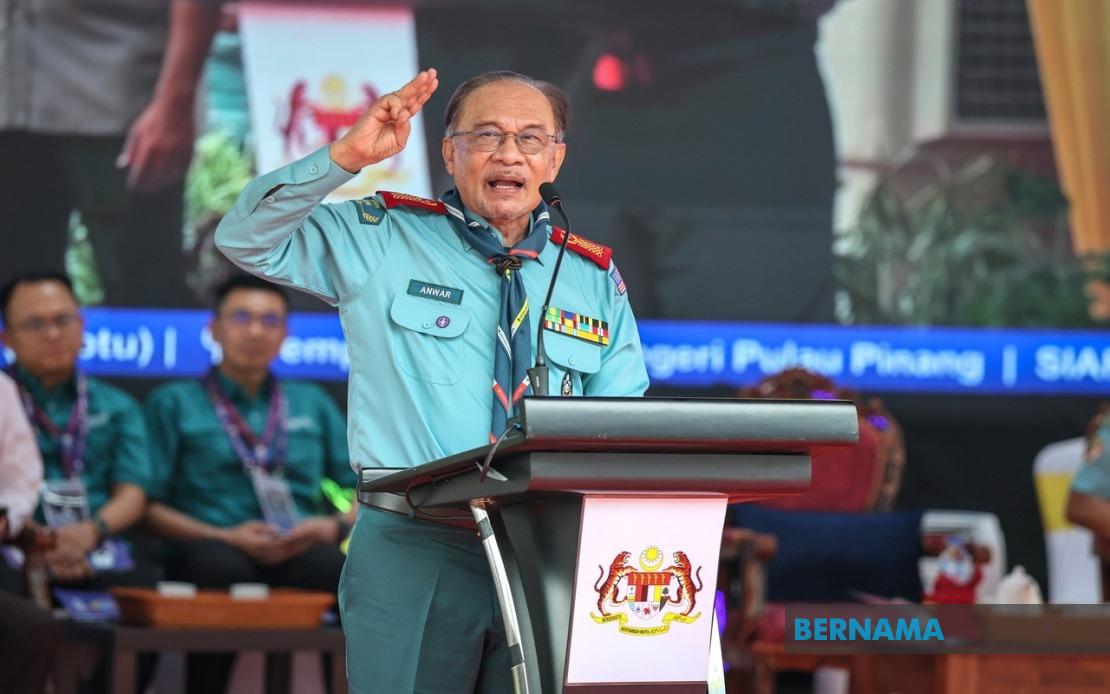
Prime Minister Datuk Seri Anwar Ibrahim has issued a challenge to Malaysia's education systems and society at large: measuring national achievement through GDP figures and technological milestones misses the crucial human dimension that ultimately determines a country's true prosperity. Speaking at the 15th Malaysian Scouts Jamboree in Batu Kawan on August 29, Anwar articulated a vision of development that places ethical formation and civic consciousness at the centre of youth development, arguing that economic and technological gains become hollow without corresponding moral anchoring.
The Prime Minister's intervention reflects growing concerns among policymakers across Southeast Asia about the social costs of rapid modernization. As Malaysia continues its push toward becoming a high-income nation and digital economy, Anwar's remarks suggest anxiety about whether institutional structures are adequately preparing young people for responsibilities that extend beyond professional competence. He emphasized that educational institutions at all levels—from primary schools through universities—bear responsibility for instilling what he termed a culture of service, where knowledge acquisition connects directly to meaningful contribution to family, community, and nation.
Anwar's framing positions young people as inheritors of a dual obligation: to embrace technological change while remaining custodians of cultural and spiritual heritage. This tension between modernization and tradition has emerged as a defining challenge for Southeast Asian societies undergoing rapid transformation. The Prime Minister specifically cautioned against technological advancement that severs younger generations from their cultural roots, suggesting that artificial intelligence and information technology, while essential tools, cannot substitute for the foundational values that provide coherence to society and individual identity.
The choice of venue—the Malaysian Scouts Jamboree—carries symbolic weight in this context. Scouting movements across the region have long positioned themselves as character-building institutions, emphasizing discipline, service, community engagement, and leadership development through experiential learning. By addressing scouts at MYJAM15, which drew more than 5,450 participants from 11 countries including South Korea, Indonesia, Singapore, and Sri Lanka, Anwar signalled that youth formation through non-formal education channels deserves recognition and support from the highest levels of government.
The Penang event's significance extends beyond the immediate gathering. MYJAM15 represents the return of this national jamboree to Penang after six decades, the last iteration having taken place in Teluk Bahang in 1966. This historical arc mirrors Malaysia's own transformation over 60 years—from a newly independent nation consolidating its foundations to an advanced developing country navigating complex global challenges. The fact that the event now draws international participation from multiple countries underscores how organizations like the Scouts have evolved within Malaysia's regional relationships.
Anwar's emphasis on unity in diversity carries particular resonance given Malaysia's multiethnic composition and the broader Southeast Asian context of navigating plural societies. The Prime Minister's call for younger generations to champion this principle as future leaders acknowledges that social cohesion cannot be assumed; it requires deliberate cultivation and commitment from each generation. In an era when technological platforms can either unite or divide communities, this message takes on urgency.
The reference to upcoming 2026 National Day celebrations frames youth responsibility within a forward-looking patriotic context. Rather than invoking nationalism in defensive or exclusionary terms, Anwar's formulation connects patriotism to readiness for future challenges, suggesting that national pride manifests through capability to adapt and problem-solve while maintaining continuity with foundational principles. This approach acknowledges that contemporary patriotism must address transnational challenges like climate change, cybersecurity, and pandemic resilience—issues requiring disciplined, educated thinking rather than sentiment alone.
Anwar's vision aligns with broader regional conversations about education reform. Across Southeast Asia, governments and civil society organizations increasingly question whether traditional curriculum models adequately prepare students for 21st-century complexity. The Malaysian Prime Minister's intervention suggests that the answer requires integration: schools must develop technical competencies while simultaneously nurturing ethical reasoning, emotional intelligence, and civic consciousness. The Scouts movement, with its emphasis on learning through outdoor experience and team-based problem solving, offers one model for such integration.
The practical implications for Malaysian education policy appear significant. Anwar's remarks suggest openness to expanding non-formal education, strengthening character education components within formal curricula, and recognizing that values formation occurs through experience and mentorship as much as classroom instruction. Given Malaysia's substantial investment in education infrastructure and the quality of its technical institutions, the Prime Minister's message implies a recalibration toward holistic development rather than specialization alone.
For regional observers, Anwar's positioning of youth development as central to national success reflects how Southeast Asian leaders increasingly frame demographic challenges and opportunities. As nations across the region grapple with aging populations and the need to retain young talent amid outmigration pressures, investing in making youth feel morally invested in their societies becomes strategically important. Young people who internalize responsibility toward their communities and country show greater propensity to contribute productively rather than seeking opportunities elsewhere.
The international dimension of MYJAM15 suggests Malaysia's confidence in engaging youth across borders while maintaining distinctive values. The participation of scouts from South Korea, Indonesia, Singapore, and Sri Lanka creates opportunities for cross-cultural learning and regional cooperation among the generation that will shape Southeast Asia's future. Anwar's address to this diverse gathering implies that values like discipline, service, and unity transcend cultural boundaries, even as their expression remains rooted in particular contexts.
Central to Anwar's argument is a rejection of false dichotomies between tradition and modernity, economic progress and moral development, technological capability and cultural continuity. Instead, he presents these as interconnected dimensions of flourishing societies. This framing offers useful perspective amid polarized debates about globalization, where critics sometimes portray modernization as inherently corrosive of heritage while others dismiss cultural concerns as obstacles to progress. The Prime Minister's intervention suggests a more sophisticated understanding: that sustainable national development requires both technological sophistication and institutional capacity to transmit values to successive generations.

