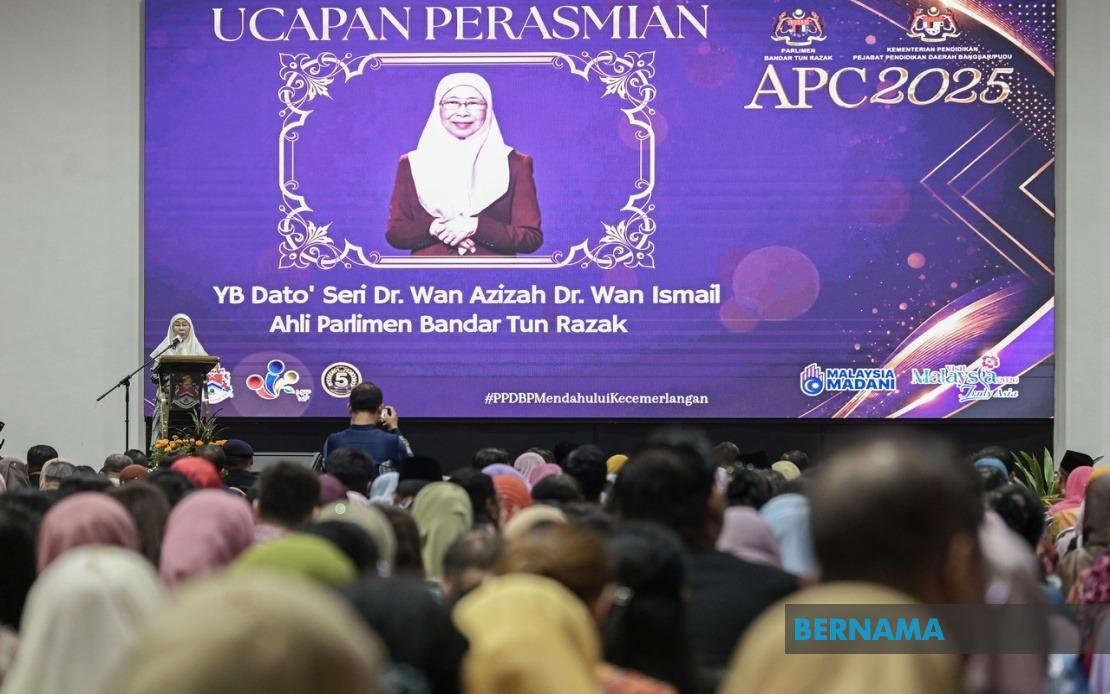
National progress cannot be measured solely by economic indicators, technological prowess, or infrastructure development. This perspective was articulated by Datuk Seri Dr Wan Azizah Wan Ismail, wife of the Prime Minister and Member of Parliament for Bandar Tun Razak, who underscored that a country's genuine advancement stems from its capacity to develop citizens who combine intellectual capability with ethical grounding and compassion. Speaking at the 2025 Excellent Service Award ceremony organized by the Bangsar/Pudu District Education Office at the Kuala Lumpur City Hall Training Institute, Dr Wan Azizah redirected the conversation about national development toward human capital as the foundational asset.
The education sector remains central to this vision, with teachers emerging as critical architects in constructing a society built on moral foundations. Dr Wan Azizah emphasized that educators serve as more than knowledge transmitters; they function as character developers during formative years when students are particularly receptive to guidance. Given contemporary urban realities where substantial parental time is consumed by professional obligations, schools have assumed an expanded responsibility in providing moral mentorship alongside academic instruction. This observation reflects Malaysia's evolving demographic patterns, wherein dual-income households dominate urban centers, placing increased expectations on educational institutions to fulfill responsibilities that traditionally extended beyond classroom walls.
The philosophical framework Dr Wan Azizah articulated distinguishes between education as information transfer and education as holistic development. She contended that curricula must transcend the mere delivery of facts and figures, instead prioritizing the cultivation of integrity, propriety, and empathetic consciousness. This approach recognizes that students entering the workforce require not only technical competencies but also interpersonal capabilities and principled judgment that enable them to navigate complex professional and social environments. The distinction carries particular relevance for Malaysia, where discussions about educational excellence frequently concentrate on examination performance and competitive rankings rather than the formation of character.
The contemporary information landscape presents unprecedented challenges that necessitate educational reform. In an era characterized by artificial intelligence proliferation and instantaneous data dissemination, the ability to discern credible information from misinformation has become an essential survival skill for citizens. Dr Wan Azizah explicitly identified critical thinking as a pedagogical priority, alongside values education, to equip students with frameworks for evaluating claims and distinguishing legitimate sources from deliberately misleading content. This concern reflects global anxieties about information integrity, yet carries specific salience for Southeast Asian nations where digital literacy varies considerably across socioeconomic strata.
The recognition ceremony itself demonstrated institutional commitment to acknowledging educator contributions. The event honored 746 teachers and school administrators representing 143 institutions across the Bangsar/Pudu district, with approximately 1,000 attendees witnessing the presentations. This scale of recognition indicates deliberate policy emphasis on celebrating excellence within the education system, moving beyond conventional structures that frequently concentrate accolades on high-performing students. By extending recognition to support staff and administrators alongside classroom teachers, the ceremony acknowledged that educational outcomes emerge from collaborative institutional efforts rather than individual endeavor alone.
The ceremony's timing and composition carry symbolic weight within Malaysia's broader educational discourse. Attendance by the Prime Minister's Political Secretary, Datuk Azman Abidin, and Kuala Lumpur Federal Territory Education Department director Megat Affandi Ismail signaled high-level political investment in recognizing educational workers. This visibility sends organizational signals that educator welfare and recognition constitute genuine policy priorities rather than rhetorical commitments. For teaching professionals operating within frequently under-resourced environments and facing emerging pressures from technological disruption and pandemic-related learning disruptions, such acknowledgment provides both psychological validation and implicit assurance of systemic support.
Dr Wan Azizah's remarks positioned teacher recognition as instrumental to broader educational transformation. She articulated that awards and public acknowledgment function not merely as compensation for past service but as motivational catalysts encouraging sustained excellence. Simultaneously, she suggested that recognizing exemplary practitioners creates demonstration effects that inspire colleagues to elevate their own performance standards. This understanding reflects behavioral psychology principles where visible institutional rewards influence organizational culture more effectively than abstract exhortations toward improvement.
The emphasis on organizational excellence and improved educational outcomes referenced in the ceremony's objectives reflects Malaysia's continuing efforts to optimize schooling systems. The Bangsar/Pudu district, encompassing areas within the capital's urban expanse, faces particular pressures arising from socioeconomic heterogeneity, linguistic diversity among student populations, and infrastructure constraints. Recognizing educator contributions within this context acknowledges the specific challenges these professionals navigate daily while implementing national curriculum frameworks under resource constraints.
Dr Wan Azizah's framing of teachers as guardians of national development challenges conventional hierarchies that frequently position economic ministries and technological sectors as primary engines of progress. By elevating education to foundational status and teachers to positions of strategic importance, her remarks advocate for resource reallocation and policy attention commensurate with education's transformative potential. This perspective gains urgency given Malaysia's aspirations toward achieving high-income nation status, an objective increasingly recognized as dependent upon workforce quality and innovation capacity rather than low-cost manufacturing competitiveness alone.
The award ceremony represents one expression of a broader imperative to strengthen Malaysia's educational architecture as the nation confronts twenty-first century demands. As artificial intelligence integration accelerates across employment sectors and information environments become increasingly complex, the skills and attributes that educators cultivate determine whether graduates prove adaptable and capable. Dr Wan Azizah's emphasis on combining knowledge with ethics and compassion suggests that technological proficiency without moral foundation risks producing technically capable but potentially destructive practitioners. This philosophical positioning aligns with emerging global discourse questioning whether educational systems adequately prepare citizens for complex decision-making involving ethical dimensions.

