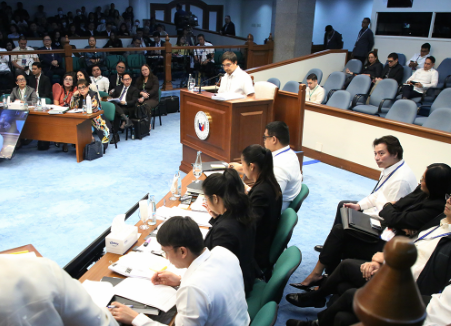
The impeachment trial of Vice President Sara Duterte heard testimony on Tuesday from a senior National Bureau of Investigation official who asserted that the Vice President possessed both the intent and capability to act on her publicly announced threats against President Ferdinand Marcos, First Lady Liza Araneta-Marcos and former House Speaker Martin Romualdez. Jeremy Lotoc, regional director of the NBI, presented the bureau's forensic assessment during the fifth day of proceedings before the Senate sitting as an impeachment court, reinforcing the prosecution's contention that Duterte's remarks amounted to grave threats and represented a fundamental betrayal of public trust warranting her removal from office.
Lotoc, who previously headed the NBI's Cybercrime Division investigation into the Vice President's statements, provided unequivocal responses when questioned by Senate President Sherwin Gatchalian about whether Duterte possessed the capacity to execute her threats. The witness anchored his assessment on Duterte's institutional position as the nation's second-ranking executive officer and her demonstrated access to networks of political influence. When pressed on whether her vice-presidential rank alone sufficed to establish such capability, Lotoc expanded his analysis to encompass her political genealogy, specifically referencing her father's previous tenure as president and the institutional networks that accompany such familial standing within Philippine political structures.
The prosecution's strategy centred on establishing that Duterte's November 2024 statements were neither hypothetical musings nor rhetorical flourishes but rather declarations rooted in deliberate intent. Lotoc testified that the NBI's investigation had identified the core elements constituting the crime of grave threats, a conclusion that prompted the bureau to recommend criminal charges to the Department of Justice. When Gatchalian questioned the evidentiary foundation for the NBI's assertion that Duterte had enlisted someone to carry out killings, Lotoc pointed to her own public disclosures during an online press conference on November 23 and a subsequent interview on November 26, during which the Vice President had explicitly referenced having spoken with an unidentified intermediary regarding potential retaliation should she herself be killed.
A central tension in the proceedings emerged around the question of independent corroboration. Lotoc acknowledged that the Cybercrime Division possessed no extraneous evidence identifying the alleged contract killer or validating that such an individual actually existed. Rather, the NBI's investigative conclusion rested substantially on Duterte's own utterances and her implicit admissions embedded within those statements. Pressed directly on this point, the witness confirmed that the bureau's evidentiary foundation consisted of "statements and admission" from the Vice President herself. This methodological limitation reflects broader investigative complexities in prosecuting cases dependent upon what subjects themselves choose to divulge or inadvertently reveal through public pronouncements.
Lotoc's testimony revealed a significant procedural frustration within the NBI's investigation. Investigators had sought direct engagement with Duterte to probe whether her assertions about contracting an assassin reflected genuine arrangements or constituted political hyperbole. The Vice President did not appear before the bureau for questioning, instead submitting a written denial that the witness characterised as inadequate to rebut the substantial factual record of her public statements. Lotoc articulated the investigative dilemma: without personal testimony from Duterte herself, his team could not definitively establish whether she had genuinely engaged someone or merely engaged in inflammatory rhetoric. However, he maintained that her documented failure to cooperate and her reliance on blanket denial did not ameliorate the seriousness of the recorded statements themselves.
During redirect examination, the prosecution sought to sharpen a critical distinction in the record. Private prosecutor Amado Virgil Ligutan emphasised that Duterte had never actually repudiated the substance of her controversial remarks, only the allegation that she had hired an assassin. Lotoc confirmed this subtle but consequential parsing, noting that the Vice President's November 26 interview demonstrated repetition rather than retraction of her earlier threats. This consistency in her public posture, from the prosecution's perspective, indicated she was not joking when articulating these threats but rather reinforcing them through reiteration.
The defence team's cross-examination focused considerably on technical deficiencies in NBI documentation, highlighting typographical and clerical errors within the bureau's investigative reports. Lotoc dismissed these lapses as immaterial to the substance of the NBI's factual findings and conclusions. The prosecution later argued through adviser Robert Ace Barbers that the defence strategy represented a rhetorical retreat, concentrating on procedural and documentary minutiae rather than confronting the core substance of Duterte's documented statements and their implications for the impeachment inquiry.
A secondary dimension of the trial involved claims that Duterte herself faced assassination threats under a purported plan denominated "Operation Romanov," which the Vice President had invoked in her own defence. Lotoc's testimony substantially undermined this claim, indicating that NBI investigations traced the terminology to Davao City Mayor Sebastian "Baste" Duterte during a January 2024 rally, where it was directed toward President Marcos and his family rather than the Vice President herself. The witness further noted that the bureau could not validate the existence of any such operation. Information about Romanov provided by social media personality Princess Maui during the November 23 press conference was deemed unreliable after Maui failed to substantiate her claims before NBI investigators.
The impeachment proceedings against Duterte represent an unprecedented political reckoning in contemporary Philippine democracy, with a Vice President facing removal through constitutional processes. The stakes extend beyond immediate personalities to encompass foundational questions about the conduct expected of holders of high constitutional office and the institutional consequences when public officials make threats against their superiors. Malaysian and Southeast Asian observers should note the procedural sophistication of the Philippine impeachment mechanism, which incorporates substantial evidentiary standards and affords defendants robust cross-examination rights, even as it grapples with the inherent difficulties of adjudicating political conduct.
The NBI testimony underscores a persistent investigative frustration: the absence of Duterte's full cooperation with authorities. Her strategic silence before investigators, combined with written denials unsupported by detailed explanations, left unresolved questions about her subjective intent and the literal existence of the alleged intermediary. From an institutional perspective, this refusal to engage with investigative processes raises discrete questions about accountability and transparency among constitutional officeholders in democratic systems. The trial's progression toward potential judgment will depend substantially on how the Senate interprets Duterte's documented public statements, her deliberate reiterations of those statements, and her unwillingness to subject herself to probing examination.
Lotoc's testimony also illuminated the investigative complexity inherent in prosecuting cases involving high-ranking political figures whose rhetoric operates within contexts of significant accumulated political influence and familial networks of power. The challenge for prosecutors lies in translating documented statements and demonstrated networks into proof of serious criminal intent sufficiently grave to warrant removal from constitutional office. As the impeachment trial progresses, this fundamental tension—between the provocative nature of Duterte's public statements and the evidentiary difficulty of proving completed criminality—will likely dominate the Senate's deliberations. The case carries implications for how democracies in Southeast Asia manage accountability for inflammatory political speech, particularly when such speech emanates from constitutional officers whose formal positions vest them with significant institutional resources and networks.

