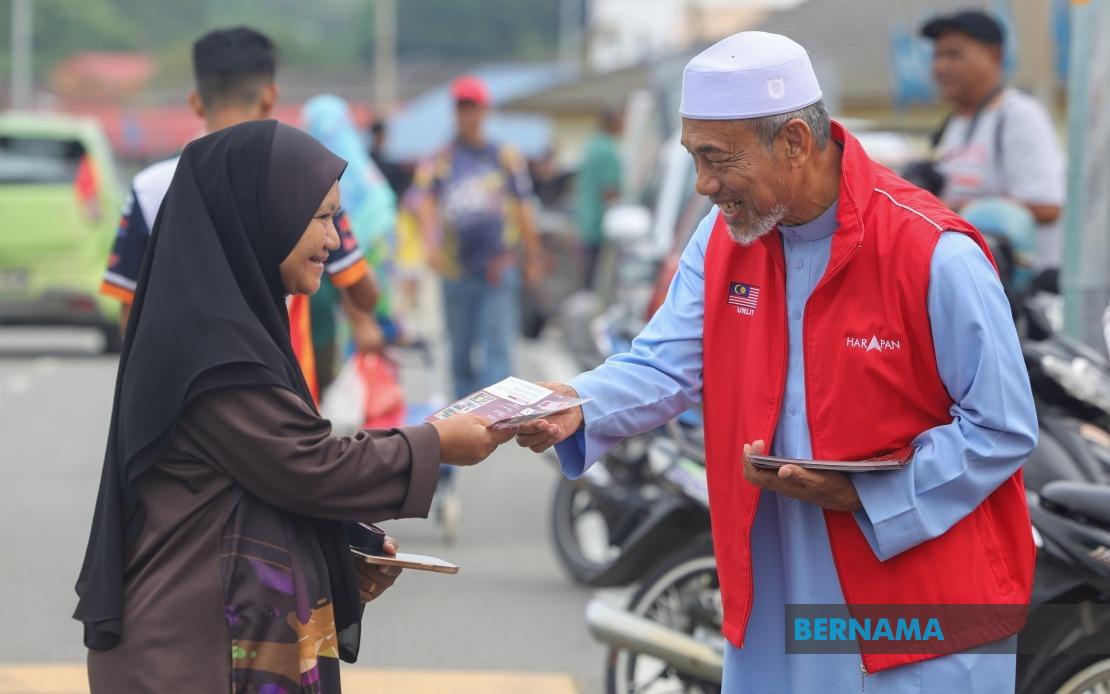
The race for the 16th Negeri Sembilan State Assembly election has shifted into high gear as competing candidates mount increasingly ambitious grassroots operations across the state. With voting scheduled for August 1, the candidates have roughly two weeks to persuade nearly 900,000 registered voters to back their bids, prompting many contenders to compress their schedules with multiple programmes each day designed to reach as many constituents as possible through direct personal contact.
Menteri Besar Datuk Seri Aminuddin Harun, the Pakatan Harapan standard-bearer for the Linggi seat, exemplified the intensity of modern campaign tactics by starting his day with congregational prayers before transitioning into a series of walkabouts spanning multiple residential areas and business districts. His approach reflects a calculated strategy to demonstrate accessibility and establish face-to-face connections with voters across demographically diverse neighbourhoods. By combining early-morning religious observance with subsequent community engagement, Aminuddin sought to project both spiritual commitment and practical dedication to constituent service, messaging aimed at reinforcing his credentials as Negeri Sembilan Menteri Besar and Port Dickson Member of Parliament.
Aminuddin's campaign messaging centred on the relationship between electoral support and development delivery, positioning his re-election as instrumental to continued infrastructure improvements and service expansion. His framing of walkabouts as opportunities to collect grievances and understand local aspirations created a feedback mechanism that candidates can later reference when claiming to represent constituent interests. This direct-engagement methodology has become standard practice across Malaysian electoral contests, as candidates recognise that televised debates and social media outreach, while important, cannot substitute for the voter impression created by an elected representative or aspirant physically present in their neighbourhood.
Opposition candidates pursued similarly aggressive scheduling. DAP secretary-general Anthony Loke, defending the Chennah seat, combined high-visibility marketplace campaigning at Seremban Central Market with formal party functions, a dual approach allowing him to reach both spontaneous foot traffic and committed party supporters. Other Pakatan Harapan candidates such as Kamarul Ariffin Wafa for Seri Menanti and Yaacob Mahmood for Serting structured their days around markets and informal business zones, recognising that informal retail and wholesale environments concentrate voters and enable extended conversation time without formal event staging requirements.
The emphasis on breakfast meetings and casual mingling rather than formal rallies reflects broader campaign evolution in Malaysian politics. Candidates have discovered that informal settings reduce barriers to voter participation and create more authentic interaction opportunities compared to staged events requiring advance registration or formal seating arrangements. Yaacob's explicit acknowledgement that informal programmes allow direct community listening while discussing local needs represents a calculated transparency strategy, essentially inviting voters to perceive candidate engagement as genuine consultation rather than performative politicking.
Barisan Nasional candidates deployed comparable intensity. Incumbent Rantau assemblyman and BN deputy chairman Datuk Seri Mohamad Hasan, widely recognised by his popular sobriquet "Tok Mat", anchored his campaign at the Barisan Nasional Polling District Centre in Mambau, establishing a fixed operational headquarters while conducting scheduled visits to specific community locations. This approach differs somewhat from the Pakatan Harapan emphasis on mobility and organic movement through neighbourhoods, suggesting different operational philosophies regarding candidate visibility and accessibility management.
UMNO's Negeri Sembilan leadership pursued youth engagement and indigenous community outreach as differentiation strategies. Jalaluddin Alias attended a sepak takraw tournament organised by youth wings before scheduling Orang Asli community visits, a deliberate diversification indicating recognition that state elections turn on coalition-building across multiple voter segments rather than appealing solely to urban middle-class constituencies. This strategic outreach demonstrates how candidates tailor schedules to address specific demographic constituencies perceived as pivotal or currently weakly attached to their parties.
The intensity of campaign scheduling, with some candidates maintaining up to nine daily programmes, reflects the compressed timeline between dissolution and polling. The Negeri Sembilan State Legislative Assembly was dissolved on June 5, with the Election Commission subsequently setting August 1 for polling and July 28 for early voting, leaving candidates approximately four weeks for campaigning. Most candidates concentrate their activities during the second and third weeks post-dissolution, when media saturation reaches peak levels and voter attention focuses more intensely on electoral choice.
Voter demographics underscore the scale of mobilisation required for competitive outcomes. Approximately 889,490 registered voters can participate, comprising 867,151 ordinary voters alongside 16,884 military personnel and their spouses and 5,455 police personnel voting early. These numbers suggest that candidates pursuing victory cannot rely upon single-segment appeals but must construct coalitions spanning multiple geographic and demographic constituencies. The relatively large proportion of military and police voters, who cast ballots separately and earlier, creates secondary campaign targets requiring specific messaging and engagement strategies.
The campaign intensity evident in Negeri Sembilan reflects broader patterns emerging across Malaysian state elections, where candidates increasingly recognise that granular voter contact and personalised engagement generate superior outcomes compared to centralised, leader-focused messaging campaigns. This tactical shift has created substantial demands on candidate endurance, financial resources for transportation and logistics, and volunteer labour for event organisation and voter communication. The competitive scheduling visible across all major party candidates suggests that contemporary Malaysian electoral contests reward persistence, accessibility, and demonstrated commitment to constituent listening over organisational resources or media dominance alone.

