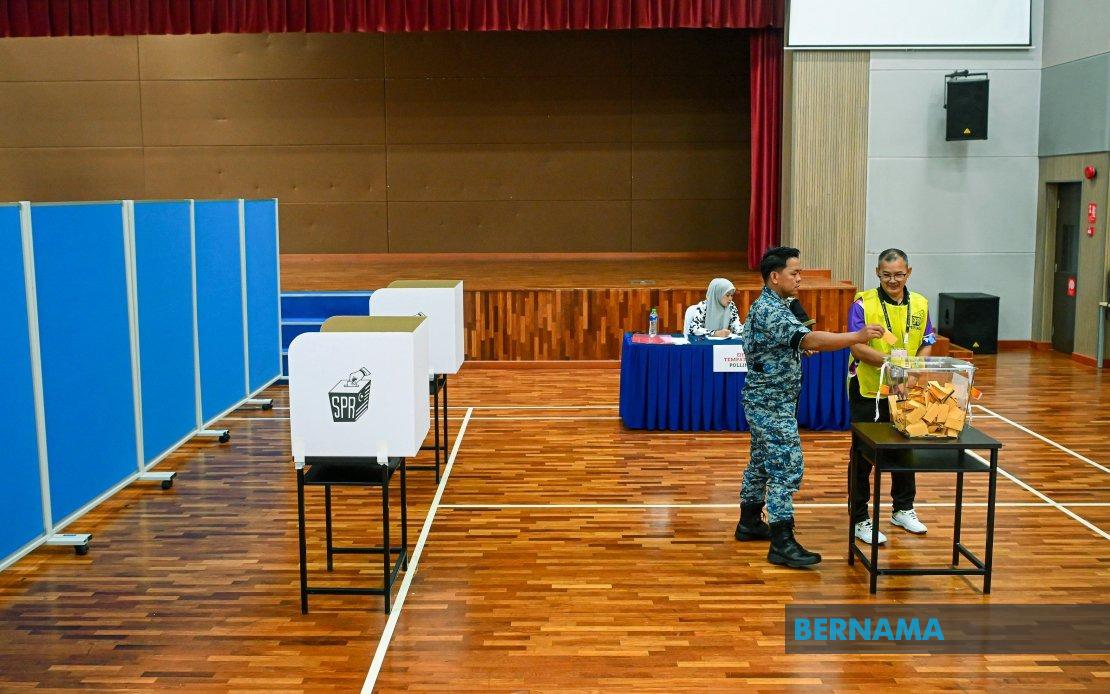
The 16th Negeri Sembilan State Election's early voting phase continued its smooth progression on Sunday, with two additional polling centres concluding their operations at 2 pm. The closure of facilities at Hall C of Dewan Serbaguna in Jempol District Police Headquarters at Bahau and Senawang police station in Paroi brought the cumulative tally of shuttered centres to 20 out of 38 that had commenced voting that morning. This measured rollout reflects the staggered approach adopted by the Election Commission to manage the flow of security personnel and their eligible spouses across multiple time slots.
The participation figures recorded thus far underscore solid engagement from the security establishment, with 13,303 voters having successfully cast their ballots by the 1 pm checkpoint—representing 80.79 per cent of the designated early voter cohort. This breakdown reveals the composition of the early voting bloc: 8,894 military personnel and family members contributed the larger share, while 4,409 police officers and their spouses accounted for the remainder. Such strong preliminary numbers suggest that the security forces have prioritised their civic duty ahead of the main polling day scheduled for Saturday.
The scale of early voting in Negeri Sembilan encompasses a substantial registered electorate specifically designated for advance participation. Across the 22,339 eligible early voters, the logistics have been divided into two streams: 16,467 individuals voting in person at designated centres, subdivided into 11,293 military voters and dependents alongside 5,174 police voters and dependents, while a further 5,872 have opted for postal voting arrangements. This bifurcation reflects modern electoral administration's attempt to accommodate diverse preferences and operational constraints within the security sector's calendar.
Comparison with the previous electoral cycle provides useful perspective on momentum and engagement trends. In the 2023 Negeri Sembilan state election, early voter turnout had reached 56.67 per cent, translating to 14,778 participants from a then-total of 26,079 early voters. The current performance, tracking at 80.79 per cent, suggests a marked increase in participation intensity or possibly a shift in eligibility criteria or voter enthusiasm. The numerical expansion in the eligible early voter pool itself—from roughly 26,000 to over 22,000 in the current cycle—indicates changing composition or revised military and police posting arrangements in the state.
The remaining 18 early polling centres are scheduled to conclude operations at 5 pm this evening, meaning the final phase of advance voting will extend throughout the afternoon. This staggered closure pattern allows administrators to manage queuing and maintain efficient operations while giving late arrivals adequate opportunity to participate. The steady pace of closures—with 18 shuttering at noon and two additional venues at 2 pm—suggests that the Election Commission has calibrated timing based on anticipated voter flows and staffing requirements.
The broader electoral contest unfolds against a landscape of significant competition. A total of 103 candidates are contending for the 36 available state assembly seats across Negeri Sembilan, indicating that several constituencies will feature multi-cornered contests. This competitive density means that every demographic segment's participation, including the security forces, could potentially influence tight races. The early voting system itself ensures that military and police personnel, whose schedules and postings may not align with the standard polling day, retain meaningful opportunity to exercise their franchise.
Saturday's main polling day will see the broader electorate of 867,151 registered voters come to the ballot. This general election represents a fresh mandate-seeking exercise for state-level governance, with the results carrying implications for coalition dynamics and leadership within the state government. Negeri Sembilan's voting patterns have historically reflected broader national political currents while maintaining certain local particularities, making the outcome potentially influential within Malaysian political discourse.
The Electoral Commission's systematic release of turnout figures provides transparency and allows observers to assess engagement levels. By publishing milestone statistics—such as the 1 pm checkpoint showing 80.79 per cent participation—the commission enables real-time understanding of electoral momentum. This informational approach builds public confidence in the integrity and inclusivity of the process, particularly important in a state election where turnout and legitimacy directly shape the elected government's governing authority.
For Malaysian electoral watchers, the Negeri Sembilan experience offers insights into how security force voting can be administered efficiently while maintaining the broader election schedule. The postal voting component, accommodating over 5,800 participants unable to attend in-person facilities, demonstrates institutional flexibility. As Peninsular Malaysia's smallest state by population, Negeri Sembilan elections often function as bellwethers for regional political sentiment, making Saturday's results noteworthy for analysts tracking state-level governance transitions.

