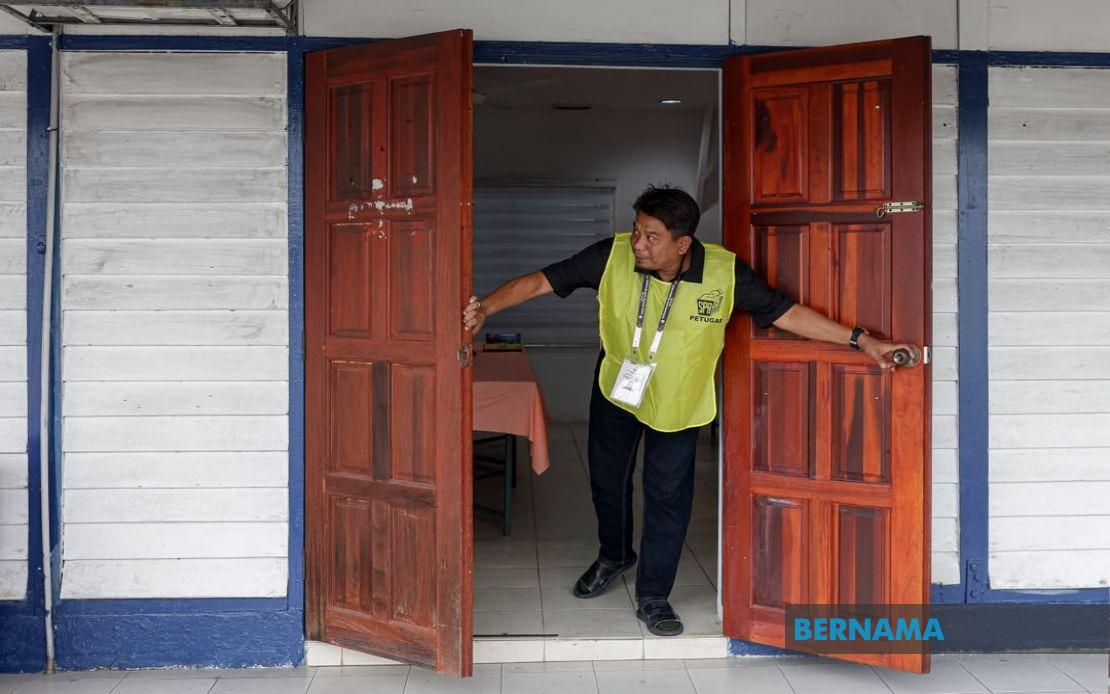
The staggered closure of all 38 early polling centres in Negeri Sembilan on Monday evening marked the completion of advance voting for the state's 16th election, with participation from security force members and their families reaching nearly the Election Commission's target. Operating since 8 am across the state, the centres progressively shut down based on voter volume and geographical considerations, with the final batch closing at 5 pm as tallying began for what officials termed a successful preliminary phase.
By mid-afternoon, the Election Commission reported that 14,651 personnel had successfully voted, representing 88.97 per cent of the 22,339 early voters enrolled for this special polling phase. The figure comprised 9,827 military service members and their spouses alongside 4,824 police officers and their families, demonstrating substantial participation from both security branches. In total, 16,467 individuals cast ballots in person at designated centres throughout the state, while the remainder exercised their franchise through postal voting arrangements made available to those unable to attend physical polling stations.
EC chairman Datuk Seri Ramlan Harun acknowledged the commission's aspiration for 90 per cent participation in early voting, noting during a media briefing that the final figures came remarkably close to this benchmark. The near-achievement of this goal underscores the efficiency with which security personnel, whose operational commitments often conflict with standard voting schedules, were accommodated through the dedicated early voting framework. The staggered closure approach—with initial closures at noon followed by additional centre shutdowns at 2 pm—allowed the commission to manage crowds effectively while maintaining voting integrity throughout the day.
The early voting exercise represents a crucial preparatory stage for Negeri Sembilan's broader electoral process, ensuring that members of the armed forces and police, whose duties may prevent attendance at Saturday's main polling day, can participate without compromise. This arrangement reflects standard democratic practice in Malaysia, where security personnel's contributions to national stability are recognised through logistical accommodations during elections. The coordination required to execute 38 simultaneous polling centres demonstrates the Election Commission's operational capacity and commitment to inclusive electoral processes.
Monday's proceedings set the stage for the genuine test of electoral appetite across the state, with general voting scheduled for this Saturday involving 889,490 registered voters. These citizens will select representatives from a field of 103 candidates competing across 36 state assembly seats, determining the composition of the Negeri Sembilan state legislature for the coming term. The scale of Saturday's exercise, involving roughly 40 times more voters than the early polling phase, will require substantially expanded polling infrastructure and significantly larger contingents of election officials and observers.
The election itself represents a significant juncture in Negeri Sembilan's political trajectory, offering voters opportunity to reshape their state government's direction. With more than 889,000 eligible participants across the 36 constituencies, the Saturday vote promises a genuine referendum on the incumbent administration's performance and the alternative visions presented by opposition coalitions. The turnout achieved during early voting suggests robust civic engagement, potentially indicating strong participation rates when the broader electorate votes.
For Malaysian observers and regional analysts tracking electoral trends within the country's federalised system, the Negeri Sembilan contest provides insights into how state-level politics continue to evolve following national developments. The state election occurs within Malaysia's broader political landscape, where state assemblies retain significant autonomy in areas including land administration, Islamic affairs, and local development policy. Results could influence factional balances within the national coalition structures, particularly regarding negotiations over parliamentary alliances and governmental configurations at federal level.
The Election Commission's management of the early voting process demonstrates institutional learning from previous electoral cycles, with refined procedures for handling security personnel voting. The near-achievement of the 90 per cent participation target suggests that dedicated early voting windows effectively reach their intended beneficiaries, validating the continued investment in parallel polling mechanisms. As Malaysia refines its democratic infrastructure ahead of future electoral cycles, such operational successes provide valuable templates for scaling and improving electoral accessibility.
Saturday's general polling will represent the definitive verdict on Negeri Sembilan's political direction. Voters across the state's diverse constituencies, from urban centres to rural constituencies, will determine which parties and individuals receive their mandate. The contrast between the security personnel voting bloc and the broader civilian electorate could prove analytically interesting, potentially revealing divergent preferences or confirming consistent patterns of electoral behaviour. With 103 candidates competing and significant stakes attached to control of the state government, the Saturday exercise promises a genuinely consequential democratic moment for this central Malaysian state and its nearly 900,000 registered voters.

