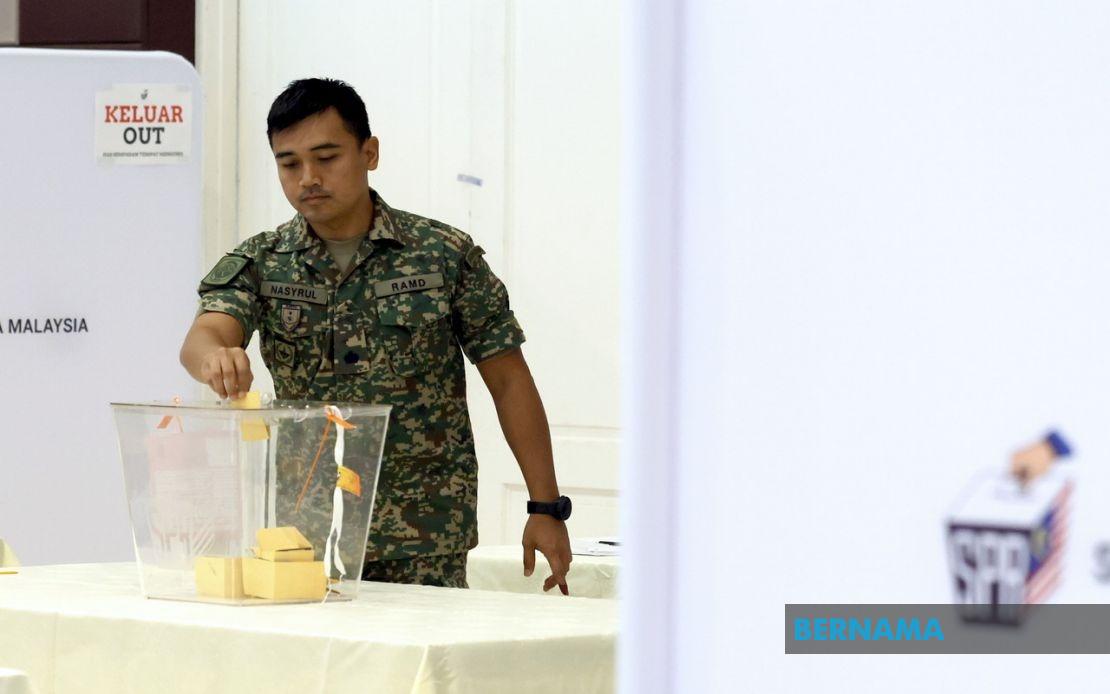
The 16th Negeri Sembilan state election demonstrated strong democratic participation on Saturday when early voting concluded with 14,995 ballots cast, representing a 91.06 per cent turnout that surpassed the Election Commission's pre-set 90 per cent benchmark. The figure, announced in Seremban, reflects robust engagement from security personnel and their families who were granted the opportunity to vote ahead of the general election day scheduled for the following Saturday.
Election Commission secretary Datuk Khairul Shahril Idrus attributed the strong showing to meticulous planning and coordination among all stakeholders involved in administering the vote. A total of 16,467 military personnel and their spouses, alongside police officers, were eligible to participate in the early voting exercise—a mechanism designed to accommodate those in the security services who may face operational commitments on election day itself. This category of early voters has historically shown consistent participation rates, though the latest figure represents a particularly impressive achievement.
The logistical operation unfolded across Negeri Sembilan with 38 polling centres distributed statewide to serve eligible early voters. The voting commenced at 8 am and proceeded in stages, with varying closure times reflecting the operational requirements of different locations and the security forces stationed there. Eighteen centres wrapped up proceedings at noon, two additional centres closed at 2 pm, while the remaining eighteen facilities continued until 5 pm. This staggered approach allowed for controlled management of voter flow while accommodating the diverse schedules of military and police personnel.
The execution of early voting represents a critical test of the Election Commission's operational capacity ahead of the main election day. The fact that turnout exceeded the internal target signals effective communication with eligible voters about the early voting opportunity and the convenience afforded by multiple polling locations. For a state election of this magnitude, where approximately 867,151 voters across Negeri Sembilan hold voting rights, the early participation of security personnel and their families represents a meaningful portion of overall electoral engagement.
For Malaysian electoral observers and international observers watching state elections, the Negeri Sembilan result provides encouraging data about voter enthusiasm during what has been an intensified period of electoral activity nationwide. State elections serve as important barometers of public sentiment and democratic health, and strong early voting participation typically correlates with expectations for robust turnout on election day itself. The 91.06 per cent figure suggests that messaging around the importance of early voting has resonated effectively with this particular demographic.
Datuk Khairul Shahril Idrus took the opportunity to publicly acknowledge the contributions of returning officers and their teams, recognising their role in executing the election management framework with precision and professionalism. The recognition extended to multiple agencies including the Negeri Sembilan State Secretary's Office, the Royal Malaysia Police, the Malaysian Armed Forces, participating media organisations, and various other entities whose coordination proved essential to the seamless administration of the process. This multi-agency approach reflects the complexity of election management in Malaysia's federated system.
The early voting mechanism itself represents an important accommodation within Malaysia's electoral framework, particularly given the constitutional obligations and deployment schedules of military and police personnel. By enabling these citizens to vote before the general polling day, the Election Commission ensures that service to the nation through the security forces does not result in disenfranchisement or the necessity to choose between civic duty and professional duty. This institutional design has become standard practice across Malaysian elections at both federal and state levels.
Looking ahead to the main election day, the momentum generated by this early voting exercise may carry forward into the broader electorate. High participation rates among any voter segment can create a cultural expectation of engagement across other demographic groups. The Negeri Sembilan context is particularly significant given the state's historical importance in Malaysian politics and its representation of both urban and rural constituencies that mirror national patterns. How turnout evolves on the actual election day will provide crucial insight into overall electoral engagement across the state.
The Election Commission's establishment of a 90 per cent target for early voting demonstrates institutional confidence in the participation rates of security personnel while also setting an ambitious but achievable benchmark. The fact that this target was surpassed by more than one percentage point suggests either higher-than-anticipated eligibility or exceptionally effective mobilisation of those eligible to vote. Such metrics become important data points as the commission evaluates the efficacy of its electoral administration and makes adjustments for future state and general elections.
With 867,151 registered voters in Negeri Sembilan entitled to cast ballots in the 16th state election, the early participation of over 14,900 represents approximately 1.7 per cent of the overall electorate. While this proportion may seem modest, the concentration among a specific demographic—security personnel and their families—reflects important institutional arrangements. The main election day will ultimately determine the state's political direction, but the strong early voting participation has established a foundation of organisational effectiveness that reflects positively on the Election Commission's management capacity during a period of heightened electoral activity in Malaysia.

