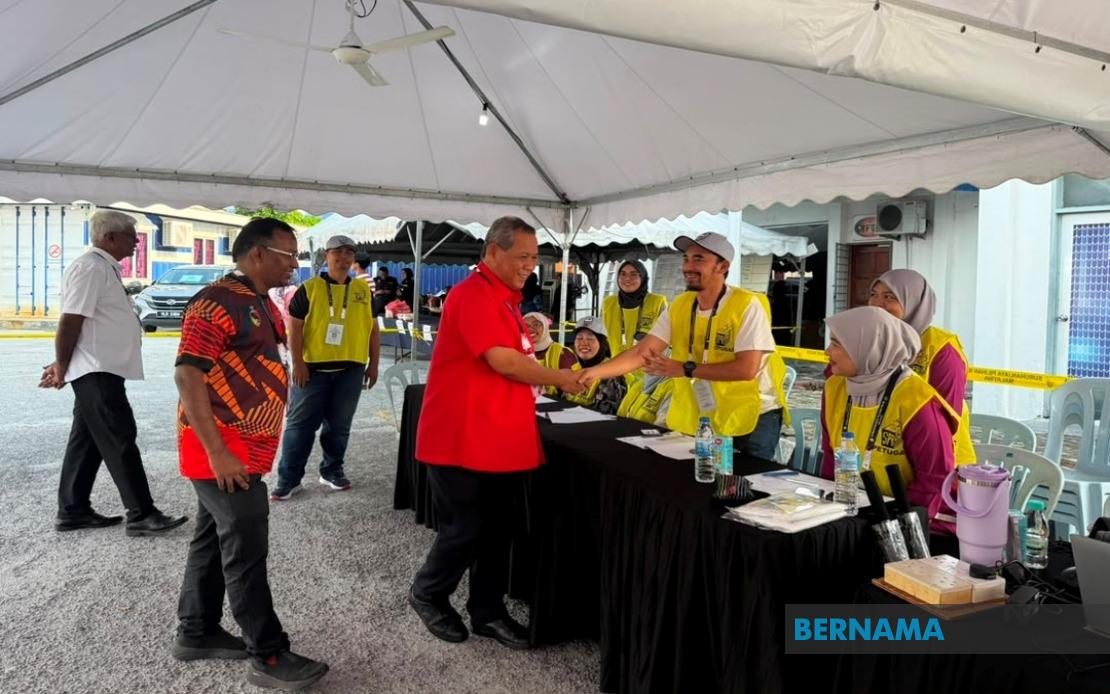
The Negeri Sembilan state election campaign reached a significant milestone on July 28 as major contenders from competing political coalitions made their presence felt at early voting venues across the state, witnessing first-hand the electoral machinery in operation. The monitored voting sites reported no disruptions or irregularities, reflecting the institutional readiness of election officials and security personnel tasked with managing the democratic process during this preliminary phase.
In Port Dickson, Menteri Besar Datuk Seri Aminuddin Harun, the Pakatan Harapan candidate contesting the Linggi state seat, arrived at the Port Dickson District Police Headquarters at 9 am to observe proceedings at one of the early voting centres. His visit allowed him to assess the administrative preparations and voter turnout while simultaneously engaging with law enforcement personnel who were participating in the early voting scheme as both stakeholders in the electoral process and voters themselves.
Aminuddin's remarks to journalists following his inspection highlighted the substantial voter participation witnessed during the morning hours. He expressed satisfaction with the administrative execution, noting that the early voting arrangement had enabled citizens, particularly those in essential services like police, to exercise their democratic rights without undue complications. His commendation extended specifically to police headquarters staff for facilitating a seamless voting experience, underscoring the collaborative approach required between electoral authorities and security agencies to maintain procedural integrity.
The Menteri Besar's emphasis on democratic participation reflects the broader significance of early voting mechanisms within Malaysia's electoral framework. These provisions recognise that citizens engaged in critical public services, including law enforcement, healthcare, and defence, require flexible voting arrangements to ensure their franchise is not compromised by professional obligations. The smooth execution observed at Port Dickson demonstrates the institutional capacity of Malaysian electoral bodies to accommodate such provisions while maintaining rigorous oversight.
Meanwhile, in the Jelebu district, the Barisan Nasional candidate for the Pertang state seat, Datuk Seri Jalaluddin Alias, conducted a similar monitoring visit at approximately 8 am at the Jelebu District Police Headquarters. His presence at the early voting centre reflected the broader pattern among major contenders to observe electoral procedures during this phase, ensuring transparency and allowing party representatives to verify that voting operations adhered to established protocols.
The coordination between election officials and candidates at early voting centres represents an important aspect of Malaysia's approach to electoral oversight. By permitting candidates to observe voting processes, the system incorporates multiple layers of scrutiny, enabling political representatives to satisfy themselves regarding procedural fairness while simultaneously demonstrating to voters that competing parties maintain confidence in the electoral system's integrity. This transparent approach strengthens institutional legitimacy across diverse political constituencies.
The early voting phase in Negeri Sembilan's state election acquired particular importance given the state's electoral competitiveness and demographic composition. Negeri Sembilan, comprising districts such as Linggi, Jelebu, and others, represents a microcosm of Malaysian electoral dynamics, where multiple coalitions actively contest for representation. The participation of prominent figures like the incumbent Menteri Besar and opposition candidates in monitoring early voting reflected the strategic significance these leaders attached to ensuring procedural credibility throughout the election cycle.
The absence of reported irregularities during early voting operations speaks to the preparedness of poll workers and security personnel in managing the expanded electorate. Typically, early voting accommodates individuals whose professional responsibilities would otherwise conflict with standard voting schedules. The successful execution of these arrangements on July 28 indicated that polling officials had adequately trained staff and established robust operational procedures to handle both regular and special voting cohorts simultaneously.
For Malaysian voters and the broader Southeast Asian region observing electoral developments, the smooth early voting process in Negeri Sembilan underscores the maturity of Malaysian democratic institutions. Despite periodic controversies surrounding electoral matters, the demonstrated capacity to execute complex voting arrangements without incident reflects decades of institutional development and procedural refinement. This capability becomes increasingly relevant as electoral systems across the region contend with demographic shifts, urbanisation, and evolving voter expectations regarding accessibility and transparency.
The candidates' observations of early voting also signal their commitment to validating election outcomes through procedural transparency rather than post-election contestation. By engaging directly with the voting process and publicly acknowledging smooth operations, major contenders implicitly committed themselves to accepting the legitimate results that would emerge from the state election. Such engagement builds confidence in electoral results across competing political camps, which proves crucial for post-election political stability and constructive opposition roles within state governance structures.
Looking toward the conclusion of the Negeri Sembilan state election campaign, the observed early voting operations suggested that election management structures had successfully absorbed the procedural complexities involved in conducting democratic contests. The participation of candidates from both Pakatan Harapan and Barisan Nasional in monitoring these operations demonstrated that institutional confidence in electoral administration transcended partisan divisions, a positive indicator for the election's ultimate credibility and acceptance across Malaysian political society.

