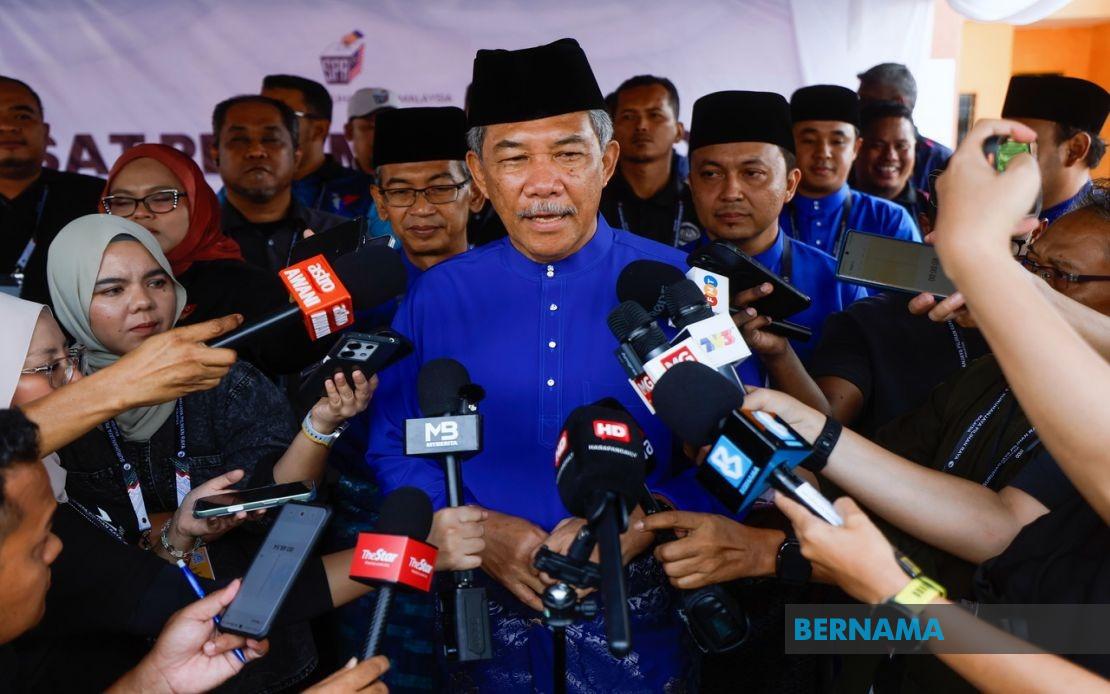
Barisan Nasional's second-highest ranking official has drawn a clear boundary for the forthcoming Negeri Sembilan state election, instructing the coalition's campaigners to refrain from weaponising the state's adat customs as political ammunition. Datuk Seri Mohamad Hasan, speaking after nomination proceedings concluded at Dewan Seri Rembau, articulated a position that reflects broader concerns about preserving institutional integrity during competitive electoral periods. His warning carries particular weight given his dual roles as UMNO deputy president and BN deputy chairman, positions that grant him considerable influence over how the party apparatus functions during campaigns.
The timing of this directive proves significant for understanding the Negeri Sembilan political landscape. The state's Legislative Assembly was dissolved on June 5, triggering a race that will see voters cast ballots on August 1 across all 36 state seats. The Election Commission has scheduled early voting for July 28, compressing the campaign window substantially. Within this compressed timeframe, parties competing for power might be tempted to exploit sensitive cultural and traditional matters to mobilise their respective support bases. Mohamad Hasan's intervention seeks to establish guardrails against such tactics before they materialise.
The invocation of adat—the collection of customary practices, protocols, and institutions that form the bedrock of Negeri Sembilan's governance structure—hints at underlying tensions within the state's political ecosystem. Unlike Malaysia's other states, Negeri Sembilan operates under a distinctive constitutional arrangement where the Yang di-Pertuan Agong is elected by the Negeri Sembilan rulers council, reflecting the state's historical composition as a federation of nine districts. This unique setup means that adat and royal prerogatives are not merely symbolic but constitute functional components of state administration. Consequently, injecting adat disputes into electoral competition could destabilise relationships between the political parties and traditional institutions.
Modhamad's statement underscores a critical distinction between legitimate political contestation and the weaponisation of cultural and traditional institutions. He emphasised that Negeri Sembilan's adat apparatus warrants respect and must remain insulated from partisan competition. This approach reflects an understanding that when political actors instrumentalise cultural or traditional matters, the consequences extend beyond electoral victory or defeat—they can corrode the institutional autonomy and credibility of the bodies ostensibly being protected. For Negeri Sembilan specifically, where traditional governance structures carry constitutional weight, such degradation poses risks to administrative stability.
The BN deputy chairman articulated his position with directness, stating explicitly that adat matters must not contaminate campaign discourse. He framed this restriction not as arbitrary prohibition but as a practical necessity for governing effectively post-election. Complicated relationships between political actors and traditional authorities make governance cumbersome, potentially hampering the incoming administration's capacity to implement policies and secure cooperation from all constituencies, including those traditionally aligned with rival coalitions. This consequentialist framing—emphasising outcomes rather than abstract principles—may carry persuasive weight with pragmatically-minded campaigners.
The broader context involves the electoral understanding maintained between Barisan Nasional and Perikatan Nasional. Mohamad Hasan clarified that the two coalitions are not forming a merger akin to the Johor arrangement but rather sustaining an electoral understanding whereby each respects the other's strongholds, thereby maximising combined support across the 36 contested seats. This accommodation suggests sophisticated coalition management, where both groups recognise that head-to-head competition across all constituencies would fragment anti-incumbent votes and potentially hand victory to other contenders. The arrangement reflects lessons learned from previous electoral cycles where undivided opposition support tilted outcomes.
However, maintaining such electoral understanding while preserving campaign distinctiveness requires discipline. Coalition partners must campaign vigorously for their own candidates while restraining from attacks that could damage the broader understanding. Adat matters, should they become politicised, risk fracturing this delicate balance. If one coalition partner perceives the other as exploiting customary institutions for partisan gain, reciprocal escalation becomes likely, ultimately poisoning the partnership. Mohamad Hasan's intervention thus serves both principled and pragmatic coalition-management functions simultaneously.
For Malaysian and Southeast Asian observers, the Negeri Sembilan election illustrates how competitive democracies must negotiate boundaries between legitimate contestation and institutional preservation. Unlike fully centralised systems where traditional institutions answer directly to political leadership, Malaysia's constitutional framework grants significant autonomy to royal institutions and customary authorities. Parties operating within this system must develop discipline to compete fiercely on policy and performance grounds without destabilising the broader institutional architecture. Breaching such boundaries creates precedents with long-term consequences, as competing actors invoke earlier violations to justify escalatory tactics.
The Negeri Sembilan situation also reflects regional trends where customary and traditional institutions face evolving pressures from modernisation, electoral competition, and shifting social priorities. Across Southeast Asia, countries hosting strong adat or equivalent customary systems—including Indonesia with its adat recognition frameworks and the Philippines with indigenous peoples' arrangements—grapple with similar tensions. When political actors exploit these systems for short-term advantage, they accumulate constitutional and social debt that becomes payable later through institutional weakening. Mohamad Hasan's warning implicitly acknowledges this longer-term cost calculus.
Moving forward, the Negeri Sembilan election will test whether Malaysian political parties can honour such self-imposed constraints. The compressed campaign schedule and intense competition might generate pressures to deviate from the established line, particularly if one coalition perceives rivals capitalising on adat sensitivities. Media scrutiny will prove important in holding campaigners accountable to the standards articulated by senior leaders. Furthermore, civil society organisations monitoring the election can amplify messaging around institutional respect, creating reputational costs for violations. The successful implementation of Mohamad Hasan's directive would provide a constructive model for conducting competitive elections while maintaining constitutional and institutional integrity—a balance that becomes increasingly difficult across the region as electoral competition intensifies.

