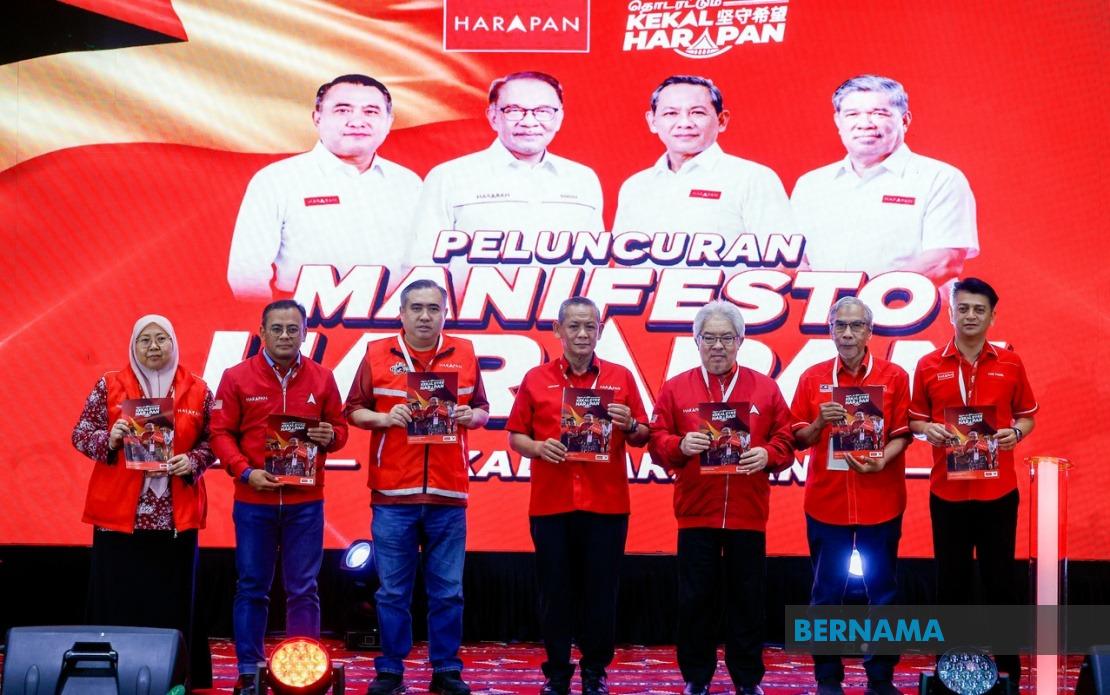
Pakatan Harapan unveiled its election manifesto for Negeri Sembilan on Monday in Seremban, signalling a strategic shift away from broad campaign promises towards specific, implementable commitments grounded in the coalition's track record in the state. State coalition chairman Datuk Seri Aminuddin Harun, who also serves as Menteri Besar, framed the document as fundamentally different from typical political pronouncements, emphasising instead that every pledge reflects lessons learned and accomplishments achieved during PH's eight years administering the state.
The manifesto, branded 'Negeri Sembilan Kekal Harapan' (Negeri Sembilan Stays With Harapan), consolidates ten core commitments that the coalition intends to pursue during a potential fifth five-year term. Aminuddin articulated a clear philosophical distinction between the coalition's previous approach and its current strategy: where earlier campaigns identified aspirational initiatives, the revised programme focuses on refining, scaling, and consolidating those existing programmes while introducing meaningful enhancements tailored to emerging state needs.
This approach holds particular significance in the context of electoral fatigue and voter scepticism towards unfulfilled pledges—a sentiment that has grown across Malaysian politics in recent years. By anchoring promises to demonstrated capabilities rather than theoretical projections, PH appears to be attempting to insulate itself against accusations of over-promising, a weakness that has haunted competing coalitions during previous election cycles. The emphasis on building a robust institutional foundation for future generations suggests the coalition is adopting a longer-term governance perspective rather than pursuing quick wins designed primarily to secure immediate electoral advantage.
Aminuddin, who personally contests the Linggi state seat, positioned the next five years as a consolidation phase critical to transforming strategic plans into tangible outcomes. This framing acknowledges that ambitious policy agendas often require multiple electoral cycles to mature fully, and that sustainable development demands patience and consistent execution rather than perpetual reinvention. For voters in Negeri Sembilan, this message carries both implicit reassurance—that governance will remain stable and predictable—and implicit pressure, as the coalition essentially stakes its credibility on delivery performance measurable against explicit benchmarks.
The manifesto launch occurs against a backdrop of evolving electoral dynamics across Malaysia. State-level elections have increasingly become testing grounds where voters assess coalition competence in delivering public services, managing infrastructure, and addressing quality-of-life concerns. Unlike federal campaigns, which often pivot around constitutional matters and inter-coalition machinations, state contests tend to focus voter attention on concrete deliverables: school conditions, hospital waiting times, road maintenance, water supply reliability, and local economic development. PH's decision to emphasise demonstrable track record rather than visionary rhetoric reflects this reality.
Negeri Sembilan's political history also contextualises this approach. The state has experienced relatively stable governance under PH leadership, without the dramatic reversals that occurred in other states following the 2022 federal realignment. This stability provides the coalition genuine grounds for highlighting accomplishments, though it simultaneously raises voter expectations for continued competent administration. The state's moderate size—neither a major economic engine like Selangor nor a periphery entity—means that governance quality directly impacts residents' lived experience in ways that resonate across demographic segments.
The structure of PH's campaign messaging also reveals strategic calculation about the electorate's current mood. Rather than deploying inspirational rhetoric centred on transformative vision, the coalition addresses voters as stakeholders evaluating stewardship of existing institutions. This represents a maturation of political communication, moving beyond the revolutionary aspirations that characterised PH's 2018 breakthrough towards a more prosaic but potentially more credible platform. Voters fatigued by unfulfilled mega-projects and grandiose schemes may find such pragmatism refreshing, though others may perceive it as lacking ambition.
The ten core commitments within the manifesto, while not detailed in the source account, presumably address sectors where PH governance has demonstrated capacity—education, healthcare, infrastructure maintenance, and economic development support—alongside new initiatives responding to changed circumstances since the coalition's previous electoral cycle. This balanced approach of consolidation and innovation allows PH to present itself as both reliable steward and responsive administrator, simultaneously appealing to voters seeking predictability and those wanting adaptive governance.
For the broader Southeast Asian region, Negeri Sembilan's election carries subtle significance as a test case for how ruling coalitions frame performance during periods of democratic consolidation. Many Southeast Asian democracies have shifted from revolutionary change rhetoric towards management-focused governance platforms. PH's manifest approach in Negeri Sembilan exemplifies this wider regional trend, reflecting maturation of both political systems and electorates navigating post-crisis normalisation. How effectively the coalition translates this strategy into electoral support will provide data points for political analysts assessing voter preferences across the region.
The launch of the manifesto in Seremban also underscores PH's geographic strategy, concentrating organisational energy and messaging in key urban and semi-urban constituencies where swing voters often determine electoral outcomes. Aminuddin's emphasis on building foundations for future generations appeals to younger voters establishing families and considering long-term residence decisions, while his stress on consolidating existing programmes reassures older voters dependent on established public services. This bifurcated messaging, executed through a unified manifesto framework, demonstrates sophisticated understanding of contemporary electoral segmentation.
Ultimately, PH's calculated pivot towards delivery-focused campaigning reflects realistic assessment of its political moment. The coalition governs nationally under constrained circumstances involving multiple constituent parties with divergent interests, limiting its capacity for dramatic national initiatives. At state level, however, PH possesses greater autonomy and clearer policy implementation capacity, making credible performance commitments strategically advantageous. Whether Negeri Sembilan voters respond to this sober, outcomes-oriented appeal—or whether they ultimately favour more ambitious or contrasting platforms presented by competing coalitions—will substantially influence PH's broader political trajectory in the coming electoral cycle.

