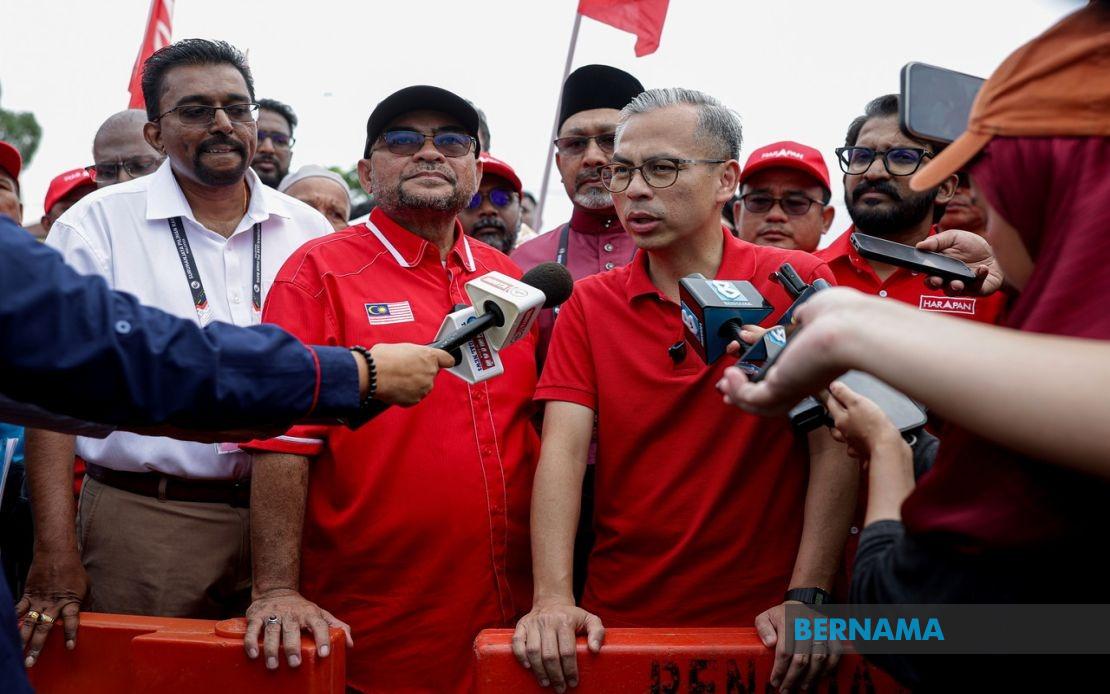
Pakatan Harapan will build its campaign for the upcoming Negeri Sembilan state election around administrative continuity and the economic achievements of Menteri Besar Datuk Seri Aminuddin Harun, party communications director Datuk Seri Fahmi Fadzil announced on July 18 after candidate nominations concluded in Jempol. The coalition's strategy represents a deliberate choice to shift focus away from national issues and towards tangible state-level accomplishments that voters have directly experienced.
The coalition intends to highlight what it characterises as the proven capabilities of Aminuddin's administration since assuming office in 2018, positioning economic stability as the primary argument for returning the current government. Fahmi, who also serves as Communications Minister, outlined concrete examples of state performance that the campaign will emphasise, including increased zakat collections, growth in state government revenue, and sustained foreign investment inflows. These metrics, the party argues, demonstrate competent governance that has delivered measurable benefits to constituents.
Among the specific achievements cited is the development of a new port facility, a significant infrastructure project with long-term implications for Negeri Sembilan's economic diversification and regional trade positioning. The port represents not merely a construction achievement but a strategic investment in the state's future commercial capacity, particularly relevant given the port sector's importance across Southeast Asia. By highlighting such projects, PH attempts to frame the election as a referendum on proven delivery rather than political ideology or personality contests.
The campaign messaging prioritises what might be termed "steady hands" governance—the idea that changing administrations would risk interrupting beneficial economic momentum. This approach proves particularly potent in a state election context, where voters often prioritise tangible local improvements over broader political narratives. Fahmi explicitly stated that PH intends to convince voters that maintaining the current administration is essential for sustained economic prosperity and stability.
In specific constituencies, campaign messaging has been tailored to address distinct voter concerns. Within Jeram Padang, where a four-way contest will occur, PH candidate G. Manivannan—a lawyer and political secretary to Prime Minister Datuk Seri Anwar Ibrahim—will emphasise employment opportunities, reflecting priorities repeatedly raised by younger constituents. This targeted approach suggests sophisticated voter segmentation, with economic messaging adjusted to resonate with specific demographic groups facing distinct challenges.
Manivannan's candidacy in Jeram Padang places him against Barisan Nasional incumbent Datuk Mohd Zaidy Abdul Kadir, Perikatan Nasional-aligned Bersatu's R. Sri Sanjeevan, and Dayana Dal, an Orang Asli candidate representing Asli party. This four-way split complicates the political landscape, potentially fragmenting opposition votes in ways that could advantage the incumbent coalition.
Across the four constituencies within the Jempol parliamentary division—Serting, Palong, Bahau, and Jeram Padang—contest structures vary. Bahau presents a straight two-way fight between PH's incumbent Teo Kok Seong of DAP and Barisan Nasional's Chong Fui Ming of MCA, typically the clearest contest format. Both Serting and Palong feature three-way contests, complicating vote calculations and potentially influencing candidate momentum and resource allocation. In Serting, PH's Yaacob Mahmood confronts Perikatan Nasional incumbent Mohd Fairuz Mohd Isa and Bersatu's Muhammad Noraffendy Mohd Salleh. The Palong race places BN incumbent Datuk Mustapha Nagoor against PH's Muhammad Zahin Zinal Abidin and Bersatu's Rebin Birham.
Fahmi simultaneously reminded all campaigning parties to maintain ethical standards throughout the two-week campaign period, explicitly urging avoidance of sensitive topics involving religion, race, and the institution of rulers—Malaysia's constitutional "3Rs" framework. This guidance from the Communications Minister implicitly acknowledges tensions that periodically emerge during electoral campaigns and reflects official concern about maintaining inter-communal harmony during politically charged periods. The emphasis on responsible netizen engagement and prevention of disinformation suggests awareness of how digital platforms have complicated modern Malaysian campaigning.
The Election Commission has designated July 28 for early voting, with general polling scheduled for August 1. This calendar provides a two-week window for campaigns to operate, a compressed timeframe that incentivises efficient messaging and resource concentration. Early voting provisions have become increasingly important in Malaysian elections, accommodating workers and others unable to vote on polling day, though they simultaneously complicate campaign planning and potentially advantage better-organised parties with voter identification capabilities.
From a regional perspective, the Negeri Sembilan election offers insights into evolving Malaysian electoral dynamics. PH's emphasis on administrative performance and economic delivery rather than anti-incumbent messaging or personality-driven campaigns reflects maturation in how governing coalitions conduct defensive campaigns. The strategy implicitly concedes that Negeri Sembilan voters have become sophisticated consumers of political messaging, responsive to evidence of competent governance rather than rhetorical flourishes.
The involvement of multiple opposition configurations—Barisan Nasional, Perikatan Nasional (via Bersatu), and smaller parties including Asli—fragments the anti-PH vote, potentially fragmenting resources and creating opportunities for the incumbent coalition. However, this fragmentation also complicates PH's strategic calculations, as split opposition votes might not necessarily translate proportionally into PH victories, depending on constituency-specific dynamics and voter movement patterns.
For Malaysian business investors and regional observers, the Negeri Sembilan election outcome carries implications for policy continuity and state-level economic direction. Sustained foreign investment and successful infrastructure projects like the port development depend partly on political stability. A PH victory would presumably maintain this trajectory, while substantial opposition gains might signal policy recalibration, potentially affecting investment confidence and project timelines.

