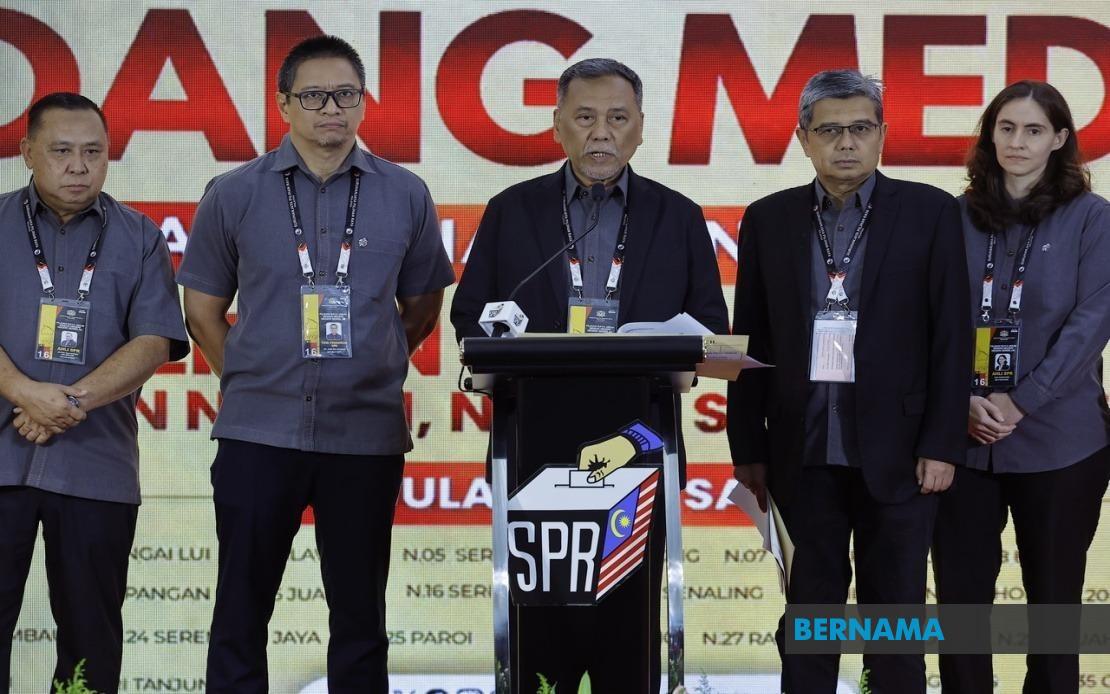
Malaysia's Negeri Sembilan state will witness a highly competitive electoral contest when voters head to the ballot box on August 1, with the Election Commission confirming participation from 103 candidates across a fragmented political landscape. The verification process, completed on July 18 after nominations closed at eight centres, revealed a diverse field of competitors ranging in age from 23 to 70 years old, with the vast majority drawn from the peninsula's major political coalitions. The state assembly's 36 seats will see contests ranging from straightforward two-way races to complex five-cornered battles, reflecting the increasingly splintered nature of Malaysian electoral politics at the subnational level.
Pakatan Harapan maintains its traditional dominance in the state by fielding the largest contingent with 36 candidates, demonstrating the coalition's organisational strength and grassroots presence in Negeri Sembilan. Barisan Nasional, the federal government's coalition partner, trails significantly with 25 candidates, suggesting it may be consolidating resources and focusing on winnable constituencies. The internal coalition dynamics prove more complex on the Perikatan Nasional side, where Bersatu has independently submitted 24 candidates whilst the broader PN alliance brings 11 additional hopefuls to the race. This parallel candidacy arrangement underscores ongoing tensions within the opposition coalition, with Bersatu effectively operating as a quasi-independent entity despite nominally sitting within the PN framework. Such divisions potentially benefit the ruling coalition by fragmenting opposition votes across multiple parties.
Three smaller political entities have also registered their presence in this election cycle, each putting forward single candidates to challenge the dominance of the major coalitions. Berjasa, ASLI, and the Socialist Party of Malaysia have each identified seats where they believe their particular political messaging might resonate with voters, whilst four independent candidates stand outside the party structure entirely. These fringe participants, whilst unlikely to secure seats given their limited resources and minimal campaigning infrastructure, nonetheless demonstrate the democratic space available for alternative political voices in Malaysia's electoral system. Their presence in Negeri Sembilan provides voters with genuine options beyond the two major ideological camps.
The geographical distribution of contests across the 36 seats reveals distinct patterns that will likely shape campaign strategies. Of paramount interest are the 21 seats designated for three-cornered contests, which introduce unpredictable dynamics where plurality victories become possible without majority support. Four seats—Nilai, Sri Tanjung, Jeram Padang, and Rahang—feature even more congested fields with either five or four candidates respectively. These complex battlegrounds will test voter preferences most severely, as splitting support amongst multiple credible candidates could determine outcomes. The remaining 11 straightforward two-way races will likely prove less dramatic but potentially more indicative of underlying swing patterns, as voters face simpler choices between established alternatives. Strategic campaign positioning becomes critical in three-way contests, where candidates must simultaneously build affirmative support whilst attempting to consolidate opposition against their strongest rival.
Gender representation in the candidate pool reflects persistent patterns within Malaysian politics, with 94 male nominees substantially outnumbering nine female candidates across the 103-person field. This nine percent female participation rate remains well below parity despite growing calls for enhanced gender representation in electoral politics. The disparity suggests that selection mechanisms within all participating parties—whether formal quotas or informal decision-making—continue privileging male candidates for state-level positions. Female candidates, whilst numerically marginal, do appear across multiple coalitions rather than concentrating in any single party, suggesting that gender representation issues cut across the political spectrum rather than being confined to particular ideological camps.
The voter base eligible to participate comprises 889,490 registered electors, constituting a substantial democratic exercise for a state assembly election. Beyond the 867,151 ordinary voters, the rolls include 16,884 military personnel and their spouses, plus 5,455 police officers, reflecting Malaysia's longstanding inclusion of security personnel in electoral processes. These constituencies within the broader electorate often demonstrate distinct voting patterns and organisational advantages that campaigns must specifically address. The sheer scale of the electorate means that ground operations, volunteer mobilisation, and targeted messaging become decisive factors in converting general support into actual votes on polling day.
The Election Commission's scheduling has established July 28 for early voting, providing military personnel, police officers, and other eligible voters unable to cast ballots on primary election day with an earlier opportunity. This administrative consideration recognises the logistical challenges facing disciplined forces during ordinary polling periods. Early voting provisions effectively extend the election timeline across multiple days, potentially reducing the compression of campaign messaging in final hours and providing more distributed voter participation across the electoral period. The two-day gap between early voting and the main election day offers campaigns a final window to mobilise remaining supporters and address late-breaking issues that might influence undecided voters.
Negeri Sembilan's election occurs amid broader regional political shifts affecting Malaysian electoral calculations. The state has historically represented a bellwether for national political sentiment, with results often foreshadowing shifts in federal electoral preferences. Consequently, the distribution of seats won by various coalitions will attract intense scrutiny from political analysts seeking indicators about evolving voter preferences ahead of the next federal election. For Pakatan Harapan, victory would consolidate its control of a traditionally important state whilst demonstrating continued voter confidence. For Barisan Nasional, merely competitive performance against the larger PH candidate pool would constitute a relative success given its reduced presence. For Bersatu and Perikatan Nasional, the election provides an opportunity to demonstrate electoral viability and build towards future state or federal contests.
The concentration of three-way battles in 21 seats fundamentally alters campaign mechanics compared to conventional two-party competition. Candidates cannot assume that simply mobilising their core support guarantees victory; instead, they must carefully position themselves as preferable alternatives to each rival separately. In seats where three viable candidates exist, the winner may secure office with substantially less than majority support, introducing volatility into outcome prediction. This dynamic has historically benefited certain parties whilst disadvantaging others depending on how their support distributes geographically. The specific distribution of Pakatan Harapan, Barisan Nasional, and Perikatan Nasional votes across three-way contests will ultimately determine seat allocation far more decisively than overall candidate numbers or aggregate support levels.
The Election Commission's completion of the verification process marks the formal transition from administrative preparation to active campaigning, with all candidates now definitively confirmed and able to conduct unrestricted public campaign activities. The coming weeks before August 1 will determine which candidates successfully translate their nomination into actual electoral support. Campaign intensity typically escalates following the close of nominations as parties mobilise volunteers, allocate resources strategically, and attempt to shape voter perceptions through media engagement and grassroots activity. The Negeri Sembilan election will showcase contemporary Malaysian electoral practice, balancing multiple coalition structures against candidate quality, grassroots organisation, and the persistent influence of personality-driven politics at the state level.

