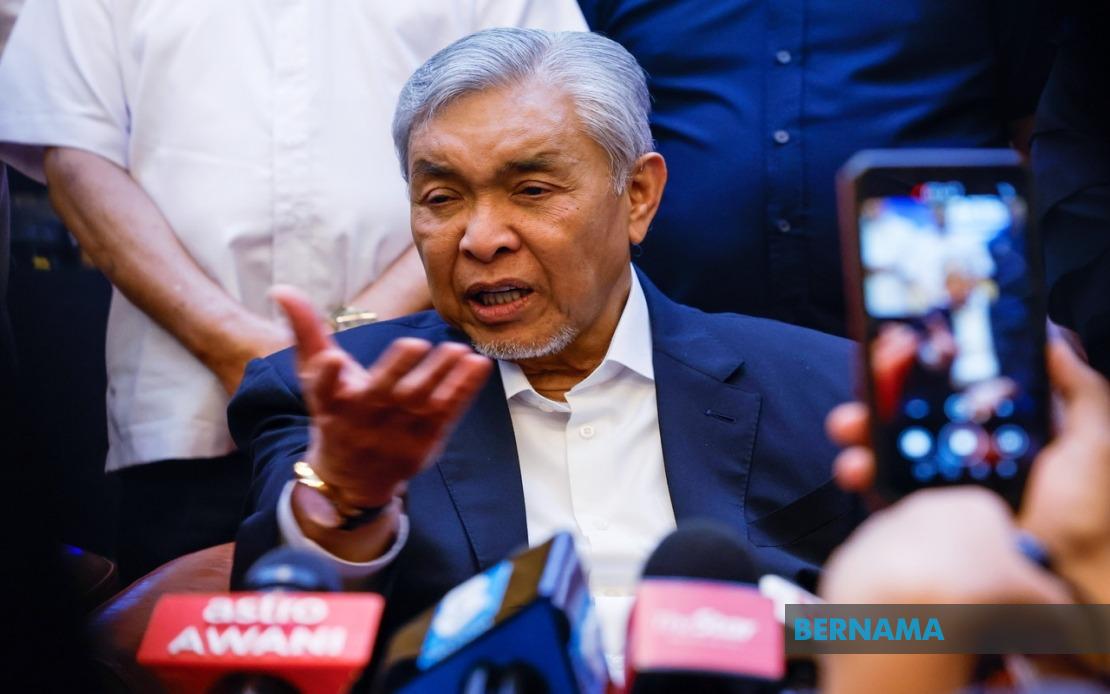
Deputy Prime Minister Datuk Seri Dr Ahmad Zahid Hamidi has called on Negeri Sembilan's incoming state administration to embrace business-friendly governance as a cornerstone of its agenda, emphasising that entrepreneurial growth and international competitiveness must become defining features of the new regime's economic strategy.
Speaking at the Negeri Sembilan Entrepreneurs Gathering Programme in Seremban on July 27, Ahmad Zahid articulated a vision where the state positions itself as a hub for dynamic enterprise, particularly among Bumiputera business owners seeking to expand beyond domestic markets. His remarks come as the state prepares for fresh political leadership, signalling that federal policymakers view entrepreneurial empowerment as central to Negeri Sembilan's future prosperity and regional standing.
The Deputy Prime Minister, who also holds the portfolio of Rural and Regional Development Minister, highlighted that the state possesses considerable competitive advantages stemming from its geographical proximity to Malaysia's administrative centre and major transportation hubs. These structural assets, he argued, should form the foundation upon which a business-enabling ecosystem can be constructed. Rather than viewing entrepreneurship as a peripheral concern, Ahmad Zahid framed it as integral to the state's trajectory toward becoming a genuine economic powerhouse within the Southeast Asian region.
Central to his message was the imperative that Bumiputera entrepreneurs should not merely succeed domestically but should aspire to and achieve international market penetration. This framing reflects broader federal policy objectives around inclusive economic development and the elevation of Bumiputera business capabilities to compete globally. Ahmad Zahid's emphasis on creating pathways for local business owners to reach international stages underscores recognition that domestic market saturation limits growth potential and that global engagement offers the greatest returns.
Regarding the role of institutional actors like the Majlis Amanah Rakyat (MARA), Ahmad Zahid proposed a recalibrated approach to measuring institutional success. Rather than gauging effectiveness through disbursement volumes alone, he advocated for impact-based metrics centred on how many entrepreneurs receive support to graduate through successive business growth stages. This philosophical shift suggests dissatisfaction with traditional metrics and implies that future MARA operations in Negeri Sembilan should focus on capability building and progressive business maturation from micro-enterprises toward internationally competitive small and medium-sized enterprises.
The Deputy PM's enumeration of Negeri Sembilan's strategic economic sectors—manufacturing, logistics, agri-food, halal products, tourism, and digital services—reflects a sophisticated understanding of where the state possesses comparative advantages. Rather than attempting diversification into unrelated fields, he advocated concentrating resources on these established strongholds, suggesting that depth of specialisation within proven sectors yields superior outcomes compared to shallow engagement across numerous industries.
Ahmad Zahid's invocation of the Malaysia Vision Valley project signals ambitions to transform Negeri Sembilan into a comprehensive ecosystem serving multiple stakeholder needs simultaneously. By positioning the state as simultaneously a residential destination, employment centre, business establishment, investment magnet, and entrepreneurial incubator, he articulated an integrated development model that transcends conventional sectoral silos. This holistic approach recognises that entrepreneurs require not merely business support but also liveable communities, quality infrastructure, and skilled workforces.
The emphasis on religious obligations, particularly zakat payments, within an entrepreneurial framework reflects efforts to align business success with Islamic principles, suggesting that profitable enterprise should not come at the expense of spiritual commitments. This integration of religious responsibility within commercial discussions indicates awareness among policymakers that Malaysian entrepreneurship, particularly within the Bumiputera community, operates within a value system encompassing both material prosperity and spiritual observance.
Technical and Vocational Education and Training emerges as a critical accelerator in Ahmad Zahid's development agenda, recognising that human capital formation underpins sustainable economic advancement. SME modernisation, halal ecosystem expansion, and tourism revitalisation were presented not as isolated initiatives but as interconnected elements requiring coordinated implementation. This systemic thinking suggests that achieving competitive advantage requires orchestrated movement across multiple development pillars rather than sequential or fragmented approaches.
For Malaysian entrepreneurs and particularly those in Negeri Sembilan, Ahmad Zahid's remarks signal strong federal support for business-enabling policies and suggest that the incoming state government should anticipate collaborative relationships with federal agencies committed to entrepreneurial success. The emphasis on international competitiveness implies that parochial or domestically-focused policies will prove insufficient, requiring instead engagement with global value chains and export-oriented strategies. Business owners contemplating expansion may interpret these signals as indicating favourable conditions for ambitious ventures backed by supportive governance frameworks.

