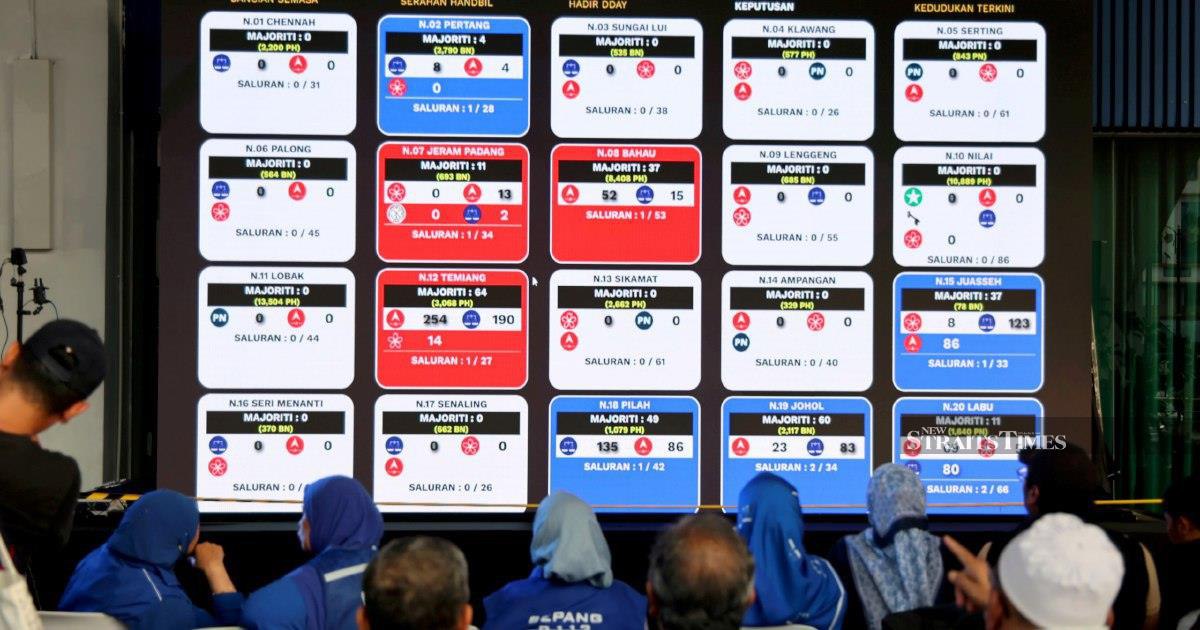
The Negri Sembilan state election has laid bare a significant vulnerability in Pakatan Harapan's electoral machinery: the coalition's inability to decisively capture and sustain support from Malay voters, a constituency that remains fundamental to winning states and federal power in Malaysia. The results from the state, which borders Selangor and sits within the strategic Klang Valley-Negeri Sembilan corridor, demonstrate that PH's strategies to broaden its appeal beyond urban, non-Malay, and younger demographics have not yet crystallised into tangible gains where they are needed most.
For more than a decade, PH has positioned itself as a multiethnic alternative to the long-governing Barisan Nasional and, since 2018, has attempted to govern while managing the competing interests of its component parties. Yet the Negri Sembilan outcome suggests that efforts to strengthen party machinery, communicate policy achievements, and rebuild trust with Malay-majority rural constituencies remain incomplete. The state has a population of roughly 1.1 million, with Malays constituting approximately 60 percent of the total, making it a microcosm of the electoral challenge PH faces nationwide where Malays represent nearly 70 percent of the population.
One of the central issues for PH is the perception among Malay voters that the coalition either does not prioritise their concerns or lacks the capacity to deliver on promises relevant to bumiputera rights, religious affairs, and economic opportunity. In states where PH has governed or competed strongly—Selangor, Penang, and Kedah—the coalition has had to carefully balance messaging around Islamic governance, the role of the Malay Language, and the maintenance of constitutional bumiputera privileges. Negri Sembilan, with its mixed urban-rural composition and strong traditional monarchy, demands a nuanced political touch that has proven elusive for PKR-led administrations.
The PKR, as the largest party within PH, carries additional complexity. While PKR claims a multiethnic membership and leadership, many Malay voters perceive it through the lens of its secular-liberal positioning on certain social issues—a perception that, justified or not, creates distance between the party and more conservative sections of the Malay electorate. This perception gap is particularly acute in states like Negri Sembilan, where PAS, the Islamic opposition party, has successfully framed itself as the authentic guardian of Malay and Islamic interests. Without a comparable Islamic credentials apparatus, PH struggles to compete credibly for the loyalty of voters in constituencies where religious sentiment and communal identity carry significant electoral weight.
The coalition's internal dynamics also matter considerably. The partnership between PKR, DAP, and other component parties requires ongoing negotiation over candidate selection, policy priorities, and campaign messaging. In Negri Sembilan, these tensions may have been visible to voters—inconsistent messaging on Islam, differing tones between urban and rural campaigning, and occasional friction over seat allocation can undermine a unified front. By contrast, BN's Umno-MCA-MIC alliance, despite its own fragilities, has decades of experience managing these coalitional dynamics in exactly these types of mixed-composition states.
Geographically, Negri Sembilan occupies a particular position in Malaysian politics. It is near enough to Selangor's economic gravity to have substantial urban constituencies, yet remote enough to have significant rural, plantation, and small-town constituencies where traditional patronage networks and religious leadership retain political influence. This duality means that no single campaign strategy can dominate; rather, PH must excel simultaneously in different registers. The evidence from the election suggests the coalition may be winning in specific pockets—likely in urban areas and Chinese-majority constituencies—but falling short in the Malay heartland that determines overall state control.
Looking forward, the implications for Malaysian politics at the national level are substantial. General elections typically turn on outcomes in ten to fifteen swing states and regions, and Negri Sembilan's position as a bellwether makes its political direction consequential. If PH cannot stabilise and expand Malay support in such states, the coalition's path to retaining federal power in the next general election, expected around 2025 or 2026, will narrow significantly. Conversely, if Umno and BN continue to consolidate Malay-majority areas, PH faces a structural disadvantage that transcends short-term campaign effectiveness.
The coalition has some advantages it could leverage. PH governments in Selangor and Penang have accumulated records of economic management and service delivery that appeal to Malay middle-class voters; these achievements are not always effectively communicated beyond urban centres. Additionally, younger Malay voters, particularly those in cities and with tertiary education, have shown openness to PH politics, suggesting that demographic shift could gradually work in the coalition's favour if it can translate generational trends into electoral gains. Furthermore, grassroots party building—strengthening branch structures, training cadres, and deepening community engagement—takes time but is essential for changing voter perceptions.
For Malaysian readers and observers, the Negri Sembilan result serves as a reminder that electoral competition in Malaysia remains profoundly shaped by ethnic and religious demographics, and that coalition-building strategies must account for these realities. PH's difficulties are not unique; indeed, every coalition seeking power in Malaysia must win Malay votes to govern. The challenge for Pakatan Harapan is whether it can develop messaging, policies, and internal coherence that resonate with Malay voters without compromising its multiethnic identity—a tension that may define Malaysian politics for years to come.

