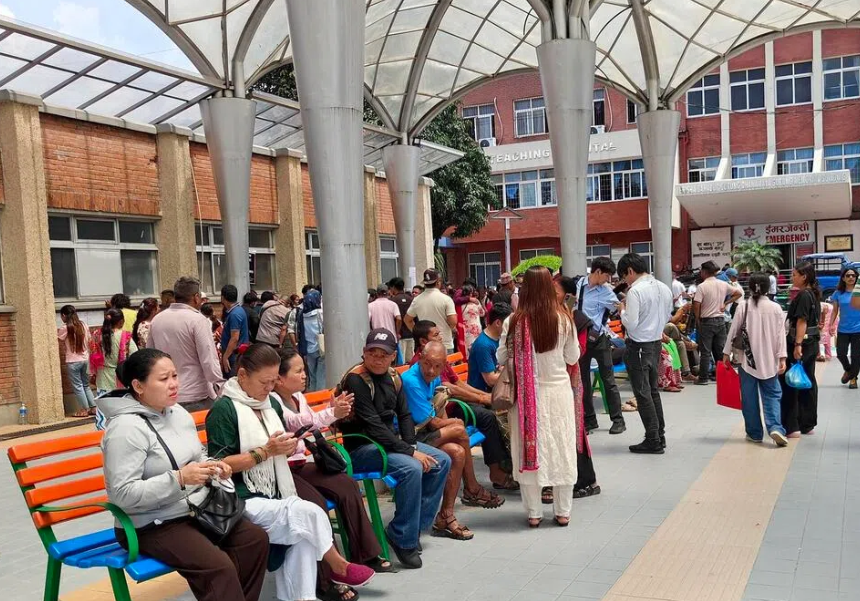
The search for missing relatives following Nepal's devastating August 26 flash flood has taken on a harrowing dimension in Kathmandu, where hospital gates have become grim information boards displaying photographs of unidentified corpses. The Tribhuvan University Teaching Hospital, one of the capital's two major public facilities, has transformed into a focal point of collective despair, with bereaved families gathering daily to scan images of mangled bodies in hopes of locating their loved ones. The scene encapsulates the scale of tragedy unfolding across Nepal's border districts, where the death toll has exceeded 500 and hundreds remain missing as rescue teams navigate the devastated Bhotekoshi river system and surrounding areas.
Three days after the disaster struck Rasuwa district and surrounding regions, the full extent of the calamity remains unclear. The missing persons register at TUTH had swelled to more than 1,500 individuals by August 28 afternoon, growing hourly as desperate relatives arrived from across the country and beyond. Security forces deployed over 4,400 police personnel alongside the Nepali Army and Armed Police Force to comb through debris fields, collapsed structures, and inundated valleys. Yet despite these intensive efforts, the recovery operation faces mounting logistical challenges, particularly as downstream districts report critical shortages of morgue capacity to store recovered bodies.
Among those searching is 36-year-old Dolma Tamang, who has spent three days moving between Kathmandu hospitals seeking any word of her sister and brother-in-law. The couple was travelling through Rasuwa district in a truck transporting goods from the Chinese border when the flood struck on the morning of August 26. Both their mobile phones went silent immediately, leaving Tamang with no information beyond that final conversation before they entered the disaster zone. "It has been very difficult; my tears have run dry," she told reporters, her exhaustion reflecting the emotional toll extraction of conducting a search among hundreds of unidentified remains.
The disaster has proven particularly devastating for pilgrims and traders traversing the Nepal-Tibet border region. Approximately 288 Indian nationals remain missing, many of them returning from or heading toward the sacred Kailash-Mansarovar pilgrimage route that passes directly through Rasuwa district. The Gyirong border crossing between Nepal and Tibet suffered severe damage from mudslides and floodwaters, trapping individuals on both sides of the frontier. Viral footage of the Gyirong Port overwhelmed by torrents of mud and water has provided grim visual documentation of the disaster's ferocity. Some missing pilgrims were at the border crossing itself when the deluge arrived, creating additional uncertainty about whether they remain stranded in Tibet or were swept downstream into Nepal.
International concern has intensified as foreign nationals remain unaccounted for. Singapore has reported nine citizens missing, while the Nepal Tourism Board announced on August 28 that 121 foreign tourists had been rescued to date, including 85 Indians and 16 Chinese nationals. The figures underscore how the flash flood struck during peak tourism season, affecting not only local populations but also visitors traversing major international travel routes. International airports in Kathmandu have received incoming flights carrying anguished family members and friends desperately hoping to locate their relatives. A group from Tamil Nadu arrived on an early morning flight from New Delhi, motivated by news that members of their travel group had gone missing while returning from pilgrimage in Tibet.
The emotional weight of the search manifests starkly at hospital gates and morgues. Bikesh Shrestha, 35, stood outside TUTH looking for his cousin Rakesh Shrestha but found himself unable to examine the photographs of corpses displayed for identification. "I had to turn my eyes away," he recounted, his voice breaking as he grappled with the possibility that his search might end in tragedy rather than reunion. Inside the hospital, 23-year-old Sushila Shrestha searched for her younger brother Bir Bahadur Shrestha, a truck driver heading to the Chinese border who was passing through Rasuwa district when the flood hit. The absence of any news, paradoxically, provided her with a measure of hope. "I am convinced he will return; he has to return," she insisted, clinging to the possibility that no confirmed sighting might mean he survived and remained unreachable rather than perished.
Rescue operations have documented remarkable survivals amid overwhelming tragedy. Security agencies have recovered hundreds alive, many found trapped beneath debris, inside collapsed tunnels, and under broken buildings. The government maintains an updated website listing names of those rescued, providing a crucial reference point for searching families. However, operations briefly paused on August 28 morning due to concerns that a barrier lake formed upstream might breach and unleash another catastrophic flood. Although officials indicated by evening that immediate danger had passed, the situation remained unstable, adding uncertainty to ongoing search timelines and limiting the ability to access certain areas.
Downstream districts bear acute suffering from the flood's secondary effects. Chitwan, a scenic district renowned for its national park and elephant sanctuary, has been severely impacted by debris accumulation and silting that has blocked major roads and rendered areas inaccessible. By August 28 afternoon, 186 bodies had been recovered in Chitwan alone, yet the district's hospital morgues possessed capacity for only 30 to 50 bodies collectively. The Kathmandu Post reported that several districts were experiencing critical storage shortages, creating a grimly pressing logistical crisis even as recovery efforts continued. The inability to properly process and store recovered remains complicates identification procedures and adds further anguish to families awaiting information.
Nepal's government has adopted a measured approach to international assistance following lessons from the 2015 earthquake response. Prime Minister Balen Shah declined offers from China, India, and other countries to deploy their own search and rescue teams, citing coordination difficulties that arose when multiple international rescue operations arrived simultaneously in 2015. Instead, the government has requested financial assistance channelled through a unified mechanism it plans to announce shortly. India has already provided 47 tonnes of humanitarian aid including temporary shelters, blankets, hygiene kits, solar lamps, medicines and food packets via military aircraft, and has offered prefabricated truss bridges to replace the dozens of small and large structures destroyed in the floods.
The strategic positioning of the disaster in a border region dominated by trade routes and pilgrimage networks means the impacts ripple across multiple nations and jurisdictions. The Rasuwa district, sitting on Nepal's northern frontier with Tibet, experiences high seasonal traffic of Indian pilgrims, Nepali traders, and Chinese visitors. When disaster strikes such locations, missing persons searches become inherently transnational, requiring coordination between governments and complicating identification procedures. Families arriving in Kathmandu from multiple countries and Indian states represent layers of administrative complexity beyond the core humanitarian crisis. The Nepal government's decision to consolidate international assistance through a single mechanism reflects recognition that previous earthquake responses struggled precisely with managing multiple well-intentioned but uncoordinated external interventions.
As search and rescue operations continue with uncertain prospects, Kathmandu's hospitals have become focal points not merely of medical treatment but of collective grief and desperate hope. Families display printed photographs and smartphone images of missing relatives to anyone who might possess information. Hospital walls have been commandeered as informal missing persons registries, their surfaces covered with posters bearing faces and names. The grim photograph exhibition at TUTH's gate represents a failure of normal communication systems—a desperate reversion to analog methods when modern technology has proven insufficient to restore connection with the lost. Each photograph represents not merely an individual but a network of relationships fractured by disaster, with ripple effects extending from Kathmandu across regional borders to families in Tamil Nadu, Singapore, and beyond waiting for news that may never arrive.
The recovery and reconstruction effort ahead remains daunting. Beyond the immediate search phase lies the monumental task of rebuilding infrastructure, restoring livelihoods, and processing grief on a massive scale. The decision to request financial rather than operational assistance indicates Nepal's confidence in its own capacity to manage response coordination, yet the sheer scale of damage—with hundreds dead, thousands missing, bridges destroyed, and critical supply lines severed—suggests the recovery period will extend years. For families currently gathered outside hospital gates scanning photographs of unidentified remains, the full timeline of this disaster has only begun, with both the immediate search phase and the longer psychological and infrastructural recovery remaining ahead.

