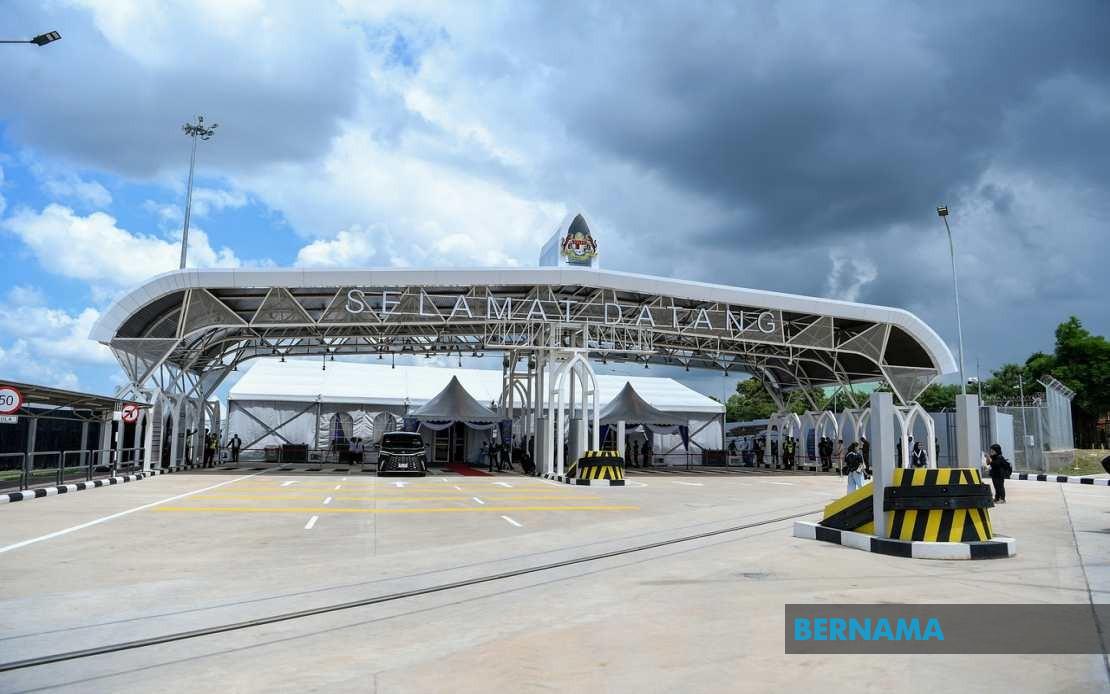
The freshly inaugurated border crossing at Bukit Kayu Hitam-Sadao is already delivering tangible benefits to Malaysia-Thailand trade relationships just weeks into operation. Since opening on July 11, the 900-metre route connecting Kedah's Bukit Kayu Hitam Immigration, Customs, Quarantine and Security Complex with Thailand's Sadao Customs, Immigration and Quarantine facility has fundamentally transformed how logistics and travellers move between the two nations, signalling a significant step forward in regional economic integration.
The project, jointly opened by Thai Prime Minister Anutin Charnvirakul and Malaysian Prime Minister Datuk Seri Anwar Ibrahim on July 10, represents more than ceremonial diplomacy. Within weeks, the infrastructure has nearly eliminated modal shift, with Sadao Customs director Buntoon Oucharoen reporting that close to 100 per cent of commercial vehicles—lorries, buses and vans—have migrated to the new route, abandoning congested pathways that previously characterised the crossing. This wholesale transition reflects genuine operational advantages that shippers and drivers immediately recognised and acted upon.
The acceleration in throughput owes substantially to technological advancement rather than physical expansion alone. The deployment of advanced X-ray inspection equipment branded as "Fast Scan" has achieved a remarkable compression of processing times. Container scanning, which previously demanded up to five minutes per unit, now completes in under a minute. This efficiency gain compounds across thousands of daily crossings. Concurrently, the integration of direct computer-based cargo information systems allows vehicles to proceed without traditional queuing bottlenecks, fundamentally altering the operational mathematics of border crossing logistics.
The volume metrics underscore the crossing's capacity and appeal. Sadao Customs records indicate that the facility now processes more than 1,000 logistics lorries daily, a figure that reflects both the route's technical capability and the pent-up demand for expedited cross-border movement. For regional supply chains dependent on Malaysia-Thailand connectivity—from automotive components to agricultural products—this operational reliability translates into measurable cost reductions and schedule certainty.
The financial impact has been striking. During July 11 to 31, import values through Sadao reached 19 billion baht, equivalent to approximately RM2.35 billion, representing a 58 per cent increase from the 12 billion baht recorded during the corresponding month in 2023. Export figures proved even more dramatic, climbing to slightly over 24 billion baht or roughly RM2.97 billion, nearly doubling the 13 billion baht exported in the prior-year period. These gains emerged within a single month, suggesting that the improved crossing functionality is driving not merely the redistribution of existing trade but the generation of new cross-border commercial activity.
The broader bilateral trade landscape provides important context for these localised gains. Malaysia-Thailand bilateral commerce during the January-to-March 2026 period reached RM31.33 billion in value, compared with RM27.35 billion during the same quarter in 2025. While this represents year-on-year growth, the two governments have articulated an ambition to achieve US$30 billion—approximately RM122.6 billion—in bilateral trade by 2027. The new border crossing, by reducing transaction costs and processing delays, materially improves the feasibility of this target. Each hour saved at the border translates into competitive advantage for exporters and importers, potentially catalysing previously marginal trading partnerships into viable commercial relationships.
Tourist and leisure traffic has equally benefited from the expansion. The new crossing features 11 inbound and 11 outbound dedicated lanes, accommodating the surge in cross-border movement particularly during weekends and public holidays. Sittipong Sitthiphataraprabha, president of the Hatyai-Songkhla Hotel Association, welcomed the infrastructure expansion as facilitating visitor flows. For Thailand's southern tourism economy, enhanced accessibility from Malaysia represents a significant commercial opportunity, particularly given Malaysia's proximity to the crossing and the substantial domestic tourism traffic between the nations.
The timing of this development carries geopolitical resonance beyond mere commercial transaction efficiency. Malaysia and Thailand will commemorate the 70th anniversary of diplomatic relations next year, a milestone underscoring the depth and longevity of bilateral engagement. The Bukit Kayu Hitam-Sadao crossing represents contemporary expression of this enduring partnership, translating political commitment into infrastructure that serves the economic interests of both populations. Both governments have remained explicitly committed to deepening integration through the planned trade target, positioning this crossing as foundational infrastructure for achieving that objective.
From a Southeast Asian perspective, the Bukit Kayu Hitam-Sadao crossing exemplifies the broader regional imperative toward seamless logistics connectivity. As supply chains increasingly organise across borders rather than within them, the ability to move goods swiftly across international frontiers becomes a primary competitive factor. The Fast Scan technology and integrated information systems deployed here represent best practices that regional neighbours may contemplate for their own border infrastructure. The crossing demonstrates that substantial improvements in cross-border efficiency need not require vast capital expenditure or years of construction; strategic technological deployment and process redesign can yield remarkable operational gains within compressed timeframes.
The sustainability of these performance metrics will merit monitoring as the crossing matures beyond its initial operational honeymoon. Seasonal variations, peak travel periods, and evolving regulatory requirements may stress the system in unforeseen ways. Nevertheless, the initial month of operation has established that the crossing possesses genuine technical and operational capacity to justify the governmental investment and political commitment that its creation required.

