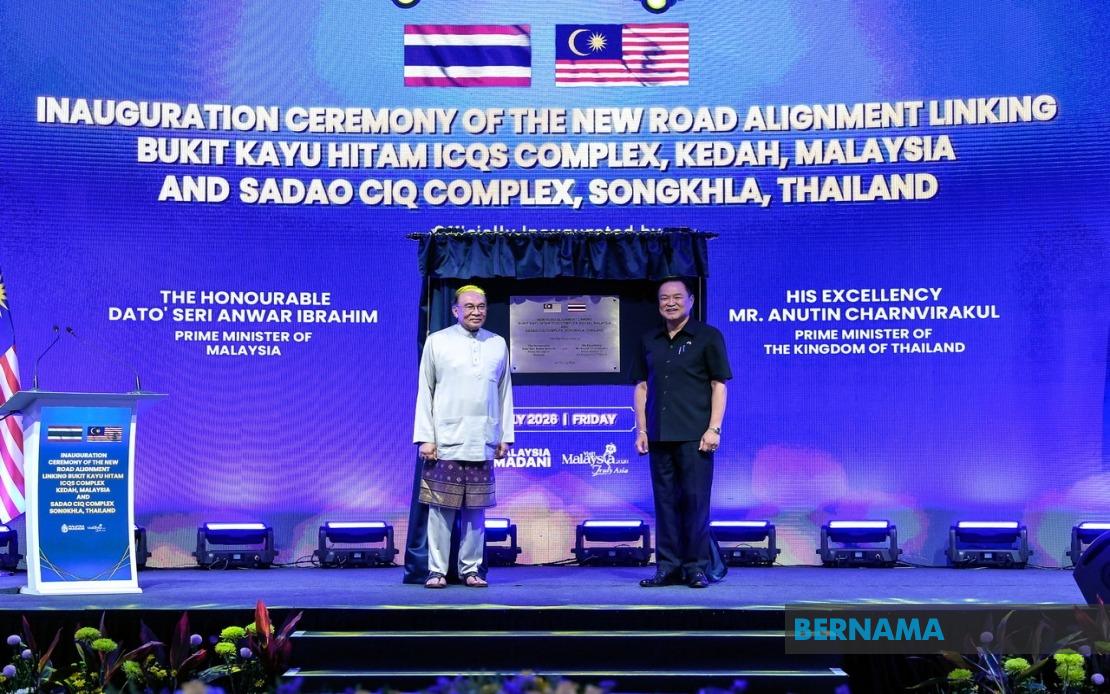
The inauguration of a new road linking Malaysia's Bukit Kayu Hitam Immigration, Customs, Quarantine and Security Complex in Kedah with Thailand's Sadao Customs, Immigration and Quarantine Complex represents far more than a routine infrastructure project. Prime Minister Datuk Seri Anwar Ibrahim, speaking at the ceremony attended by his Thai counterpart Prime Minister Anutin Charnvirakul, framed the initiative as a watershed moment in bilateral relations that could fundamentally reshape the economic landscape of northern Malaysia and southern Thailand.
The symbolic weight of the occasion underscores how both governments are moving beyond conventional diplomatic protocols towards concrete action on shared prosperity. Anwar characterised the venture as part of a deliberate strategy to harness the potential of border regions that have historically been peripheral to national economic centres. Rather than viewing the Malaysia-Thailand boundary as a dividing line, the two leaders are positioning it as a dynamic interface where complementary economies can generate mutual gains through enhanced connectivity and streamlined cross-border operations.
Central to this vision is the establishment of a special economic border zone encompassing northern Peninsular Malaysia—specifically Perlis, Kedah, Kelantan, Perak and Penang—and corresponding provinces in southern Thailand. Such zones, while not unprecedented globally, require sustained political commitment and operational coordination across multiple government departments. Anwar acknowledged that building this framework would demand time and effort, signalling realistic expectations about the implementation timeline while projecting confidence in the shared determination of both administrations.
The improved road infrastructure itself addresses a practical bottleneck in the cross-border trade ecosystem. Smoother physical connections between clearance points reduce delays and transaction costs for transporters and traders, particularly crucial for time-sensitive goods. For Malaysian businesses engaged in regional trade, faster border crossing translates directly into improved competitiveness. Similarly, Thai enterprises seeking market access to Malaysia and beyond benefit from expedited movement of goods and reduced logistics expenses.
Beyond infrastructure, the two governments have committed to accelerating resolution of longstanding procedural obstacles. Customs protocols, immigration procedures, fisheries regulations, and trade classifications have historically created friction points in bilateral commerce. Anwar's statement that both countries resolved in a single day issues that had taken years or decades to negotiate suggests a fundamental shift in diplomatic approach—prioritising pragmatic problem-solving over protracted formal processes. This acceleration could remove significant barriers for small and medium enterprises that lack the resources to navigate complex regulatory mazes.
The ambitious bilateral trade target of USD30 billion by 2027 reflects confidence in these structural improvements. Current trade levels between Malaysia and Thailand, while substantial, leave considerable room for expansion, particularly once border friction decreases. Enhanced cross-border investment flows, greater participation of regional companies in supply chains, and increased tourism and service sector interactions could all contribute to reaching this milestone. For Malaysian companies, particularly those in manufacturing, agriculture, and logistics, Thailand represents both a market and a platform for deeper penetration into broader Southeast Asian trade networks.
The involvement of senior leadership—with Anwar personally attending the launch and Thailand's PM making an official border visit—demonstrates both countries' commitment to regional development beyond major metropolitan areas. Such gestures, while symbolic, carry real significance for communities in Kedah and surrounding northern states that have often felt marginalised in national development narratives. Investment and opportunity flowing from improved cross-border cooperation could address regional disparities that have periodically generated political friction domestically.
For Malaysia's northern corridor specifically, the implications extend beyond trade statistics. Enhanced economic activity in border regions typically stimulates employment, encourages private investment, and creates demand for infrastructure and services. Local businesses gain access to a larger customer base, while workers benefit from expanded job opportunities. Tourism and hospitality sectors could experience particular growth as cross-border movement becomes easier and more attractive.
The special economic zone concept also presents opportunities for coordinated industrial development, potentially attracting investment from third countries seeking to leverage the combined advantages of both nations' strategic positions, labour availability, and market access. Manufacturing clusters focused on sectors aligned with regional supply chains—automotive components, electronics, agro-processing—could emerge as both countries deliberately position their border regions as investment destinations.
Regionally, this Malaysia-Thailand initiative signals a broader pattern among Southeast Asian neighbours recognising that border areas need not be sites of suspicion but can become zones of prosperity. As the region grapples with competition from larger economies and supply chain realignments, the ability of ASEAN members to deepen internal integration offers a strategic advantage. Successful border cooperation between Malaysia and Thailand could serve as a template for other pairings within the bloc.
The commitment to resolving outstanding fisheries and trade issues reflects understanding that sustainable cross-border cooperation requires addressing concerns on both sides. Fisheries disputes, particularly relevant given the maritime boundaries involved, have historically created diplomatic tensions. Demonstrating the capacity to manage such contentious issues through negotiation rather than confrontation strengthens the overall relationship and creates confidence for deeper integration.
The practical impact will ultimately depend on implementation quality. Launching infrastructure and announcing commitments represents the political phase; translating these into functioning mechanisms requires sustained administrative attention, adequate funding, and coordinated capacity-building across both governments. The enthusiasm expressed by both prime ministers suggests momentum exists, but maintaining this through inevitable bureaucratic obstacles will test institutional commitment.
For Malaysia's business community, the moment represents an opportunity to position firms advantageously before enhanced border connectivity fully materialises. Companies operating in sectors benefiting from improved regional connectivity—logistics, manufacturing, retail, financial services—may find the northern corridor increasingly central to strategic planning. The convergence of political will, infrastructure investment, and procedural reform in the Malaysia-Thailand border zone signals that the coming years could bring tangible economic transformation to a region historically positioned on the periphery of national growth strategies.

