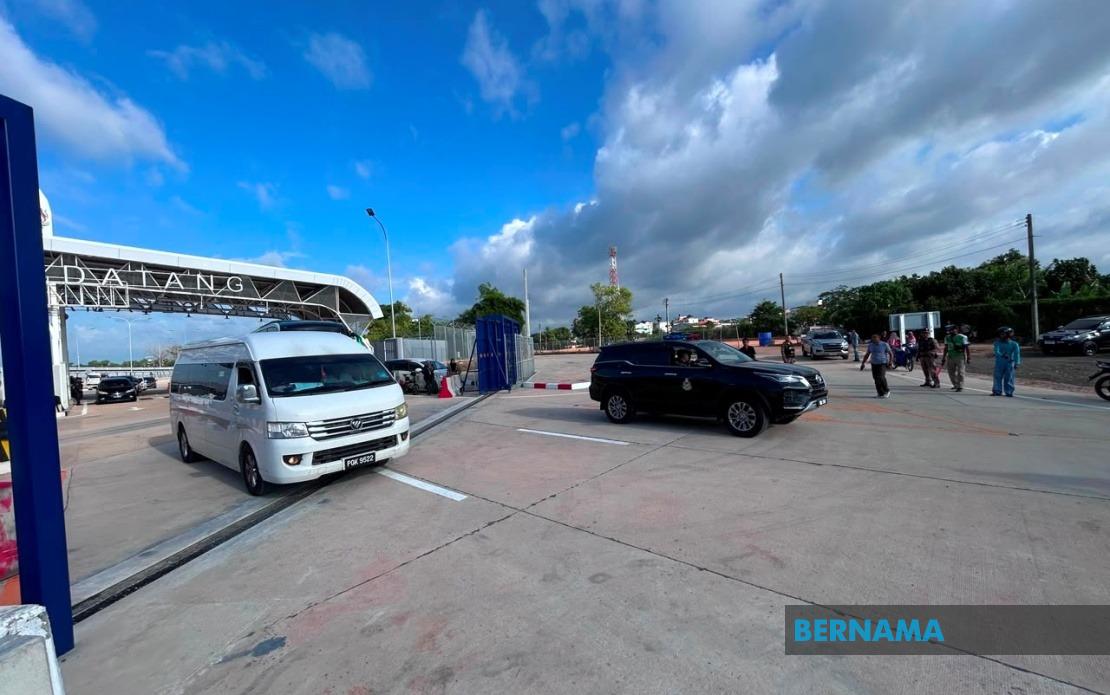
A freshly constructed road linking the Bukit Kayu Hitam Immigration, Customs, Quarantine and Security Complex in Kedah with the Sadao Customs, Immigration and Quarantine Complex in Thailand commenced operations to the travelling public this morning at 6 am, marking a significant milestone in regional transport connectivity. The route's inauguration, which followed an official ceremony led by Malaysian Prime Minister Datuk Seri Anwar Ibrahim and Thai Prime Minister Anutin Charnvirakul yesterday, represents a collaborative infrastructure investment aimed at streamlining one of Southeast Asia's busiest land borders.
Traffic conditions on the inaugural day appeared orderly, with early indicators suggesting the newly opened artery will deliver tangible benefits to the thousands of daily commuters and travellers who depend on this crucial crossing. The project's core objective is to enhance operational efficiency at the border, particularly during high-volume periods such as weekends and school holidays when congestion at the traditional Danok entry point becomes acute. Officials anticipated that by distributing traffic flows across improved infrastructure and separating vehicle categories more effectively, the new route would substantially curtail bottlenecks that have long frustrated both Malaysian and Thai road users.
Motor vehicle operators sampled on the opening day proved enthusiastic about the improvements. Mohd Faizal Ahmad, a 42-year-old traveller from Penang, highlighted how the revised configuration enhanced organisation and reduced friction in the border-crossing experience. He specifically noted that previous school holiday periods had seen severe traffic congestion, and he expressed confidence that the new route would compress transit times and alleviate the frustration passengers typically endured when traversing this stretch. For frequent commuters like Ahmad, such incremental improvements in journey predictability carry genuine practical significance.
Heavy vehicle operators, a constituency with acute interest in border infrastructure, proved equally positive in their initial assessments. Wan Muhammad Shahid Wan Mohd Desa, a 28-year-old lorry driver, elaborated that the newly constructed thoroughfare features wider lanes and implements systematic vehicle categorisation, segregating heavy transport from passenger cars at the Sadao checkpoint. Previously, Desa explained, articulated vehicles originating from the Bukit Kayu Hitam ICQS bound for the Danok crossing shared identical pathways with light traffic, creating compounding congestion as vehicles merged toward the Thai facility. The logical separation of vehicle classes promises substantial relief for freight operators whose commercial schedules depend on reliable transit windows.
The expanded and modernised Sadao CIQ facility itself constitutes a material improvement over its predecessor. Mat Li Daman, a 59-year-old Thai national with extensive experience crossing into Malaysia, characterised the new customs building as markedly more spacious and operationally superior to the cramped checkpoint configuration it supersedes. Enhanced amenities for documentary procedures, including streamlined vehicle entry declaration processes, reduce administrative friction that previously consumed traveller time. Daman's perspective carries weight given his position as a frequent cross-border user with intimate knowledge of both the old and new systems.
The infrastructure project addresses longstanding constraints that have impeded bilateral trade and tourism flows. Malaysia and Thailand both recognise that competitive trade advantages hinge partly on logistics efficiency, and protracted border delays impose measurable costs on commercial operations traversing the Bukit Kayu Hitam-Sadao corridor. By reducing clearance times and improving traffic predictability, the new route removes friction that previously deterred less time-sensitive commerce and discouraged some leisure tourism. For Malaysian businesses exporting goods to Thailand and Thai operators importing Malaysian products, such improvements translate directly into enhanced cost competitiveness.
The initiative reflects broader regional recognition that land border infrastructure requires continuous upgrading as traffic volumes expand and commercial patterns shift. The Malaysia-Thailand border at Bukit Kayu Hitam-Sadao handles not merely bilateral traffic but serves as a gateway for goods and persons transiting through Thailand toward Laos, Cambodia, and Vietnam. As Southeast Asia's economic integration deepens through initiatives like the ASEAN Economic Community, border crossing efficiency increasingly determines competitiveness across the region. Countries investing in seamless cross-border movement gain tangible advantages in attracting transit commerce and facilitating supply chain networks.
For Malaysian travellers, the development carries personal significance beyond mere convenience metrics. The improved infrastructure reduces the anxiety and scheduling uncertainty that previously accompanied border crossings, particularly for families undertaking cross-border journeys during peak periods. Enhanced facilities and clearer traffic management create a more orderly and professional border experience, which indirectly strengthens perceptions of government service delivery and bilateral cooperation. Tourism operators offering Thailand packages can now more confidently project reliable travel times, potentially expanding market demand for cross-border leisure travel.
The Thai government's parallel investment in modernising the Sadao CIQ complex signals commitment to reciprocal infrastructure development that benefits both nations. When major trading partners simultaneously upgrade critical border infrastructure, network effects amplify the benefits beyond what either nation could achieve unilaterally. Thai exporters gain equivalent access to improved Malaysian border facilities, while Malaysian importers benefit from Thailand's enhanced processing capacity. This symmetrical development pattern strengthens the mutual incentives for ongoing cooperation and investment in the bilateral relationship.
Looking forward, stakeholders will monitor whether the traffic distribution benefits materialise as projected, particularly during the approaching school holiday periods and festive seasons when traditional congestion reaches extreme levels. Early assessments suggest the project's architects properly diagnosed the underlying bottlenecks and designed solutions proportionate to the identified problems. However, infrastructure projects often encounter unanticipated usage patterns or secondary congestion points that only emerge once high-volume operations commence. Authorities would be prudent to maintain adaptive management postures, remaining alert to emerging constraints that may require fine-tuning in traffic direction protocols or procedural sequencing.
The opening of the Bukit Kayu Hitam-Sadao road link exemplifies the category of infrastructure investment that generates outsized regional benefits relative to direct financial outlays. By reducing cross-border friction, the project indirectly stimulates trade expansion, tourism growth, and people-to-people connectivity that strengthen the broader Malaysia-Thailand relationship. For Malaysian readers contemplating cross-border travel or commerce with Thailand, the timing of this infrastructure upgrade offers tangible practical benefits that should become increasingly apparent as peak travel periods approach.

