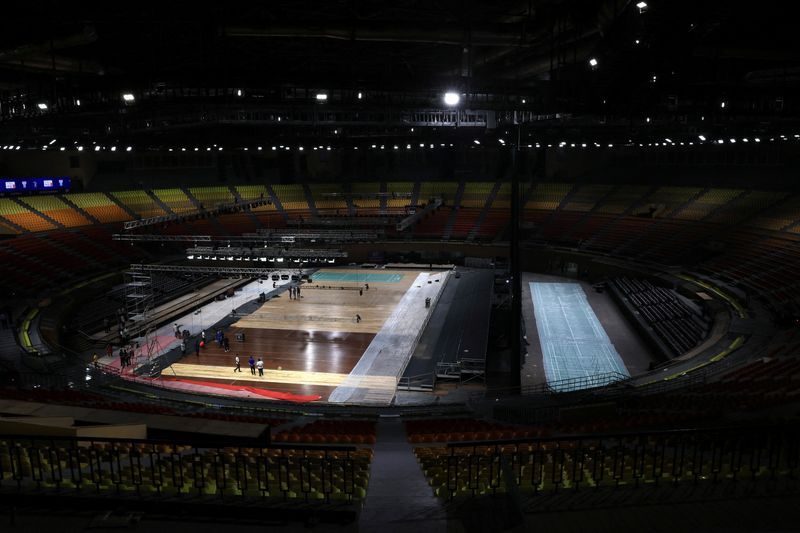
New Delhi's preparations for the Badminton World Championships next week have taken an unconventional turn, with event organisers enlisting a specialized workforce whose primary skill lies in reproducing the vocalizations of langur monkeys. This unusual recruitment strategy reflects a distinctly Indian challenge that has plagued major venues in the capital—the persistent problem of rhesus macaques invading public spaces and disrupting carefully orchestrated events. The deployment of these animal behaviour specialists marks a determined effort by the Badminton Association of India to prevent a repeat of the disruptions that marred the Indian Open earlier this year.
Rhesus monkeys represent one of New Delhi's most persistent urban wildlife challenges. These intelligent and opportunistic primates regularly breach building security, create public safety hazards through unexpected attacks on pedestrians and residents, and show little fear of human presence. Their adaptability to urban environments and large populations have made them virtually impossible to control through conventional means. However, there exists a natural predator-prey dynamic within the primate world that Indian organisers and government agencies have learned to exploit. The langur monkey, considerably larger than the rhesus and distinguished by its striking black face, occupies a position of dominance in the primate hierarchy and represents an effective deterrent that consistently frightens away smaller rhesus populations.
The BAI's decision to hire monkey mimics stems from a particularly embarrassing incident during the Indian Open at the Indira Gandhi Indoor Stadium. A rhesus monkey managed to breach security and was observed roaming freely in the gallery during competition—a security and reputation nightmare for an international sporting event. This breach exposed significant organisational vulnerabilities that threatened the venue's credibility as a world-class facility. The incident prompted serious reflection within the sporting community about how to prevent similar occurrences from undermining the championship event and, by extension, India's broader ambitions on the international sporting stage.
Zafar, one of the hired specialists and a third-generation practitioner of what might be called the ancient art of monkey communication, provided a demonstration of his hooting skills to assembled media representatives during a recent stadium inspection. His technique, refined through generational transmission of knowledge, produces sounds that langur monkeys naturally emit, effectively convincing rhesus populations that a territorial threat exists in the area. Zafar explained his methodology with evident professionalism, emphasizing that the goal is not to harm the unwanted monkeys but simply to convince them to avoid the venue entirely. This welfare-conscious approach reflects evolving Indian attitudes toward urban wildlife management, prioritizing coexistence and deterrence over more aggressive animal control measures.
Beyond the monkey situation, organisers confront a second major animal-related challenge that previously disrupted competition at the same venue. An overabundance of pigeons throughout New Delhi has created hygiene and operational difficulties that directly affected play during the Indian Open. On at least two occasions, matches were halted after pigeons defecated on the court surface, prompting health concerns from players and umpires alike. The aesthetic and sanitary problems created by uncontrolled pigeon populations posed genuine threats to the professional standards expected at a world championships event. Addressing this secondary problem became equally essential to organisers' comprehensive preparation strategy.
To combat the pigeon menace, facility managers have implemented a systematic approach employing non-toxic deterrent gels commonly used on railway infrastructure throughout India. These substances have been strategically applied across the stadium's roof systems and internal duct work where pigeons typically roost and nest. The gels create uncomfortable perching surfaces that discourage birds from settling without inflicting harm, aligning with the same humane animal management philosophy applied to the monkey problem. Such comprehensive environmental modifications demonstrate the level of detail that event organisers consider necessary to meet international standards for sporting facilities.
Sanjay Mishra, serving as secretary general of the Badminton Association of India, provided confident reassurance that lessons learned from the Indian Open have been thoroughly incorporated into preparations for the world championships. He noted that substantial investments by the sports ministry have upgraded various aspects of the facility, addressing identified deficiencies in infrastructure and operational procedures. The Badminton World Federation, the international governing body overseeing the championship, has reportedly expressed complete satisfaction with the arrangements and preparedness demonstrated by Indian organisers. This vote of confidence from the global federation suggests that the multi-faceted approach to facility management has successfully addressed previous concerns.
These preparations carry significance well beyond the immediate badminton championship. India has committed to hosting the 2030 Commonwealth Games and is actively campaigning for the 2036 Olympic Games. The badminton world championships therefore represent a crucial opportunity to demonstrate organisational competence, international-standard facility management, and problem-solving capability to the global sporting community. How India handles the comprehensive challenges posed by this event—from primate management to pigeon control—will directly influence perceptions of its ability to successfully deliver far larger and more complex multi-sport competitions. The apparent small-scale concern of monkey whisperers thus connects directly to India's larger strategic interests in the competitive international arena for hosting major sporting events.
For Southeast Asian observers and sports administrators, New Delhi's approach to these venue management challenges offers both practical lessons and broader cultural insights. The hiring of specialist monkey mimics represents an entirely legitimate adaptation to genuine local environmental conditions that cannot be simply ignored or engineered away. Rather than viewing the solution as unusual or unorthodox, it demonstrates pragmatic acceptance of regional context and creative deployment of local knowledge. As other countries in the region prepare to host major international events, similar ecological and urban wildlife challenges may require equally unconventional solutions grounded in deep understanding of local conditions and traditional management techniques that predate modern stadium construction.
The badminton world championships ultimately represent far more than a sporting competition. They serve as a comprehensive test of India's capacity to manage complex operational and environmental challenges while maintaining the professional standards and safety expectations demanded by international governing bodies and global audiences. The monkey whisperers hired for this event, whatever the international media makes of their unusual role, constitute an essential part of India's detailed preparation strategy. Their presence in the stadium galleries next week will be a quiet testament to sophisticated event planning that bridges modern sports management with pragmatic adaptation to local environmental realities.

