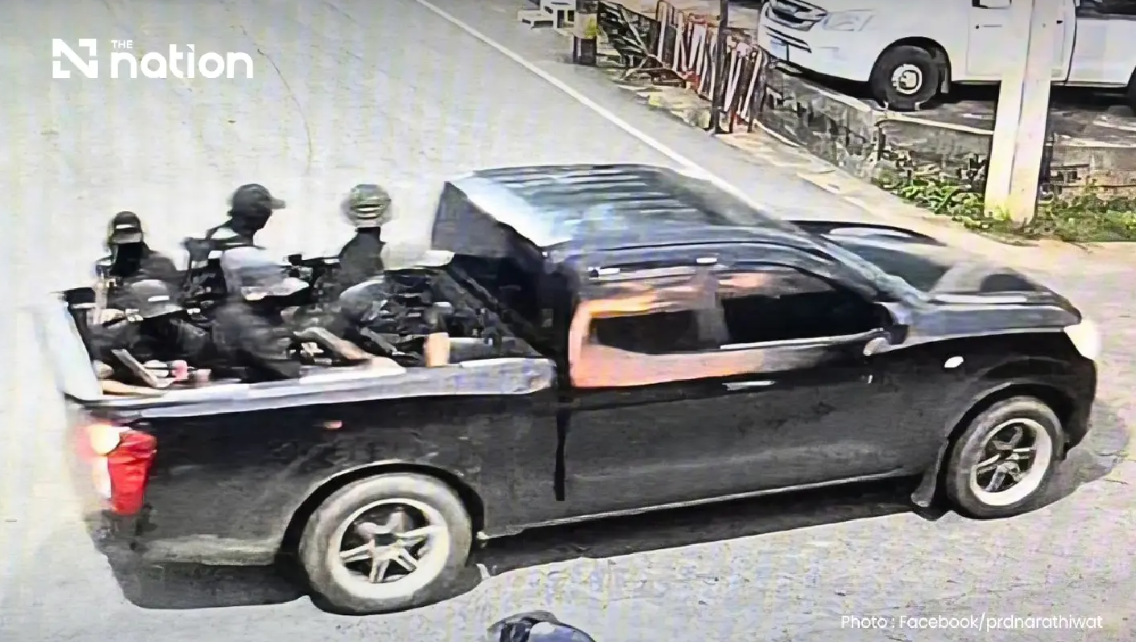
A coordinated assault on a paramilitary checkpoint in Thailand's restive southern province of Narathiwat has claimed five lives and wounded six others, according to CCTV footage that captured the entire operation's brutal efficiency. The attack unfolded at the Bukeh Sami checkpoint in Village 7 of Tanyong Mat subdistrict on the evening of July 22, striking what security officials believed would be a routine patrol post manned by the 4509th Ranger Company.
Surveillance cameras initially suggested a smaller operation, with early investigators estimating six perpetrators were involved. However, detailed review of footage from multiple angles revealed a more substantial force of nine attackers operating in two distinct tactical groups. This coordinated structure suggests planning beyond spontaneous violence, pointing to an organised militant operation rather than opportunistic gunfire. The composition and execution indicate tactical training and familiarity with checkpoint procedures, raising questions about intelligence networks in the region.
The assault force deployed two vehicles in a carefully choreographed approach. A black Nissan pickup truck registered in the neighbouring province of Songkhla served as the primary assault platform, carrying six armed operatives in its bed alongside the driver. These attackers dressed in black clothing styled to resemble paramilitary uniforms, complete with broad-brimmed hats designed to obscure facial features and complicate identification efforts. Behind them, a red-and-white Honda Wave motorcycle provided rear security and support, with its rider armed with an 11mm pistol and carrying papers indicating white-shirt attire, while the passenger—disguised in a black women's hijab—wielded an AK-pattern rifle. The disguise chosen for the motorcycle passenger suggests deliberate deception tactics and an awareness of surveillance possibilities.
As the convoy approached from Tanyong Mat market, three rangers stationed at the roadside perimeter became the initial targets. When the pickup slowed to position itself, gunfire erupted from the truck bed as operatives unleashed sustained bursts from M16 and AK-type rifles. The rangers fell almost immediately, their positions offering minimal cover against the concentrated fire. The assault then intensified as several attackers dismounted and maintained fire toward the checkpoint's fortified bunker, where two additional rangers attempted to mount a defence. The bunker's walls would later show extensive bullet scarring, testimony to the ferocity of the incoming rounds.
Once the initial defence collapsed, the attackers methodically searched the checkpoint facility, gathering weapons and tactical equipment before withdrawing. As they retreated toward their vehicles, one operative hurled a pipe bomb toward an elevated structure near a nearby bridge, adding explosive force to an already devastating assault. The entire operation—from initial approach to final withdrawal—consumed merely 90 seconds, demonstrating exceptional coordination and predetermined timing. The pickup and motorcycle then fled toward Dusongyo subdistrict in Ra-ngae district, leaving behind a scene of carnage and tactical questions for investigators.
The five rangers killed in the assault have been formally identified as Sergeant Major First Class Theerayut Somakerd and ranger volunteers Sakiriya Jena, Wimon Dabthong, Nattasit Kaewsena, and Salahuding Pi. Their deaths represent a significant loss to Thailand's counterinsurgency operations in the Deep South, where ranger units form a crucial frontline against militant activity. Beyond the fatalities, six civilians sustained injuries, including a 10-year-old child, emphasizing the broader community impact of such violence. Initial reports provided conflicting casualty figures ranging from two to five injured civilians, a discrepancy later clarified as the actual tally reached six.
Forensic examination of the scene proved exhaustive, with Narathiwat Governor Boonchuay Homyamyen coordinating oversight alongside senior security officials including Provincial Police Region 9 Commissioner Pol Lt Gen Piyawat Chalermsri, Narathiwat Police Chief Pol Maj Gen Prayong Khot Sakha, and Col Witthaya Sariya commanding the 45th Ranger Regiment Task Force. Bomb-disposal technicians, tactical police units, and forensic specialists worked through the night collecting evidence and reconstructing the assault sequence. More than 100 spent cartridge cases lay scattered across the road, with ammunition types matching M16 rifles, AK-pattern weapons, and the 11mm pistol employed by the motorcycle operator. Investigators also discovered ammunition apparently ejected when attackers cleared weapon malfunctions—a detail suggesting the intensity of fire and possible mechanical complications during combat.
The material losses inflicted upon security forces underscore the attack's planning sophistication. Attackers succeeded in securing four folding-stock AK-type rifles, one 11mm pistol, four ammunition magazines, and four bulletproof vests. The apparent theft of protective equipment carries particular significance, as it suggests either future operational planning or an intent to equip additional operatives. Authorities faced challenges in confirming the complete inventory due to conflicting early accounts about item numbers and specifications, complicating both investigative efforts and understanding of militant capability expansion.
Attempts to destroy evidence pointed toward operational awareness of forensic procedures. The black Nissan pickup employed in the assault was subsequently located abandoned and deliberately incinerated, presumably to eliminate fingerprints, trace evidence, and forensic markers that might identify individual perpetrators. Security forces rapidly established checkpoints and roadblocks along probable escape corridors, yet the attackers achieved sufficient distance to dispose of their primary vehicle. The destruction of the pickup reflects tactical maturity beyond simple violence—these operatives understood that vehicle forensics could trace their movements and identities.
The Narathiwat attack carries significant implications for Thailand's broader security posture in the Deep South, a region plagued for nearly two decades by an asymmetric conflict claiming thousands of lives. The assault's sophistication, coordination, and successful execution against a fortified military position suggest militant groups maintain organisational capacity despite counterinsurgency efforts. For Malaysia and other Southeast Asian nations, the incident underscores transnational security concerns, particularly regarding weapons acquisition, cross-border movement, and operational planning capabilities among southern Thai insurgent networks. Regional governments monitor such developments carefully, recognising that instability in Thailand's southernmost provinces can generate refugee flows, weapons trafficking, and extremist recruitment affecting neighbouring countries.
The tactical lessons evident in this assault—the use of disguises, coordinated multi-vehicle approaches, precision timing, and deliberate targeting of security infrastructure—represent a concerning evolution in militant methodology. The fact that nine trained operatives could overcome a fortified checkpoint despite ranger presence raises uncomfortable questions about force deployment, reaction times, and intelligence collection in the region. Authorities face mounting pressure to prevent similar incidents while gathering sufficient evidence to pursue prosecutions, a balance that has proven elusive throughout the Deep South conflict. The investigation continues as officials attempt to identify the nine attackers and determine whether the assault represents escalation by established militant groups or emergence of new operational cells.

