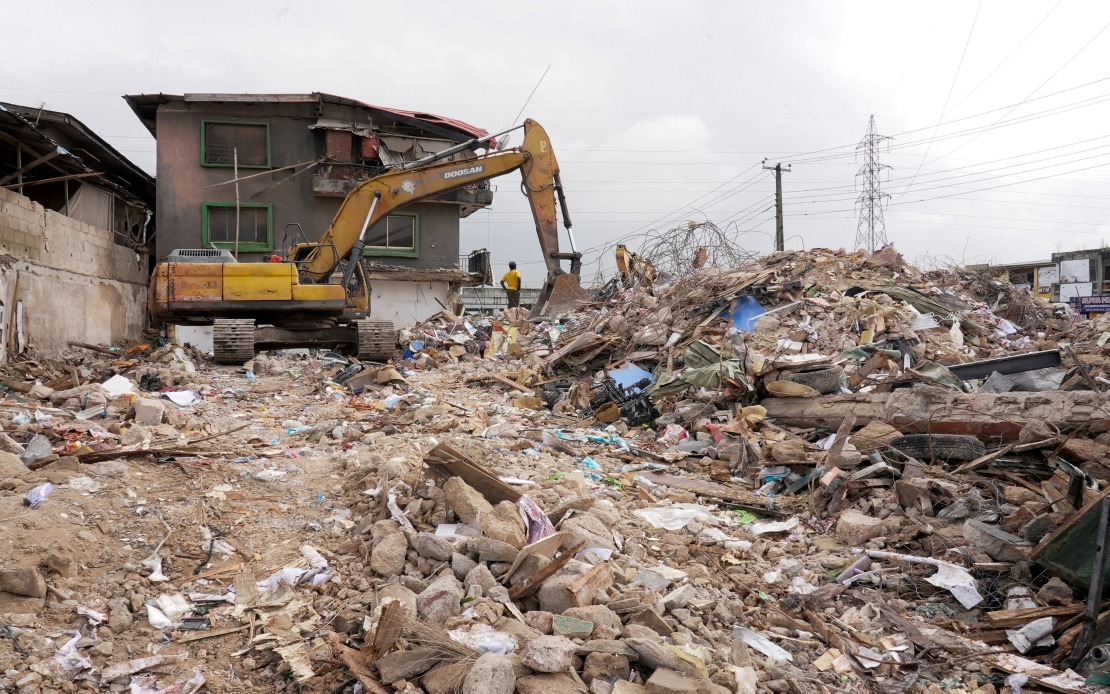
A three-story shopping complex in Alakija, a developing commercial hub along the Lagos-Badagry Expressway in Nigeria's southwestern Lagos state, collapsed on Thursday morning, claiming nine lives and prompting an urgent multi-agency rescue response that continued through the night. By Friday, as rescue operations concluded, authorities confirmed that 27 people had been successfully extracted from the rubble, many requiring medical attention for injuries sustained in the disaster.
The sudden structural failure trapped a mixture of shop proprietors, their customers who were conducting business when the building gave way, and nearby residents whose homes bordered the commercial space. Olufemi Oke-Osanyintolu, permanent secretary of the Lagos State Emergency Management Agency, reported that emergency teams worked continuously without rest to locate survivors beneath the concrete and metal debris, employing heavy machinery and careful manual excavation to avoid further casualties among those still trapped.
Rescue personnel transported all 27 survivors to medical facilities across Lagos for treatment of varying injury severities. The evacuation process proved challenging given the volume of structural debris and the risk of secondary collapses, requiring coordination between multiple government agencies and private sector participants. Notably, the China Civil Engineering Construction Corporation, actively engaged in a railway infrastructure project in the surrounding area, mobilized its own equipment and personnel to assist in the recovery effort, demonstrating the importance of inter-organizational cooperation during such emergencies.
For Malaysian readers familiar with Southeast Asia's construction landscape, the incident underscores a troubling pattern affecting multiple developing nations in the region. Nigeria has experienced a recurring cycle of building failures over recent years, each prompting renewed questions about regulatory enforcement and structural integrity standards. These collapses typically occur in urban areas experiencing rapid informal expansion, where profit incentives often override safety considerations in the construction phase.
Engineers and building safety experts consistently point to three primary culprits behind Nigeria's structural failures: buildings that have aged significantly without proper maintenance or reinforcement, systematic disregard for established construction codes during the planning and execution phases, and the deliberate use of substandard materials to reduce costs. Each factor independently compromises safety; together they create conditions for catastrophic failure. The Alakija collapse appears to follow this familiar trajectory, though investigators have not yet released findings on the specific cause.
Authorities initiated a formal investigation into the circumstances surrounding the complex's collapse, with preliminary examinations suggesting defects in either design, material quality, or construction methodology. Lagos State officials have pledged to determine whether negligence, corruption in the permitting process, or structural defects precipitated the disaster. Such investigations often reveal complex chains of responsibility extending from developers and contractors through municipal oversight bodies, with accountability remaining elusive in systems where enforcement mechanisms are inconsistent.
The timing of the collapse—during business hours when the complex was fully occupied—amplified the human cost of the structural failure. Had the building given way during off-hours, the death toll would likely have been substantially lower. This element of chance highlights why building code enforcement matters urgently in rapidly developing urban areas where pedestrian traffic and commercial activity concentrate in aging or poorly constructed facilities.
For the broader West African context and implications for other developing economies, the Alakija incident reinforces the necessity for coordinated approaches to construction standards and inspections. While Lagos has undertaken various building safety initiatives in recent years, implementation gaps persist, particularly in informal settlements and rapidly expanding commercial districts. The involvement of Chinese construction firms in infrastructure projects creates additional opportunities for knowledge transfer and adoption of international best practices, though such cooperation requires active government facilitation.
Malaysia's own experience with building regulations, particularly following incidents like the Muar collapse in 2009, demonstrates that even middle-income nations require constant vigilance. The regulatory framework established under Malaysia's Street, Drainage and Building Act provides mechanisms for inspection and enforcement, yet lapses continue to occur when developers or contractors prioritize cost reduction over compliance. Nigeria's challenges reflect an earlier stage of development where institutional capacity for consistent enforcement remains limited.
The rescue operation's successful conclusion, with all trapped individuals located and evacuated within approximately 24 hours, suggests that Lagos possesses adequate emergency response capabilities despite broader systemic construction deficiencies. The coordination between government agencies and private sector organizations like the China Civil Engineering Construction Corporation demonstrated pragmatic crisis management. However, preventing future collapses requires upstream interventions targeting building design approval, material certification, and construction site oversight rather than relying solely on reactive emergency response.
Looking forward, the Alakija collapse will likely generate political pressure for regulatory tightening in Lagos, though whether such pressure translates into sustained enforcement remains uncertain. The cycle of disaster, investigation, temporary heightened scrutiny, and subsequent lapse into complacency has characterized Nigeria's approach to building safety for decades. Breaking this pattern requires sustained commitment to institutional development and professional standards that extend beyond individual political cycles.
For investors and businesses monitoring West African infrastructure, the incident underscores the importance of due diligence regarding facility conditions and construction quality in regions with developing regulatory frameworks. Companies operating in or considering expansion into Lagos must account for elevated structural risk when occupying older commercial buildings and ensure comprehensive insurance coverage. The disaster serves as a cautionary reminder that rapid urbanization without corresponding investment in regulatory infrastructure creates genuine dangers for residents and workers who depend on structural reliability for their daily safety.

