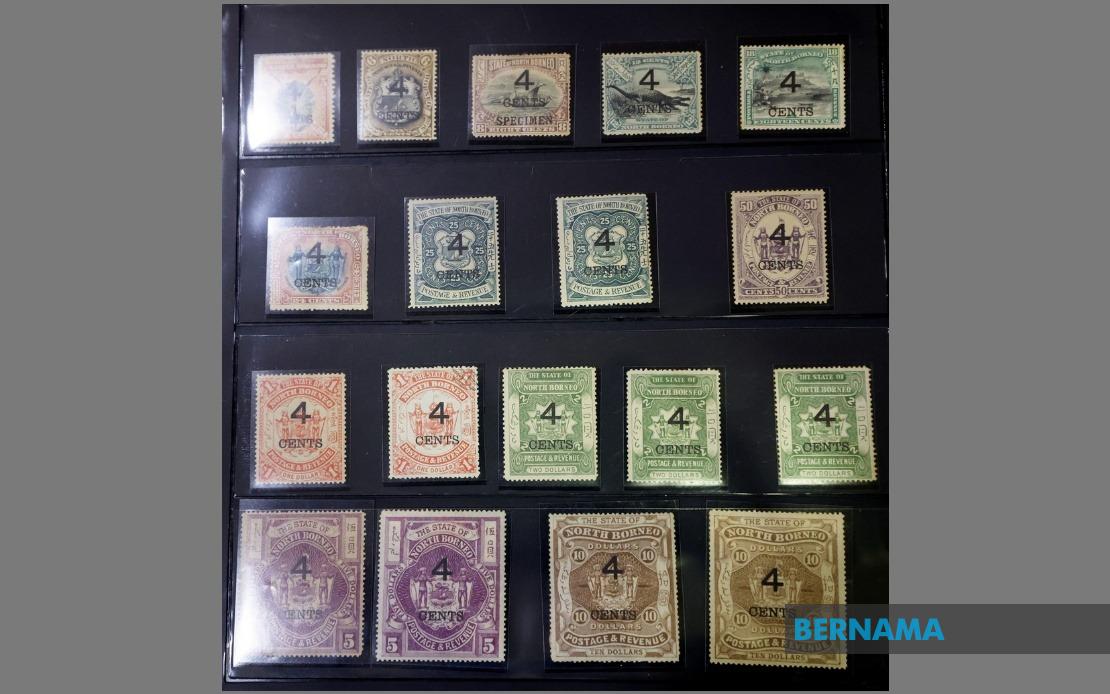
The race to preserve North Borneo's philatelic heritage has taken on fresh urgency in Kota Kinabalu as these remarkable postal artifacts—some dating back to 1883—become increasingly scarce and expensive to acquire. The challenge extends beyond mere collection; it represents a broader mission to ensure that the stories embedded within these stamps, which document Sabah's transformation across different colonial administrations, do not fade into obscurity as digital communication renders physical mail nearly obsolete.
Dr Shari Jeffri, 56, founder and president of the Borneo History Association, frames these collectibles as far more than aesthetic objects or investment pieces. He describes the philatelic materials issued between 1883 and 1963 as a "living archive"—repositories of visual and postal information that must be transmitted carefully to succeeding generations. Yet this transmission faces mounting obstacles. Contemporary enthusiasm for stamp collecting has contracted dramatically compared to earlier decades, with only a dedicated minority maintaining active engagement in the hobby, according to Jeffri's observations.
Field surveys conducted around Kota Kinabalu's antique retail sector reveal the practical dimensions of this preservation challenge. Dealers consistently report difficulty sourcing authentic North Borneo stamps, and asking prices have climbed substantially as scarcity compounds desirability. The market value of individual pieces fluctuates considerably based on issuance date, physical condition, and rarity—variables that require expertise to assess accurately. One notable discovery during recent surveys included an album containing a six-cent stamp from the 1954–1961 period depicting Queen Elizabeth II alongside a Dusun woman, alongside a ten-cent denomination illustrating logging scenes.
Jeffri's personal trajectory illuminates how philatelic passion develops and transfers within families. He inherited much of his collection from his grandfather, who worked at the Recreation Club Jesselton during the 1920s. That ancestor's exposure to British colonial officers—for whom stamp collecting represented a standard leisured pursuit—sparked his own collecting instincts, eventually creating a chain of knowledge spanning three generations. Jeffri himself encountered stamps at age seven but only matured into a serious collector during secondary school, alongside peers who shared similar enthusiasms. This progression, now becoming rarer, illustrates how cultural practices become attenuated when transmission between age cohorts weakens.
Among Jeffri's most treasured holdings are two two-cent stamps from the inaugural 1883 North Borneo issue, identifiable by their brown sailing boat design and bearing period-appropriate postal cancellations. For serious collectors, he explains, an 1883-issue example remains essential to any comprehensive collection, elevating these stamps beyond their utilitarian function as postage prepayment into historical documents capturing specific moments and places. Each denomination and variant becomes a chronicle of its era, recording not merely commercial transactions but the administrative, social, and economic realities of the territories where they circulated.
The British North Borneo Chartered Company introduced these stamps in 1883, maintaining their use for approximately fifty-two years before later administrative transitions altered the postal system. Design evolution tracks observable shifts in how colonial authorities wished to represent the territory to the world. Early issues featured symbolic imagery—lions, boats, and tigers—until around 1892, when designs increasingly shifted toward indigenous flora, fauna, and wildlife representations. A particularly significant redesign in 1935 introduced stamps that more explicitly emphasised Sabah's distinctive identity through their visual language. The denominations expanded progressively from humble two-sen values to one-dollar pieces, reflecting expanding economic activities and correspondence networks.
Authentication and preservation present technical challenges that separate serious collectors from casual enthusiasts. The composition of stamp paper itself—particularly the presence and quality of adhesive backing—provides crucial clues to verify genuineness and determine historical provenance. Complete postal cancellations, including legible postmarks showing dates, office names, and locations, render specimens far more valuable and scientifically useful than examples bearing faint or incomplete markings, since they provide verifiable documentation of historical postal operations. Stamps lacking such postal information remain inherently less informative, though still collectible.
Jeffri has pursued advanced expertise to evaluate philatelic authenticity, consulting with Singapore-based specialists Voon Kyam Foh and Tan Chun Lim while developing familiarity with authoritative reference catalogues including Commonwealth & British Empire Stamps. This methodical approach reflects growing recognition that preservation transcends casual accumulation; it demands rigorous standards ensuring that items remain intact and properly documented for future researchers. Storage itself requires vigilance—acid-free albums prove essential to prevent oxidation and deterioration that would render specimens scientifically compromised within decades.
The broader preservation imperative reflects a peculiar paradox: as postal communication transitions inexorably toward electronic transmission, the physical artifacts from the postal era acquire heightened historical significance. North Borneo stamps become invaluable witnesses to Sabah's journey through various colonial frameworks, administrative transitions, and economic transformations. Their designs, denominations, circulation dates, and usage patterns collectively constitute a material record that complements and sometimes corrects written histories. Without deliberate conservation efforts and intergenerational knowledge transfer, this documentary resource risks fragmentation and loss.
The challenge facing institutions and collectors involves reversing the declining trajectory of philatelic engagement among younger Malaysians. Educational initiatives connecting stamps to regional history rather than treating them as isolated collectibles might broaden appeal beyond traditional enthusiasts. Digital technologies could support preservation efforts while simultaneously democratizing access, allowing researchers and students to study high-resolution images without risking originals. Museums, universities, and heritage organizations could establish dedicated collections with proper climate control and expertise, ensuring that Sabah's postal heritage survives not merely as scattered private accumulations but as coherent institutional archives available for scholarship and public understanding.

