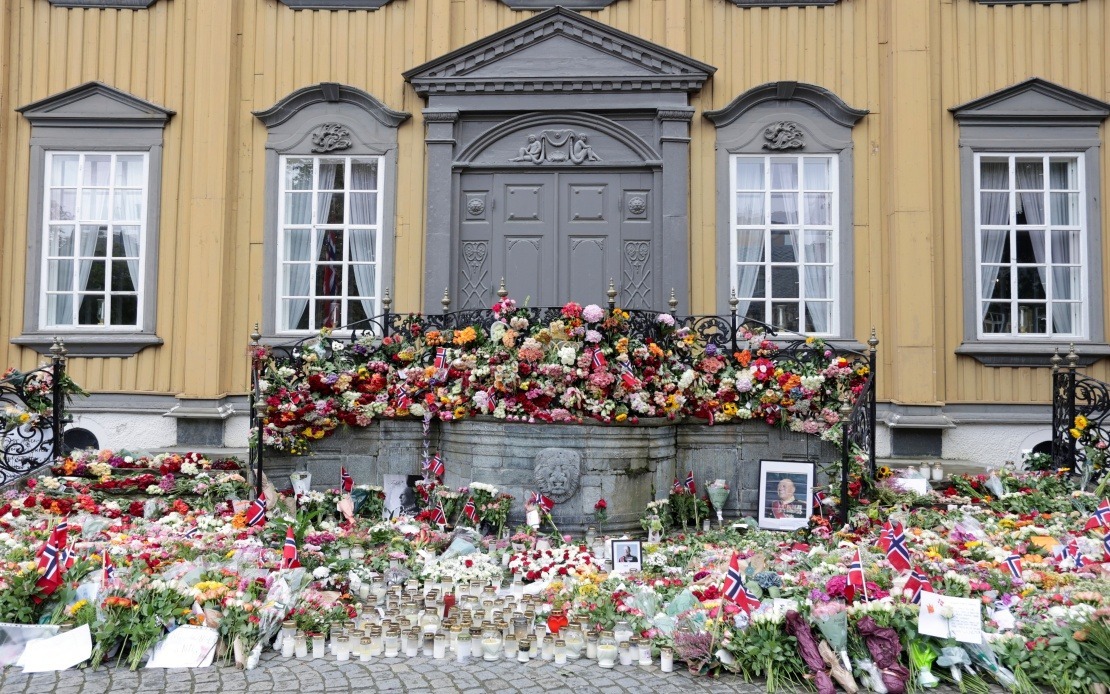
Norway came to a standstill on Sunday as the Nordic kingdom observed nationwide memorial services honouring King Harald V, the longest-reigning Norwegian monarch who died on Friday aged 89. Across Oslo and towns throughout the country, churches and cathedrals opened their doors to accommodate the outpouring of public grief, with tens of thousands of citizens gathering to pay their final respects to a figure who had shaped the nation's identity for nearly seven decades. The Norwegian Royal House confirmed that the state funeral will be held on September 9, providing a formal occasion for the country to bid farewell to its beloved sovereign.
The scenes witnessed at religious institutions and the Royal Palace in the Norwegian capital reflected the deep affection Norwegians held for their king. Outside the palace gates in Oslo, mourners created spontaneous memorials, laying flowers, lighting candles, and leaving handwritten notes expressing their grief and gratitude. These touching tributes underscored the personal connection many citizens felt with Harald V, who had reigned since 1991 and represented continuity and stability throughout decades of social and political change. The diversity of those paying respects—from elderly citizens who remembered his coronation to young Norwegians who had known no other monarch—demonstrated the breadth of his influence across generations.
Harald V's death marks the end of an era in Scandinavian monarchy. His reign had witnessed Norway's transformation into one of the world's wealthiest nations through petroleum wealth management, and he had presided over the country's evolution as a modern, progressive democracy. The monarch had been a symbol of Norwegian identity and values, embodying the nation's traditions while adapting the royal institution to contemporary expectations of accessibility and informality that Norwegian culture favours. His passing at an advanced age was not entirely unexpected given his years, yet it still shocked a nation accustomed to his steady presence.
Under Norway's constitutional succession laws, the transition of power occurred immediately and without ceremony. Harald V's eldest son, aged 53, automatically assumed the throne upon his father's death, adopting the regnal title Haakon VIII. This seamless transfer of authority represents the functioning of Norway's well-established monarchical system, wherein the rules of succession are clearly defined and widely accepted. The new king's accession ensures continuity of the institution and provides Norwegians with a sense of institutional stability during a time of national grieving.
The appointment of Haakon VIII signals the beginning of a new chapter for the Norwegian Royal House. As a middle-aged monarch assuming power, he brings his own perspective and approach to the role, having spent decades in public service and maintaining an active presence in Norwegian civic life. The transition from a 89-year-old king to one in his early 50s may also reshape how the monarchy engages with contemporary challenges, including climate concerns, technological change, and evolving social values that particularly resonate with younger demographics.
For Malaysia and other Southeast Asian nations, Norway's orderly succession provides a contrasting model of institutional stability. While Malaysia has experienced its own royal transitions and succession debates, Norway's constitutional clarity and public acceptance of the succession process offer insights into how monarchies can maintain legitimacy and public confidence. The Nordic country's approach emphasises the rule of law and constitutional precedent, elements that strengthen democratic institutions across different systems of governance.
The forthcoming state funeral on September 9 will serve as a formal moment for Norway to collectively process its loss and celebrate Harald V's legacy. Such ceremonies typically draw international delegations and provide opportunities for reflection on the departed leader's contributions. For the Norwegian people, the funeral will represent both an ending and a beginning—a chance to honour their late king while formally welcoming his successor and the renewed chapter ahead.
Harald V's long reign had witnessed Norway navigate major international events, from the Cold War's conclusion to the post-9/11 era, membership in the European Economic Area, and the emergence of global environmental concerns. Throughout these transformations, the monarchy remained a stabilising force, and the king personally engaged in diplomatic endeavours that reinforced Norway's standing among nations. His death closes a significant chapter in modern Norwegian history.
The widespread public mourning observed across Norway on Sunday demonstrated that monarchies, even in egalitarian societies like Norway, retain deep symbolic significance for their citizens. The spontaneous memorials and large gatherings at religious institutions were not obligatory displays but genuine expressions of loss from a populace that had developed genuine affection for their king. This phenomenon reveals how national symbols transcend partisan politics and unite people across social divisions, a function that monarchies continue to serve in modern democracies.
As Norway enters the period leading to the state funeral, the nation will likely see continued reflections on Harald V's impact on the country. Media outlets, historians, and public figures will examine his most significant contributions, whether to constitutional matters, national unity, or Norway's international relationships. Simultaneously, attention will gradually shift toward Haakon VIII and the priorities he may pursue as the new monarch, ensuring that the institution remains relevant and responsive to contemporary Norwegian society.

