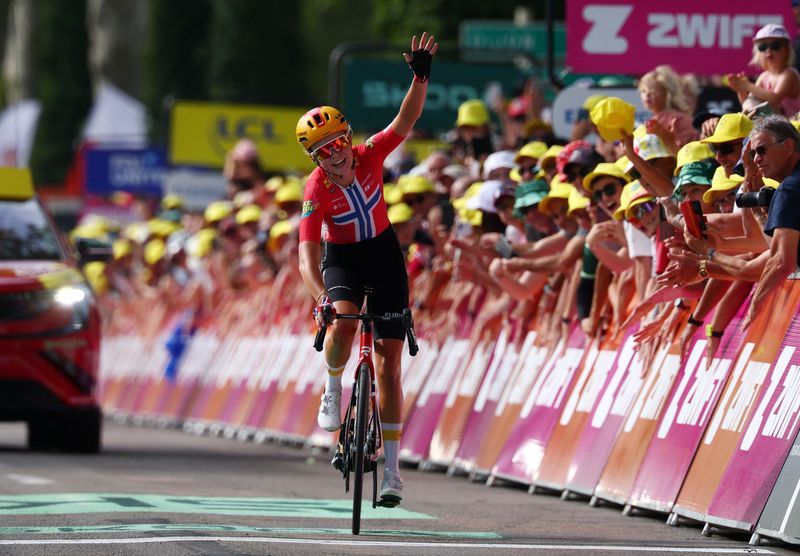
Sigrid Haugset etched her name into cycling history on Monday when the 27-year-old Norwegian rider powered to a dramatic solo victory at the Tour de France Femmes, surpassing the celebrated Lotte Kopecky of Belgium in a gruelling battle across demanding French terrain. The Uno-X Mobility team member's triumph represents a watershed moment for Norwegian women's cycling, marking the first time a rider from the Scandinavian nation has claimed a stage win in the Tour de France Femmes, and more significantly, securing the prestigious yellow jersey that denotes overall race leadership. Haugset's emotional victory thrust her into genuine contention for the coveted title, establishing a commanding advantage of two minutes and 22 seconds over Kimberly Le Court of Mauritius heading into the remaining stages.
The stage unfolded across 156.5 kilometres of increasingly challenging terrain as the race ventured into the alpine foothills for the first time, presenting riders with formidable climbs that would ultimately decide the outcome. Early in the proceedings, as the peloton tackled the category one-ranked Col de la Faucille, chaos erupted when multiple riders found themselves on the tarmac following a significant crash. The incident claimed several notable casualties, including reigning world champion Magdeleine Vallieres and Demi Vollering, a former Tour de France champion, though both managed to remount and continue competing. The dramatic tumble set the tone for a day defined by unpredictable developments and the thin margins separating success from disappointment at cycling's highest level.
What distinguished Haugset's performance was not merely her physical prowess but rather her tactical acumen and extraordinary mental resilience under mounting pressure. As the bunch reorganised following the crash, the Norwegian seized the initiative during the subsequent ascent to Col de la Savine, establishing a decisive breakaway that would ultimately prove insurmountable. Kopecky, seeking to defend her podium position and challenge for victory, launched a counterattack shortly after the race's midpoint, narrowing the gap with remarkable persistence as both riders pushed through the suffering inherent in professional cycling. The Belgian's pursuit tested Haugset repeatedly, bringing the gap down to merely ten seconds with just ten kilometres remaining, seemingly signalling an impending reversal of fortune.
Yet Haugset discovered reserves of determination precisely when they mattered most, summoning a final explosive effort that decisively extended her advantage over Kopecky to nearly one minute with three kilometres remaining. The Norwegian's ability to respond when it appeared her lead might evaporate demonstrated the mental fortitude demanded of elite cyclists competing at the Tour de France, where tactical execution and psychological strength prove equally important as aerobic capacity. Kopecky ultimately crossed the finish line in Poligny more than 84 seconds adrift, a substantial margin in professional cycling terms that underscored Haugset's superiority on the day. Marianne Vos of the Netherlands completed the podium in third place, rounding out a stage that produced meaningful changes in the overall race standings.
Haugset's achievement carries particular significance within the broader context of Scandinavian cycling. Norway has produced numerous world-class cyclists across multiple disciplines, yet the nation's women had never previously achieved stage victory at the Tour de France Femmes since the race's inception in 2022. The psychological barrier of becoming the first Norwegian woman to claim the yellow jersey elevates Haugset's accomplishment beyond mere statistical achievement, positioning her as a potential inspiration for future generations of female cyclists throughout the Nordic region. Her breakthrough performance on Monday illustrated that Norwegian talent in women's professional cycling possesses the capability to compete at cycling's most prestigious platform.
The overall classification now reflects Haugset's commanding position, though the race format remains sufficiently unpredictable that subsequent stages could dramatically alter the trajectory. Le Court, from the African island nation of Mauritius, holds the second position nearly two and a half minutes behind, while other pre-race contenders have seen their overall aspirations substantially diminished by Haugset's decisive action. The establishment of such a substantial lead this early in the three-week competition suggests that the Norwegian has fundamentally altered the race's narrative, though professional cycling has repeatedly demonstrated that no advantage proves insurmountable until the final stage concludes in Paris.
In the aftermath of her triumph, Haugset reflected upon the emotional intensity of the experience, acknowledging that her own self-doubt nearly cost her the victory. During the stage itself, she considered yielding to Kopecky's pursuit, recognizing that a second-place finish would constitute a respectable outcome for any cyclist on their opportune day. However, contemplating the support awaiting her back home in Norway, Haugset resolved to maintain her effort, to push through the physiological agony that characterises competitive cycling at the professional level, and to seize the opportunity before her. Her reflective comments after crossing the finish line demonstrated the psychological complexity underlying professional cycling, where technical brilliance means little without the mental resolve to persevere through suffering.
Notably, Haugset's post-race demeanour revealed another dimension of her character when, despite achieving her career-defining moment, she refrained from celebrating extensively because her exhaustion proved so profound that she lacked even the physical capacity to lift her arms from the handlebars. This telling detail, delivered with characteristic humour, humanises elite athletic achievement and reminds observers that behind statistical records and accolades stand individuals pushed to their absolute physiological limits. Her lighthearted mention of her boyfriend's presumed disapproval at her muted celebration provided audiences with an intimate glimpse into the person behind the athlete, creating narrative resonance that extends beyond the technical aspects of cycle racing.
The implications for Southeast Asian cycling merit consideration as well, particularly regarding development pathways for the region's emerging cyclists. While Southeast Asia has produced strong cyclists across numerous disciplines, the continued dominance of European and increasingly Asian cycling nations at the Tour de France Femmes underscores the competitive intensity required to succeed at cycling's most prestigious platform. Haugset's breakthrough, achieved through a combination of talent, strategic preparation, and unwavering determination, provides a template applicable to developing nations seeking to elevate their women's cycling programmes. The Norwegian's success demonstrates that cyclists from nations without profound cycling traditions can compete successfully against entrenched rivals through focused commitment and effective team support structures.

