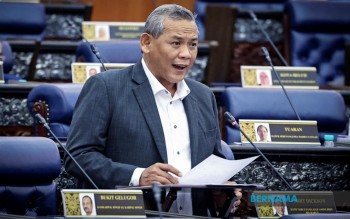
The distinction between legitimate investment losses and those stemming from poor governance has become central to Malaysia's reassessment of Tabung Haji, the pilgrimage fund managing savings for millions of Muslims preparing for the hajj. Port Dickson Member of Parliament Datuk Seri Aminuddin Harun articulated this nuance during parliamentary deliberations on the Royal Commission of Inquiry report, arguing that public discourse around the institution's financial difficulties must acknowledge the inherent risks that accompany any investment portfolio.
Aminuddin, a former Negeri Sembilan menteri besar, emphasised that stakeholders should possess the analytical capacity to separate market-driven declines from losses precipitated by negligent decisions, conflicts of interest, or systematic governance breakdowns. This clarification matters considerably, as it reframes the narrative surrounding the fund's reported losses and provides a more granular understanding of where accountability truly lies. The RCI had recommended forensic audits on 14 investments that experienced significant decline, a measure intended to distinguish between these categories and identify specific points of failure.
Central to Aminuddin's intervention was a challenge directed at how Tabung Haji selects its leadership. He contended that the institution requires individuals selected explicitly for their investment acumen, financial expertise, and professional credentials rather than through patronage networks or political favours. This structural problem—the conflation of board positions with political patronage—has long plagued Malaysian institutional governance. The implication is stark: institutional competence suffers when positions function as rewards for political loyalty rather than as professional responsibilities requiring specialised knowledge.
The former menteri besar articulated a comprehensive framework for prospective board candidates, proposing rigorous screening encompassing integrity assessments, investment experience, Islamic finance knowledge, risk management proficiency, accounting and auditing competency, legal expertise, corporate governance understanding, and hajj management familiarity. Additionally, candidates would be required to disclose potential conflicts of interest transparently. This multidisciplinary approach reflects recognition that modern fund management, particularly for an institution serving millions of pilgrims, demands sophisticated expertise spanning numerous domains.
Among the RCI's key recommendations was a prohibition on active politicians serving as chairman or board members of Tabung Haji and its subsidiary entities. Aminuddin endorsed this direction while signalling his willingness to extend such measures further. The political independence of institutional leadership represents a critical governance principle, particularly for entities entrusted with citizens' retirement and pilgrimage savings. When politicians occupy such positions, questions inevitably arise regarding decision-making independence and whether institutional interests or political considerations take precedence.
Parallel concerns emerged from Datuk Mohd Isam Mohd Isa, Tampin Member of Parliament, who highlighted significant temporal limitations in the RCI's mandate. The inquiry covered only 2014 to 2020, a period chosen for its relevance to historical governance questions but increasingly insufficient given subsequent institutional developments. Mohd Isam argued persuasively that substantial developments affecting Tabung Haji transpired after 2020, particularly between 2021 and 2025, rendering the RCI's conclusions incomplete for understanding contemporary institutional vulnerabilities.
The call for an extended or supplementary investigation reflects legitimate concerns about oversight continuity. A five-year temporal gap between the RCI's final year of examination and the present creates investigative blind spots at precisely the moment when institutional reforms are being implemented. Whether reforms prove effective or whether new governance weaknesses have emerged during the post-2020 period cannot be adequately assessed without detailed scrutiny of recent management decisions and operational changes.
Mohd Isam, speaking from his position on the Public Accounts Committee, advocated channelling Tabung Haji governance matters to that body for comprehensive examination spanning 2022 to 2026. The PAC, as parliament's primary mechanism for institutional accountability, possesses both the structural independence and investigative capacity to conduct sustained oversight. This proposal suggests that traditional parliamentary mechanisms may prove more effective than ad-hoc royal commissions for ongoing institutional supervision, particularly when governance issues span multiple fiscal years and require continuous monitoring.
The RCI report itself, released publicly on July 29, comprised 211 pages of findings addressing management and operational weaknesses across the 2014-2020 period. The inquiry advanced 25 distinct recommendations for institutional improvement, with Tabung Haji confirming implementation of 75 per cent of these measures by July 30. While this compliance rate suggests institutional responsiveness, the lag between recommendation and implementation warrants scrutiny, as does assessment of whether implemented reforms actually address root causes or merely introduce superficial procedural changes.
For Malaysian Muslims and the broader public, these governance discussions carry tangible significance. Tabung Haji operates as a quasi-national institution, managing savings accumulated over decades by millions of ordinary Malaysians preparing for their religious obligation. Any failure in institutional stewardship directly threatens the hajj aspirations of beneficiaries and erodes public confidence in government-linked institutions more broadly. The emphasis on professional appointment criteria and depoliticised leadership reflects belated recognition that institutions managing public assets require independence from electoral cycles and partisan considerations.
The emerging consensus around governance reforms also speaks to institutional maturation within the Malaysian system. Rather than defending past practices or attributing all losses to external factors, parliamentary discussion has shifted toward constructive scrutiny of structural weaknesses and procedural improvements. This represents meaningful progress, though sustained vigilance remains necessary to ensure that recommended reforms translate into genuine operational improvements rather than symbolic adjustments that preserve underlying dysfunction.
Moving forward, the distinction Aminuddin articulated between market risk and governance failure will prove essential for public accountability. Citizens deserve clarity regarding which losses reflected unavoidable market conditions and which stemmed from institutional decisions that alternative governance structures might have prevented. Only through such transparency can public confidence in Tabung Haji be properly restored, and only through genuinely professional leadership selection can the institution fulfil its vital role in facilitating Malaysians' hajj journeys.

