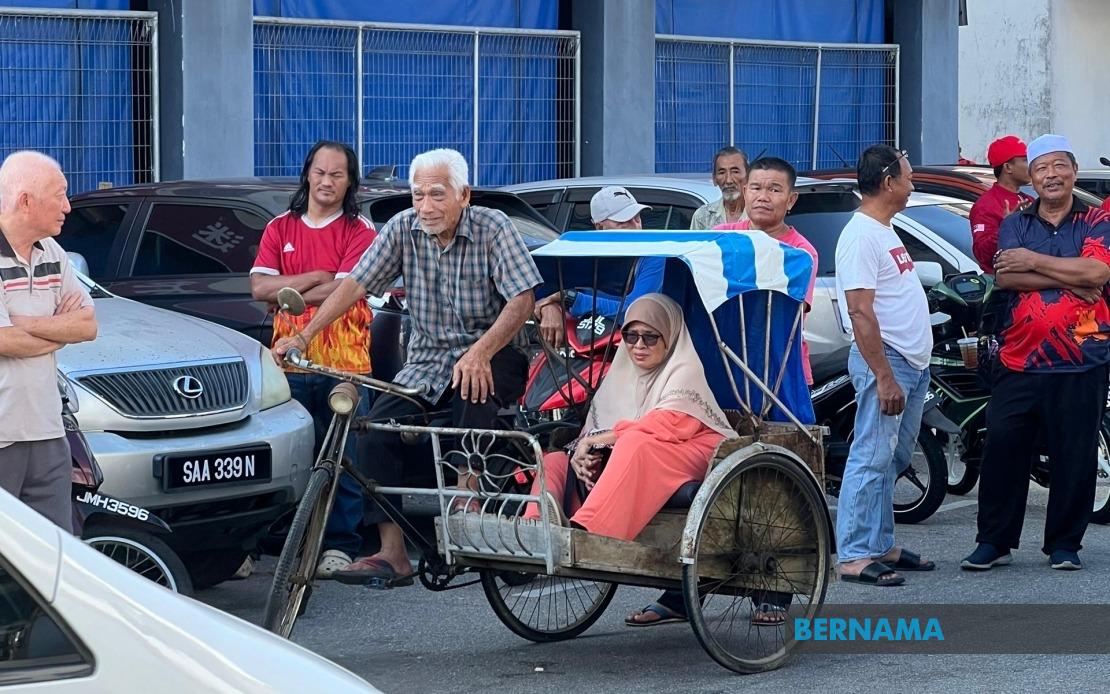
Abdul Razak Pelangga, 86, chose an unconventional mode of transport on Thursday to escort his 64-year-old wife Jamilah Samsudin to a coffee shop in Senggarang, Batu Pahat, where Prime Minister Datuk Seri Anwar Ibrahim was scheduled to have breakfast. Despite the oppressive heat bearing down on the small Johor town, the retired imam pedalled his trishaw nearly a kilometre from their home in Kampung Parit Bugis, demonstrating a determination that transcended physical comfort for the sake of his wife's wish.
The decision to use the traditional three-wheeled vehicle rather than a private car or motorcycle was deliberate. Abdul Razak explained that he preferred to avoid the complications of locating parking in an area that would inevitably attract crowds during the Prime Minister's visit. This pragmatic choice reflected both his understanding of local conditions and his willingness to embrace simpler solutions, even if they demanded greater physical exertion from someone in their mid-eighties.
Abdul Razak's connection to Anwar Ibrahim stretches back several years, rooted in a personal encounter at his mosque. Years before Anwar rose to the highest office, the future Prime Minister had visited Masjid Raudhatul Jannah Parit Bugis to attend prayers, where Abdul Razak, serving as imam, led the congregation. That interaction left a lasting impression on the elderly cleric. The friendly exchange and handshake that followed prayers became a cherished memory, one he had repeatedly recounted to his wife over the intervening years.
When news circulated that Anwar would be stopping in Senggarang as part of his campaign engagement with constituents, Abdul Razak resolved to seize the opportunity. The timing allowed him to introduce his wife to the Prime Minister, or at minimum, to bring her into his physical presence—a gesture that symbolised the fulfillment of a long-held aspiration. For Jamilah, whose familiarity with Malaysia's political leadership had been mediated primarily through television screens, the prospect of witnessing Anwar in person carried genuine significance.
The visit itself formed part of the PMX Meet-and-Greet Programme targeting the Senggarang state constituency, strategically timed to coincide with Johor's electoral campaign period. Anwar spent approximately fifty minutes at Kedai Kopi Hailam Sri Medan, mingling with local residents and engaging in the kinds of informal interactions that characterise grassroots political outreach. The atmosphere attracted considerable crowds, making it impossible for every visitor to secure a direct face-to-face encounter with the Prime Minister.
Although Abdul Razak and his wife could not manage a personal meeting amid the throng of onlookers, their objective was substantially achieved. Witnessing the Prime Minister from a relatively close distance satisfied the core aim of their journey. For an elderly couple whose prior exposure to Anwar had been filtered through media coverage, the immediacy and tangible reality of seeing him in the flesh—however briefly and from among a crowd—represented a meaningful experience that transcended the limitations of their actual interaction.
Communications Minister Datuk Fahmi Fadzil, who also holds the position of Pakatan Harapan Communications Director, was present during the occasion, underscoring the structured nature of the campaign event and the coordination involved in orchestrating such grassroots engagement initiatives across the state.
Beyond this personal narrative, Abdul Razak harboured another source of satisfaction regarding his civic participation. The timing of the election coincided with his approaching eighty-seventh birthday, which would fall on July 11—the precise date scheduled for polling in the Johor state election. He expressed genuine enthusiasm about casting his vote on his birthday, describing the alignment as adding a layer of meaning to his electoral participation. Despite having voted on multiple previous occasions throughout his life, he perceived this particular instance as notably special, an opportunity to discharge his civic responsibility on a date that held personal significance.
This convergence of personal milestone and democratic duty reflects a broader sentiment among Malaysian voters who view electoral participation as a fundamental expression of citizenship. For Abdul Razak, the combination elevated what might otherwise be routine participation into something distinctly memorable.
The Johor state election campaign moves toward its conclusion, with early voting scheduled for July 7 and general polling set for July 11. The contest represents the sixteenth such election for Johor's state assembly, and the PMX Meet-and-Greet Programme through which Anwar visited Senggarang exemplifies the intensive engagement strategies deployed during the campaign period. Such grassroots activities aim to sustain momentum and reinforce connections between political leadership and constituencies in the lead-up to polling day.
Anecdotes such as Abdul Razak's journey on his trishaw illuminate the diverse ways in which ordinary Malaysians engage with their political systems and leaders. While not every voter possesses a personal historical connection to a sitting Prime Minister, many harbour aspirations to observe their national leaders in tangible, proximate circumstances rather than through mediated representation. The physical effort undertaken by an octogenarian to fulfil his wife's wish speaks to the enduring appeal of direct political engagement, however fleeting, and the value that constituents place on glimpsing—and thereby affirming connection with—their elected representatives.

