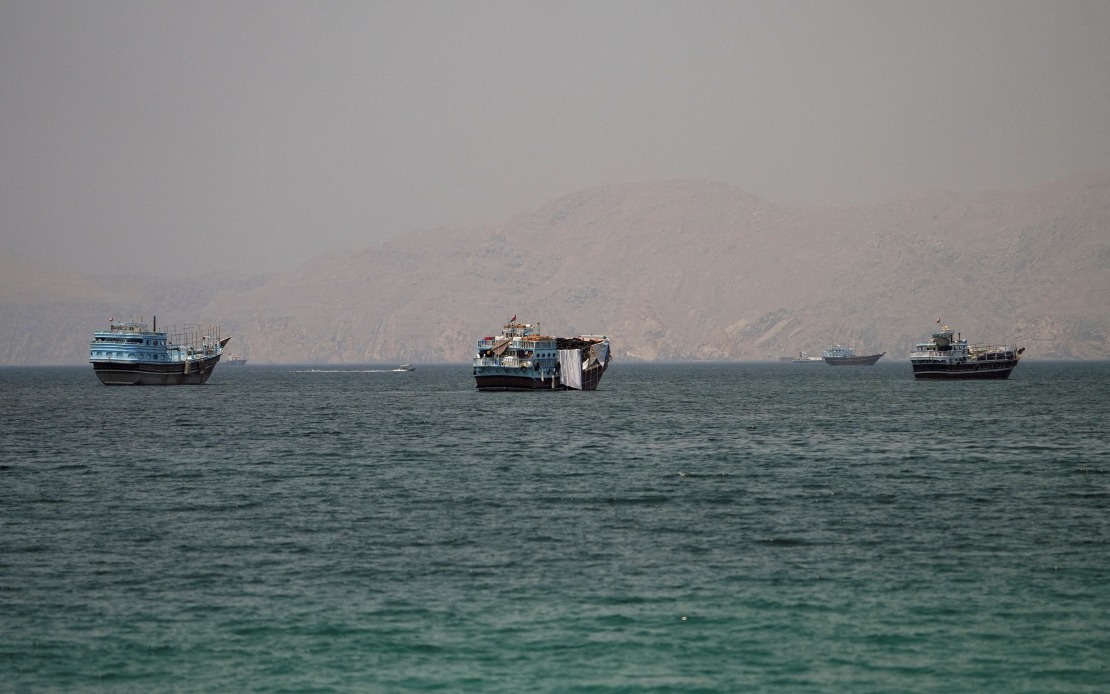
Oman has doubled down on its insistence that commercial shipping must enjoy unobstructed and cost-free passage through the Strait of Hormuz, reiterating this position after Foreign Minister Badr Albusaidi held crucial discussions with senior Iranian leadership in Muscat. The statement underscores Oman's central role as a mediator in one of the world's most strategically important waterways, where roughly one-third of global maritime petroleum trade transits annually. Albusaidi's public commitment to international maritime law reflects growing regional anxiety that the recently brokered US-Iran memorandum of understanding could inadvertently create new restrictions or complications for non-aligned shipping interests.
The Omani Foreign Minister met with Iranian Parliament Speaker Mohammad Bagher Qalibaf and Foreign Minister Abbas Araghchi in the sultanate's capital to examine how the freshly signed accord will affect navigation through the strategically vital 21-mile-wide waterway. Their discussion specifically examined the Strait of Hormuz provisions embedded within the broader US-Iran agreement, signalling that both capitals recognise the waterway's outsized geopolitical significance. The fact that Oman hosted this follow-up conversation highlights its established reputation as a trusted neutral ground where competing regional interests can negotiate without accusations of bias—a role it has cultivated for decades through careful diplomacy.
The underlying concern driving Albusaidi's statement relates to fears that new US-Iran arrangements could result in unilateral restrictions on maritime traffic. By emphasising adherence to international maritime law and the principle of toll-free passage, Oman is essentially serving notice that any arrangement must respect established conventions governing the Strait rather than introducing new mechanisms that could effectively function as a tax or permit system on commerce. This distinction matters enormously for shipping companies, insurance providers, and energy-dependent nations throughout Asia and the Middle East who depend on predictable, unhindered access to the waterway.
The US and Iran formally inked their memorandum of understanding last week, establishing a 60-day window to negotiate resolution of several major disputes that have poisoned their bilateral relationship for over four decades. The agreement encompasses fourteen distinct provisions aimed at resolving tensions across multiple domains. Most prominently, it calls for an immediate and permanent halt to all military operations across multiple regional flashpoints, with Lebanon specifically highlighted as an area requiring urgent de-escalation. The pact additionally demands that Washington lift its naval blockade of Iranian ports and guarantee that commercial vessels transiting the Strait enjoy protected passage without interference or additional requirements.
Qatar and Pakistan, functioning as co-mediators in the US-Iran negotiations that culminated at the Burgenstock resort in Switzerland, jointly announced their own supplementary framework on Sunday. This mechanism establishes what both countries termed a "de-confliction cell" bringing together American, Iranian, and Lebanese representatives under Qatari and Pakistani facilitation. The cell's primary function involves ensuring that all parties maintain their commitments to cease military operations and prevent escalatory incidents that could undermine the broader accord. This additional layer of oversight suggests mediators harbour lingering doubts about the durability of the main agreement without continuous, real-time communication channels.
For Malaysia and broader Southeast Asia, the implications of this agreement carry significant weight. Regional economies depend heavily on predictable Strait of Hormuz transits for petroleum imports, petrochemical feedstocks, and manufactured goods destined for global markets. Any uncertainty or disruption to traffic flows directly threatens energy security and economic growth across the region. Malaysian ports serve as critical transhipment hubs connecting Middle Eastern energy supplies to Asian consumers, making unrestricted maritime access fundamental to national prosperity. The Malaysian government, alongside its ASEAN partners, has consistently advocated for freedom of navigation principles in all international waterways and demonstrated concern whenever geopolitical tensions threaten these vital corridors.
Oman's emphasis on international law reflects broader awareness that the Strait of Hormuz situation remains fragile despite the recent breakthrough. Previous disputes between Iran and Gulf neighbours, including occasional confrontations with shipping vessels, have demonstrated how easily misunderstandings or aggressive posturing can escalate into genuine security incidents. By anchoring Omani policy in established legal frameworks rather than ad-hoc arrangements, Albusaidi is attempting to prevent the accord from creating ambiguous situations where different parties claim different understandings about what constitutes permissible activity. This legalistic approach offers protection to all users of the waterway, not merely the signatories themselves.
The Strait situation represents a convergence of multiple regional anxieties that extend far beyond the bilateral US-Iran relationship. Saudi Arabia, the United Arab Emirates, Kuwait, and other Gulf states maintain deep concerns about Iranian military capabilities and regional ambitions, even while recognising that direct confrontation serves nobody's interests. These monarchies depend absolutely on Strait access remaining open to their own energy exports, making them sensitive allies of any arrangement that preserves navigational freedom. Simultaneously, Yemen's ongoing humanitarian catastrophe and the involvement of Iranian-aligned Houthis in occasional maritime incidents create genuine security concerns that cannot be dismissed as merely rhetorical posturing.
Albusaidi's reaffirmation of Oman's commitment to toll-free passage carries implicit criticism of any interpretation suggesting the accord might legitimise new restrictions or requirements for commercial shipping. The language chosen—specifically invoking international law and the explicit absence of toll mechanisms—appears deliberately crafted to preempt any future attempt to unilaterally impose new conditions on maritime traffic. This preventative diplomacy acknowledges that ambiguous wording in the main agreement could potentially be exploited by either the United States or Iran to justify actions affecting shipping, and Oman is essentially stating that such interpretations would violate accepted international norms.
The talks occurring in Muscat demonstrate how regional powers continue jostling to shape outcomes even after major powers have reached their own understanding. Oman's intervention reflects its recognition that implementation of the accord will ultimately determine whether the agreement produces lasting stability or merely delays inevitable renewed confrontation. By engaging directly with Iranian leadership and articulating clear principles governing Strait access, Oman positions itself to mediate any disputes that emerge during the 60-day negotiation window or beyond. This proactive approach has served Oman well historically, earning it respect across ideological divides and enabling it to punch above its weight in regional affairs.
For commercial operators and governments dependent on Persian Gulf trade, Oman's public commitment provides some reassurance that at least one key regional actor continues championing the principle of unrestricted maritime access. However, the very fact that such reassurance requires explicit reaffirmation suggests underlying anxiety about whether the US-Iran accord will genuinely stabilise the situation or merely establish a temporary pause before the underlying disputes resurface. The coming weeks and months will test whether the de-confliction cell mechanism and the broader agreement framework can withstand the inevitable strains of detailed implementation negotiations.