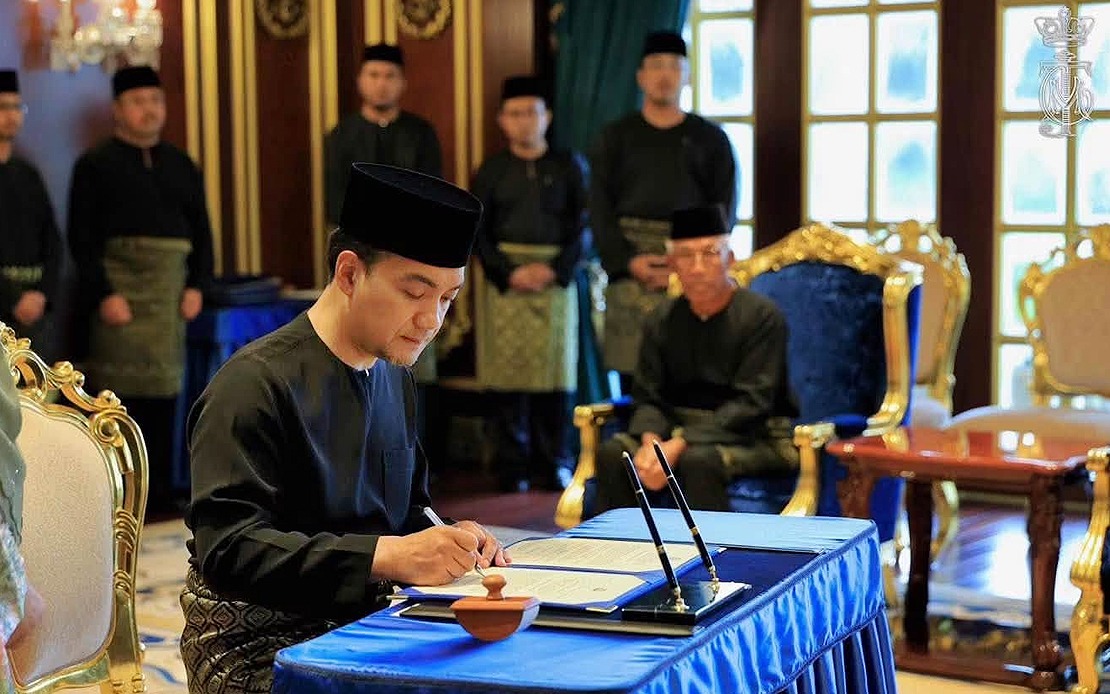
Datuk Onn Hafiz Ghazi has commenced his second term as Johor Menteri Besar following the Barisan Nasional coalition's commanding performance in yesterday's state election, consolidating the leadership position he first assumed in March 2022. The 48-year-old leader took his oath of office before the Regent of Johor, Tunku Mahkota Ismail, at Istana Bukit Serene, formalising his continued stewardship of Southeast Asia's second-largest state by population and a critical economic engine for the broader Malaysian economy.
Onn Hafiz's re-election represents a significant mandate for continuity. The BN coalition secured 48 of the 56 state assembly seats, a substantial improvement over the 40 seats it captured in the 2022 state election. This expanded majority, which translates to an 85.7 per cent supermajority in the legislature, substantially strengthens his hand to navigate the complex political and economic challenges that define Johor's development trajectory. The result demonstrates voter confidence in both his personal leadership and the BN-UMNO political machinery in a state that remains a BN stronghold despite national political turbulence.
Onn Hafiz brings considerable institutional pedigree to the position, a factor that shapes both public expectations and his own political identity. He is the great-grandson of the late Datuk Onn Jaafar, UMNO's founder and Johor's seventh Menteri Besar, and the grandson of the late Tun Hussein Onn, Malaysia's third Prime Minister. This lineage connects him directly to foundational moments in the nation's post-independence political architecture. For many Johoreans, particularly older voters and traditional BN constituencies, this genealogical connection carries symbolic weight—a sense that established political stewardship remains intact and accountable to institutional norms.
Born on March 2, 1978, Onn Hafiz's educational trajectory reflects the cosmopolitan aspirations of Malaysia's political elite. He attended the Royal Military College for secondary education before pursuing an accounting degree at the University of Hertfordshire in the United Kingdom. This combination—military discipline combined with Anglo-Saxon professional training—has shaped an administrative sensibility distinct from purely political-partisan approaches. His four children suggest a modern family structure aligned with contemporary Malaysian professional norms, though his personal narrative remains largely subsumed within his political identity.
Before entering electoral politics, Onn Hafiz accumulated nearly two decades of corporate experience that distinguishes him from legislators whose backgrounds are predominantly political. Between 2001 and 2004, he worked at PricewaterhouseCoopers, one of the world's largest professional services firms, acquiring exposure to international audit standards and governance frameworks. Subsequently, he held corporate leadership positions including directorships at Chin Well Holdings Berhad and a chief executive role at KMB Sdn Bhd between 2005 and 2013. This résumé suggests a leader who understands operational efficiency, financial accountability, and investor expectations—attributes increasingly valued in state-level governance.
Onn Hafiz's transition into active electoral politics began through conventional UMNO party structures rather than grassroots mobilisation. He served on the UMNO Youth executive council and led the Sembrong UMNO Youth division from 2012 to 2018, a period when the party faced significant internal reorganisation following the 1MDB scandal. His appointment as political secretary to the defence minister from 2013 to 2018 provided exposure to federal-level governance mechanics and security establishment networks. This trajectory—youth organiser to ministerial advisor—follows a well-established pattern within UMNO's meritocratic internal system.
Electoral success followed conventional pathways. Onn Hafiz won the Layang-Layang parliamentary constituency in 2018 and subsequently the Machap state seat in the 2022 Johor election, victories that reflected both his personal political capital and the effectiveness of BN machinery in the state. His appointment as Johor's 19th Menteri Besar in March 2022, following BN's formation of the state government, represented a generational transition from his predecessor Datuk Hasni Mohammad. Within UMNO's organizational hierarchy, he has consolidated influence through his chairmanship of the Johor UMNO Liaison Committee and his leadership of the Simpang Renggam division since 2023.
Since assuming office, Onn Hafiz has articulated his development vision through the "Maju Johor 2030" framework, a long-term blueprint emphasizing economic expansion, foreign and domestic investment attraction, and infrastructure modernisation. This agenda reflects consensus priorities across Southeast Asian states—diversification beyond traditional sectors, urbanisation management, and positioning as a regional investment hub. For Malaysia specifically, Johor's economic performance carries disproportionate weight given its strategic location, proximity to Singapore, and role as a manufacturing and logistics nexus. The state's success or failure in attracting investment and managing development increasingly shapes perceptions of BN's broader competence.
The strengthened mandate from yesterday's election provides Onn Hafiz with substantial legislative latitude to pursue ambitious development initiatives over the next five-year cycle. His 48-seat supermajority eliminates the need for cross-party cooperation and shields his government from the legislative vulnerabilities that constrain administrations with slender majorities. This political stability, from an investor perspective, signals predictability and reduces regulatory uncertainty—factors critical for attracting foreign direct investment in competitive Southeast Asian markets.
However, Onn Hafiz faces complex governance challenges that transcend electoral mandates. Johor's integration with Singapore's economy, while generating prosperity, creates vulnerabilities to regional economic fluctuations. The state must simultaneously manage rapid urbanisation, environmental sustainability pressures, and the needs of rural communities whose development has lagged behind urban centres. Youth unemployment, affordable housing provision, and the transition away from resource-dependent sectors remain long-term structural challenges that require sustained policy coherence beyond electoral cycles.
For regional observers, Onn Hafiz's continued leadership represents stability within Malaysia's broader political landscape. Johor's governance quality influences broader investor confidence in the Malaysian federation, particularly given Singapore's proximity and the comparative governance standards that multinational corporations apply when evaluating regional operational locations. A capable, corruption-aware Johor administration under established leadership provides reassurance to international capital flows.
Onn Hafiz inherits a state administration with institutional continuity and a refreshed electoral mandate, positioning himself to advance the economic development agenda that has defined his tenure. His combination of corporate experience, established political lineage, and demonstrated electoral appeal creates conditions for leadership that balances technocratic competence with political accountability. The years ahead will test whether his "Maju Johor 2030" vision translates ambitious planning into tangible outcomes that improve living standards across the state's diverse constituencies.

