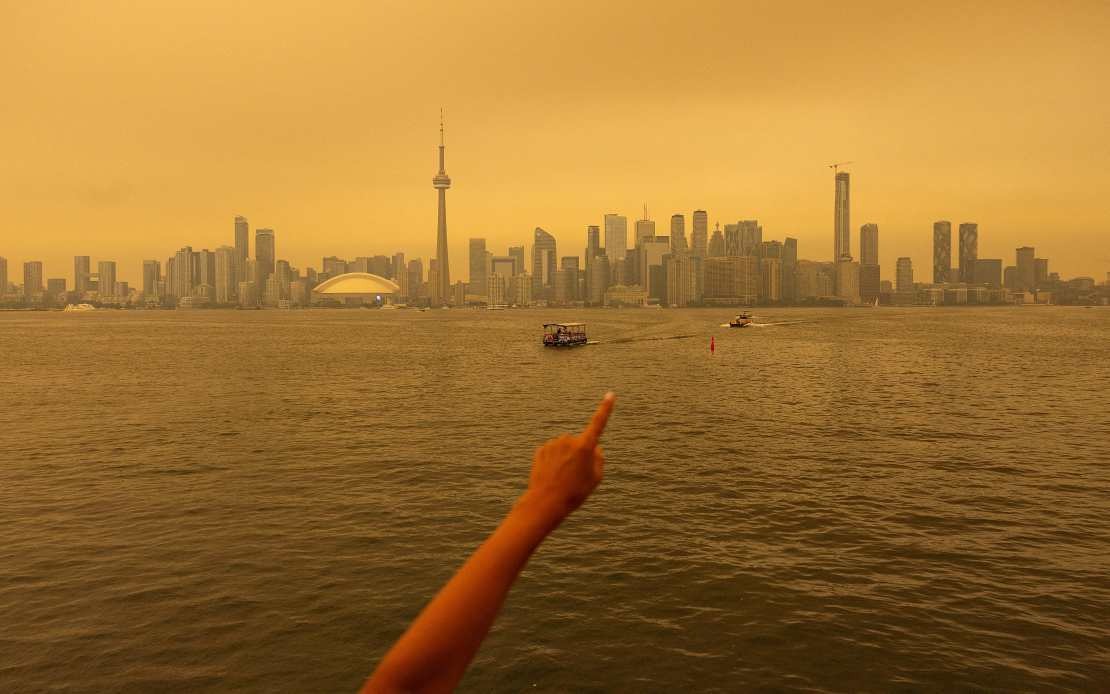
Canada's two largest metropolitan areas are struggling with dangerously poor air quality as an unprecedented outbreak of wildfires in northwestern Ontario continues to generate thick smoke that shows no sign of clearing. The crisis has extended far beyond the province, with weather patterns carrying the pollution across borders and creating hazardous conditions for millions of residents across eastern Canada and even reaching into the United States. On Wednesday morning alone, Toronto recorded the worst air quality index reading of any major city globally, a stark indicator of the severity gripping the region.
Environment Canada classified Toronto's Air Quality Health Index as "very high risk," a designation that typically triggers public health warnings and recommendations for vulnerable populations to remain indoors. The situation in Ottawa, Canada's capital, proved equally concerning, with municipal authorities issuing formal air quality alerts that reflected the combination of wildfire smoke and unusually high humidity levels. The trapped moisture amplified the smog problem considerably, as the humid air prevented smoke particles from dispersing upward into the atmosphere, instead keeping them concentrated near ground level where residents experience maximum exposure.
The visual impact proved remarkable in both cities, with residents reporting that the midday sky turned a distinctive yellow hue, a phenomenon caused by sunlight filtering through the dense smoke layer. This striking appearance served as a visible reminder of the air quality crisis unfolding across Ontario's landscape, where conditions deteriorated rapidly during the reporting period. The combination of smoke and humidity created what meteorologists describe as a perfect storm for air stagnation, whereby pollution becomes trapped in the lower atmosphere for extended periods.
The scale of the wildfire outbreak remains extraordinary, with more than 100 active fires simultaneously burning across northwestern Ontario. This concentration of simultaneous blazes has forced regional authorities to implement emergency protocols, including the evacuation of residents from multiple communities deemed to be in immediate danger. The fires have consumed vast stretches of forested terrain, and efforts to contain the blazes have proven challenging given the widespread geographic distribution and the difficulty of accessing remote burn zones.
A particularly dramatic incident highlighted the severity of conditions on the ground when video footage, captured late Monday by a Canadian National Railway locomotive crew member near Armstrong, Ontario, showed a freight train surrounded by advancing wildfires. The video, which circulated widely on social media platforms, depicted towering flames engulfing forested areas immediately adjacent to the rail line on both sides, with the intense heat generating a bright red glow visible inside the locomotive cabin. The dramatic nature of the footage captured public attention and underscored the genuine dangers facing railway workers operating in the region during this emergency period.
Canadian National confirmed the authenticity of the video footage and reported that the train crew had been evacuated safely before conditions became critical. The incident prompted CN to implement a temporary suspension of train operations along the affected section of track, a significant disruption to freight movement across Canada's transportation network. Railway authorities cited both immediate safety concerns and the broader uncertainty regarding when conditions would stabilize sufficiently to resume normal operations.
The transportation disruptions extend beyond rail services, as visibility restrictions caused by the heavy smoke and particulate matter have complicated travel across the region more broadly. The suspension of CN freight operations affects supply chains across Canada, as the company operates one of the nation's largest rail networks. Goods movement through the affected corridor must be redirected to alternative routes, creating bottlenecks and delays throughout the transportation system during a critical summer period for commerce.
Meteorological forecasts offer little comfort to residents hoping for rapid improvement, as Environment Canada warned that prevailing wind patterns and regional airflow dynamics will likely sustain the heavy smog conditions for at least several additional days. The positioning of a high-pressure system and the direction of air masses moving across the continent suggest that smoke from the Ontario fires will continue to affect air quality across a broad geographic area. This extended timeline means residents in major population centers must prepare for prolonged exposure to hazardous air conditions.
The situation carries particular implications for Southeast Asian observers given growing recognition of transboundary air pollution as a regional challenge. While Canada's wildfire smoke crosses provincial boundaries, similar phenomena occur regularly in Southeast Asia, where fires in Indonesia and Malaysia generate smog that affects multiple nations. The Ontario crisis demonstrates how natural disasters in one region can create public health emergencies across vast distances, a pattern increasingly familiar to ASEAN nations experiencing seasonal haze. The coordinated response challenges Ontario faces parallel those confronted by Southeast Asian governments managing transboundary pollution during peak burning seasons.
Public health authorities across Ontario have activated emergency protocols and issued advisories recommending that vulnerable populations including children, elderly residents, and those with respiratory conditions limit outdoor activities and consider using air filtration equipment indoors. Hospitals have prepared for potential surges in respiratory complaints and air-quality-related health emergencies. The Canadian government's environmental and health agencies are maintaining continuous monitoring of conditions and updating guidance as the situation evolves.

