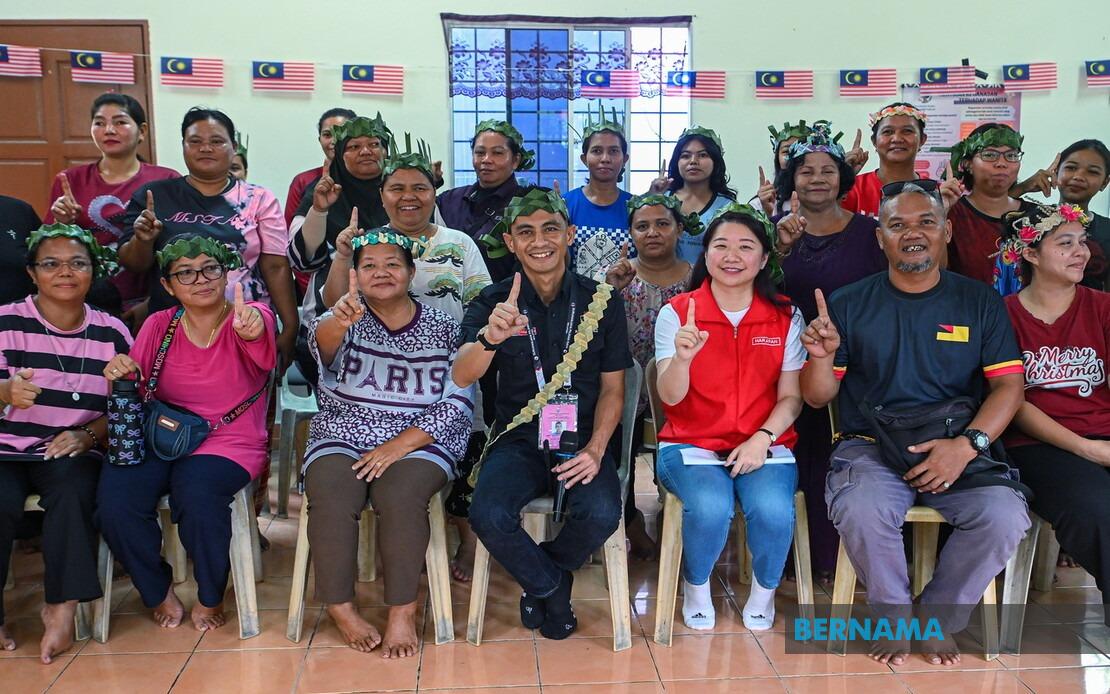
The race for the Labu state seat in Negeri Sembilan is shaping up as a contest with distinctly local dimensions, with Pakatan Harapan candidate Datuk Ahmad Faez Abdul Razak centering his campaign on addressing the socioeconomic challenges faced by the indigenous Orang Asli community in the constituency. Appearing at the Orang Asli Women Empowerment programme in Kampung Orang Asli Tekir, Ahmad Faez outlined an ambitious agenda that reflects the particular needs of this historically marginalised demographic, signalling that his party views indigenous affairs as central to its development vision for the state.
At the heart of Ahmad Faez's platform is a commitment to elevate the customary land question, a thorny issue that has long affected Orang Asli communities across the peninsula. He has specifically identified the case of Kampung Orang Asli Tekir as a matter warranting State Legislative Assembly attention, suggesting that resolving land tenure insecurity could unlock broader economic potential for residents. This positioning taps into a deeper frustration among Orang Asli groups regarding historical land dispossession and the protracted legal battles many communities face to reclaim ancestral territories. For Malaysian readers, the prominence of this issue in a state-level campaign underscores how indigenous land rights have become a litmus test for political commitment to equity.
Beyond the land question, Ahmad Faez's platform encompasses immediate quality-of-life improvements. Infrastructure deficiencies—particularly inadequate road networks and the digital divide—remain pressing constraints in many Orang Asli settlements. By pledging upgrades to road connectivity and internet infrastructure, he is addressing practical barriers that compound educational and economic disadvantage. Internet access, in particular, has become critical for rural communities seeking to participate in the digital economy, and the explicit commitment signals awareness that infrastructure gaps have real consequences for social mobility and livelihood diversification.
The candidate has also identified human capital development as a priority, emphasising that education and youth training programmes require targeted investment. This reflects a broader recognition that Orang Asli populations, despite possessing considerable cultural and practical knowledge, often lack formal qualifications and market-relevant skills that would enable upward economic mobility. Ahmad Faez's framing positions skills enhancement not merely as welfare provision but as a pathway to sustainable income generation, a rhetorical shift that reframes indigenous development as economic opportunity rather than charitable concern.
A particularly noteworthy element of his platform concerns the commercialisation of traditional handicraft production. Kampung Orang Asli Tekir residents possess established expertise in craft manufacturing, yet this potential has remained largely untapped at scale due to limited market access, inadequate branding, and weak supply-chain integration. Ahmad Faez has committed to facilitating broader market linkages, suggesting that light manufacturing and artisanal goods represent a genuine avenue for income augmentation without requiring wholesale cultural transformation or displacement from traditional territories. This approach mirrors successful models elsewhere in Southeast Asia where indigenous communities have leveraged cultural products for economic gain.
The introduction of modern agricultural techniques, particularly fertigation systems, represents another prong of the economic strategy. Kampung Orang Asli Tekir has historically relied on subsistence and small-scale commercial agriculture, yet productivity constraints and climate variability have limited returns. By introducing precision irrigation and nutrient management systems, Ahmad Faez suggests that agricultural modernisation need not preclude indigenous farming practices but rather can enhance yields and resilience. This framing is significant for Malaysian readers because it positions technological adoption as compatible with, rather than corrosive to, traditional livelihoods.
Crucially, Ahmad Faez has sought to establish credibility through continuity of engagement, claiming that his involvement with the constituency extends beyond the electoral cycle. He asserts that he has maintained a ground presence over the preceding two years, attending to community concerns and providing assistance independent of voting schedules. Such claims matter in Malaysian politics because voters in marginal communities have historically experienced the phenomenon of candidate neglect between elections, making assurances of sustained engagement a meaningful electoral signal. The willingness to invest time and resources in community relations prior to nomination suggests either genuine commitment or at least an expectation that this constituency will be competitive.
Village Chief Nasir Musil's endorsement adds local validation to Ahmad Faez's pitch, with the headman noting that infrastructure and economic development must be prioritised for the settlement's 796 residents. Notably, Nasir also raised the longstanding problem of stray cattle that endanger road users, a seemingly minor issue that illustrates how governance quality is often measured through attention to mundane but consequential local problems. The fact that this concern has persisted suggests that previous representatives may not have prioritised such matters, creating an opening for Ahmad Faez to position himself as responsive to grassroots grievances.
The electoral contest itself is a three-way race, pitting Ahmad Faez against incumbent Mohamad Hanifah Abu Baker of Parti Pribumi Bersatu Malaysia and Siti Nur Umaira Hasim of Barisan Nasional. For Malaysian political observers, this configuration represents a fragmentation of the traditional BN-opposition binary, with Bersatu's presence complicating outcomes in ways difficult to predict. The split opposition vote in previous cycles has sometimes benefited incumbent governments, though recent electoral dynamics have shown greater fluidity. Ahmad Faez's first-time candidacy positions him as an outsider to state-level politics, which could either invigorate his campaign or disadvantage him against an incumbent with established machinery and resources.
The Negeri Sembilan state election, scheduled for early August, has assumed heightened significance as a bellwether for mid-term political sentiment following the 2022 general election. The 16th state assembly election will provide insight into whether Pakatan Harapan has recovered ground in Peninsular Malaysia and whether indigenous affairs have genuinely entered mainstream electoral competition. Ahmad Faez's campaign in Labu, with its explicit focus on Orang Asli development, suggests that his party recognises both the demographic reality of the constituency and the potential electoral dividend from visibly championing indigenous interests. Whether voters credit his promises with sufficient credibility remains the open question as the August 1 polling date approaches.

