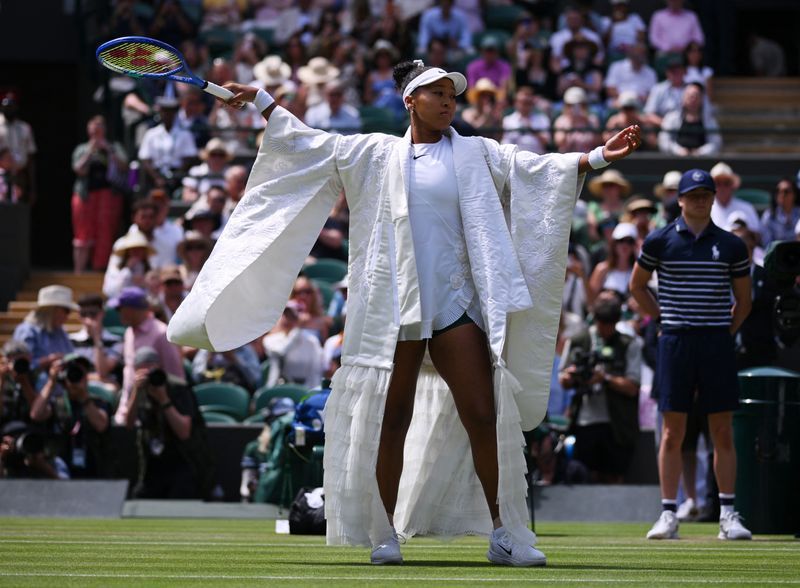
Naomi Osaka has transcended her well-earned reputation as a fashion icon at Wimbledon, demonstrating that her competitive prowess matches her sartorial confidence. The four-times Grand Slam champion from Japan dismantled unseeded Daria Kasatkina on Friday with a commanding 6-1 6-3 victory on Court One, securing her first appearance in the tournament's last 16 round and signalling serious intent in the second week.
While Osaka has dominated the early stages of the fortnight with her visually arresting ensemble choices—including an elaborate flower-patterned kimono styled as a "Kill Bill" entrance look—her latest performance suggests she is increasingly willing to let her tennis command the narrative. The 14th seed's progression through the draw reflects a maturation in her Wimbledon campaign, moving beyond the novelty of her courtside presence to establish genuine competitive credentials on grass.
The Japanese star's dominance was immediate and unrelenting. She engineered a break in the second game through a combination of aggressive baseline play and tactical precision, using a penetrating backhand to catch the Russian-born Kasatkina off-guard. Within moments, she had doubled her advantage with a deep forehand that exposed her opponent's limited grass-court mobility, racing through the opening set without meaningful resistance from the 28-year-old Australian.
Kasatkina's struggle against Osaka's controlled aggression reflected broader challenges for unseeded players facing entrenched top seeds on surfaces that reward power and consistency. The Australian's inability to dictate points or construct rallies in her favour suggested Osaka's preparation for grass-court tennis extended beyond fashion preparation. Her recent run to the Bad Homburg final before an injury forced retirement had clearly provided valuable tournament rhythm and court familiarity.
The second set presented a more competitive examination of Osaka's resolve. After establishing an early advantage, she briefly surrendered her grip on proceedings, allowing Kasatkina to claw back into the contest and test her composure. However, rather than tightening defensively, Osaka responded with heightened intensity, mounting a decisive counter-attack that culminated in two match points. She converted the second opportunity with flourish, demonstrating the composure expected of a multiple major champion.
Osaka's post-match comments reflected both gratitude and measured ambition. She acknowledged the rarity of her success on this particular court, noting that despite her pedigree and experience, Wimbledon has presented unique challenges throughout her career. Her emphasis on taking "one point at a time" and avoiding premature celebrations suggests a grounded approach that has historically served Japanese athletes well in major tournaments.
The victory positions Osaka for a tantalizing third-round encounter against the winner of the match between world number one Aryna Sabalenka and former French Open champion Jelena Ostapenko. This matchup carries significant implications for her tournament trajectory, as both opponents present contrasting challenges. Sabalenka's power-based game shares similarities with Osaka's own strengths, while Ostapenko's unpredictable baseline brilliance and improved grass-court form represent a different tactical puzzle.
For Southeast Asian tennis followers, Osaka's progression holds particular relevance beyond her Japanese heritage. Her success on the WTA circuit has consistently elevated the sport's profile across the region, inspiring younger players and demonstrating that Asian competitors can compete consistently at the highest levels of professional tennis. Her presence in Wimbledon's second week validates the technical and mental demands required for sustained success on grass.
The combination of style and substance that Osaka is now displaying at the All England Club reflects a broader evolution in her professional approach. Having successfully navigated mental health challenges and returned to competitive tennis, she appears increasingly comfortable balancing the entertainment value she brings to the sport with the serious business of winning matches. Her kimono entrances have become iconic precisely because they reflect genuine personality, not superficial showmanship.
Osaka's breakthrough run to the last 16 also arrives at a moment when her grass-court credentials were legitimately uncertain. Unlike players who have built their careers around consistent grass performances, Osaka has historically focused on hard courts and clay. That her recent tournaments have yielded both a final appearance and now a major-round progression suggests she has made meaningful technical adjustments to her serve, movement, and tactical approach.
As she advances toward confronting either Sabalenka or Ostapenko, the narrative surrounding Osaka at Wimbledon has shifted from peripheral interest in her fashion choices to genuine engagement with her tennis capabilities. The Japanese champion has demonstrated that her presence in this tournament extends far beyond the aesthetic realm, establishing herself as a legitimate contender for deep advancement. Should she continue this trajectory, the notion of Osaka as merely a fashion attraction at Wimbledon will finally and definitively be retired.

