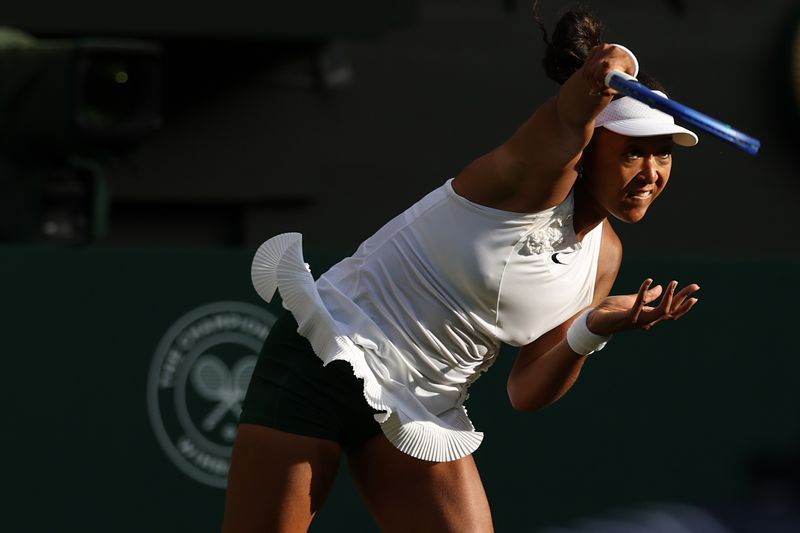
The seventh day of play at Wimbledon delivered a pair of contrasting narratives on Centre Court: one of clinical dominance and resurrection, the other of struggle persisting despite success. Naomi Osaka, the Japanese 14th seed who arrived at the All England Club adorned in a striking kimono-inspired ensemble reminiscent of her favourite Quentin Tarantino character, dismantled top-ranked Aryna Sabalenka with surgical precision, advancing to her maiden Wimbledon quarter-final courtesy of a 6-2, 7-6(2) scoreline that belied the competitive gulf between the two players.
Osaka's victory represents a watershed moment in her gradual return to the prominence that characterised her four Grand Slam championship years. The display of sustained aggression and accuracy that emerged on grass in southwest London mirrors the tennis that established her dominance on hard courts, particularly her triumphant campaigns in New York and Melbourne. Since returning from maternity leave in 2024, this constitutes her most substantial scalp, a symbolic reversal of momentum that had favoured Sabalenka in their recent meetings. The world number one had defeated Osaka three consecutive times this season, making Thursday's decisive reversal all the more emphatic.
Sabalenka's unexpected dismissal compounds what has become a seismic upheaval in the women's tournament. With defending champion Iga Swiatek and 2022 titlist Elena Rybakina both departing in the third round, the top three seeds have been eliminated wholesale. This wholesale decimation of the seeded contingent guarantees that a first-time Wimbledon champion will be crowned for the ninth consecutive year, fundamentally altering the complexion of the competition and opening opportunities for players outside the established hierarchy.
Osaka attributed her composed performance to a deliberate mental recalibration, noting that she had consciously toned down her pre-match theatrical flourishes to concentrate on the tennis itself. Her entrance attire, while eye-catching, was deliberately restrained compared to her customary sartorial statements, reflecting a philosophical shift towards allowing her racket rather than her wardrobe to generate headlines. This disciplined approach appears to have yielded dividends, permitting her to construct points methodically and capitalise on Sabalenka's uncharacteristic erratic play.
Meanwhile, the men's draw witnessed the continuation of Novak Djokovic's determined march toward an historic eighth Wimbledon title, which would equate Roger Federer's all-time record. The 39-year-old Serbian third seed triumphed over Russian qualifier Roman Safiullin 7-6(6), 6-3, 3-6, 6-3, progressing to his seventeenth Wimbledon quarter-final whilst simultaneously surpassing Federer's benchmark of 105 Wimbledon match victories. Yet the scoreline concealed considerable discomfort, with Djokovic himself acknowledging that his performance fell well short of his exacting standards.
Djokovic's candid post-match reflection revealed an athlete struggling with his movement and rhythm across the four-set encounter. He described his victory as devoid of the satisfaction and enjoyment typically associated with professional tennis, characterising the experience as a relief rather than a triumph. This candour speaks to the psychological toll that accumulates even for competitors of Djokovic's calibre, particularly when performance levels dip whilst still producing winning results. The disconnect between outcome and execution underscores the fragility inherent in attempting to sustain excellence at advanced ages.
The Serbian's path to a potential semi-final confrontation with defending champion Jannik Sinner hinges upon his capacity to overcome Canadian third seed Felix Auger-Aliassime in the quarter-finals. Auger-Aliassime himself has survived a gruelling examination, overcoming Spain's Alejandro Davidovich Fokina 6-7(4), 7-6(6), 6-3, 6-7(2), 6-1 in a four-hour, twenty-six-minute marathon punctuated by heated words exchanged at the net between the combatants. Such extended battles exact physiological and psychological costs that frequently resurface in subsequent matches, potentially tilting the balance in Djokovic's favour despite his stated concerns regarding form.
The men's draw witnessed another notable development when Poland's Hubert Hurkacz was compelled to retire from his fifth-set encounter with German veteran Jan-Lennard Struff. Struff's progression represents a remarkable achievement for the 36-year-old, who reaches his inaugural Grand Slam quarter-final at an age when most contemporaries have long since withdrawn from elite competition. Such late-career breakthroughs inject unpredictability into the latter stages of major tournaments, as players with accumulated experience and refined shot-making frequently possess the tactical acumen to trouble younger, more physically gifted opponents.
The women's quarter-final line-up has crystallised around Osaka's next obstacle: tenth-seeded Karolina Muchova of the Czech Republic. Muchova claimed a narrow victory over fellow Czech and defending champion Barbora Krejcikova, 7-5, 5-7, 6-3, in a contest that fluctuated considerably in momentum. The geographical concentration of Czech representation and the success of American players have redrawn the contours of the competition's latter stages, with five American women reaching the fourth round—the most substantial representation from the United States since 2002.
Jessica Pegula, the fourth-seeded American, demonstrated the tactical superiority that comes from sustained major tournament experience, dismantling teenager Iva Jovic 4-6, 6-3, 6-1 on Court One. Pegula's victory has now matched her previous Wimbledon best performance, with the possibility of a quarter-final encounter against fellow American Coco Gauff contingent upon the latter's ability to overcome Swiss player Belinda Bencic. The emergence of American players in such numbers hints at a recalibration of the women's game's power dynamics, potentially signalling the beginning of generational transition at the sport's highest echelon.
The implications for the tournament's ultimate victor extend beyond the immediate results on grass courts in southwest London. The elimination of established champions and top seeds has fundamentally altered the psychological landscape, removing the intimidation factor that surrounds defending titlists and world rankings. For Malaysian and Southeast Asian observers, Osaka's resurgence carries particular resonance, demonstrating that athletes can successfully navigate the professional and personal complexities of motherhood without permanently sacrificing competitive excellence. Her performance also underscores the malleability of form in tennis, where psychological focus and tactical discipline can overcome recent head-to-head records and ranking disadvantages.

