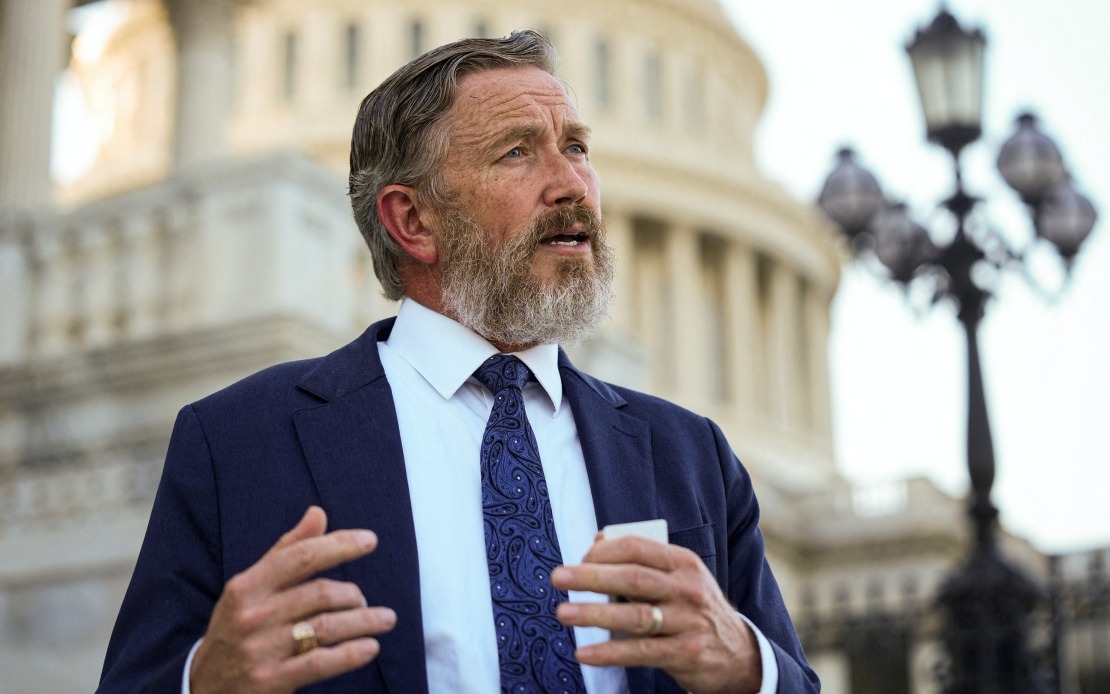
A significant contingent of Democratic lawmakers in the United States House of Representatives voted this week to halt billions of dollars in annual military assistance to Israel, underscoring the widening ideological fault lines within the party over America's approach to the Middle East conflict. The amendment, proposed by Republican Representative Thomas Massie of Kentucky to eliminate roughly US$3.3 billion in military support for the fiscal year ahead, failed to advance following a Wednesday evening vote that tallied 314 against and 104 in favour. While the measure did not succeed legislatively, its performance signals a notable shift in Democratic sentiment compared to previous years, and observers describe the vote as carrying significant symbolic weight within broader American political debates.
Massie stood virtually alone among his Republican colleagues in championing the amendment, a posture that highlights the partisan dimensions of military aid discussions on Capitol Hill. The overwhelming opposition from the Republican-controlled chamber ensured the proposal's defeat, yet the result masks important developments within the Democratic caucus itself. The amendment emerged during House deliberations focused on appropriations for the United States State Department and national security agencies, placing the contentious issue at the centre of budgetary negotiations that touch fundamental American foreign policy priorities.
Among the 215 Democrats serving in the House, exactly 103 voted to support Massie's proposal, while an additional 10 members chose to abstain rather than take a definitive position. This configuration means that nearly half of the entire Democratic caucus sided with the effort to terminate the assistance, a striking demonstration of evolving party dynamics. The contrast with recent precedent proves especially illuminating: in a comparable vote conducted just over two years earlier, only 37 Democrats had backed a similar measure to reduce military aid. The threefold increase in supportive votes reflects substantial movement within Democratic ranks during a period marked by intensifying geopolitical tensions and humanitarian concerns.
The growing support for ending military assistance stems largely from progressive Democrats' sustained criticism of Israel's military operations in Gaza and broader questions regarding civilian casualties and humanitarian consequences. Advocates for ending aid cite the ongoing conflict as generating civilian suffering that warrants a reassessment of American military support policies. This perspective has gained traction particularly among younger members and those representing urban constituencies where progressive activism remains influential, shaping both electoral calculations and principled policy positions within the party.
The vote itself crystallises deeper strategic and philosophical divisions within Democratic leadership and membership. Party leadership at the national level continues to affirm the importance of military assistance to Israel, framing such support through lenses of regional security, counter-terrorism cooperation, and long-standing strategic partnership. Simultaneously, the party's progressive wing increasingly voices dissent from this orthodox position, asserting that continued military aid implicitly endorses policies these lawmakers regard as counterproductive to meaningful conflict resolution or consistent with American values regarding civilian protection.
For Malaysian and Southeast Asian observers, these American domestic developments carry implications extending well beyond United States borders. The United States military presence and commitments throughout the Indo-Pacific region depend partly on the overall trajectory of American foreign policy and the domestic political consensus supporting international engagement. Divisions within the American political establishment regarding military aid and intervention inevitably ripple outward, influencing how regional partners assess American reliability and strategic direction. When the world's leading military power experiences internal fractures over fundamental questions of military assistance and international involvement, regional states must recalibrate their own strategic calculations accordingly.
The amendment's failure to advance does not diminish the importance of the underlying political current it represents. Legislative defeats in the short term often precede eventual policy shifts, particularly when voting patterns show accelerating support trajectories. The tripling of Democratic support within roughly two years suggests momentum toward further consolidation of anti-aid sentiment within progressive circles and potentially beyond. Congressional voting records on such matters frequently presage shifts in broader public opinion, particularly among younger demographics and politically engaged communities.
The structural imbalance between Republican and Democratic voting patterns illuminates how foreign aid debates intersect with partisan identity in American politics. Republicans' virtual unanimity in opposing the amendment contrasts sharply with Democratic internal division, reflecting differing approaches to American internationalism and military commitments. This partisan gap itself becomes consequential, shaping legislative outcomes while simultaneously embedding foreign policy questions within larger frameworks of cultural and ideological contest.
Looking forward, the trajectory revealed by this vote suggests that Israel military aid will remain contested terrain within Democratic politics. As progressive voices gain platforms and resources within party structures, positions that once occupied marginal status may transition toward mainstream acceptability. The timing of such shifts remains uncertain, yet the directional arrow appears clear. For international observers monitoring American political development, these voting patterns warrant careful attention as indicators of potential future policy adjustments that could reshape Middle Eastern dynamics and broader patterns of American military engagement globally.

