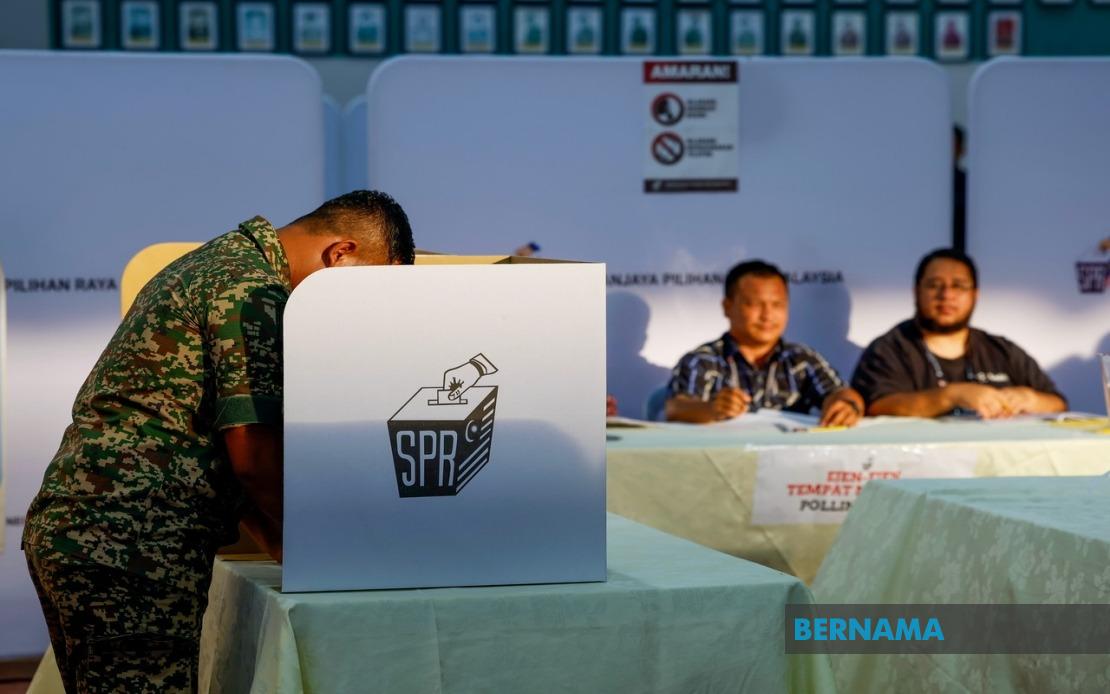
The 16th Negeri Sembilan state election got off to a steady start on July 28, with early voting proceedings attracting substantial participation from security personnel and their families during the morning hours. By 9am, approximately one in seven eligible early voters had completed their ballots at distributed polling centres across the state, demonstrating solid engagement among this prioritised voter segment.
The Election Commission reported that 3,356 individuals from the military and police forces, together with their spouses, had exercised their voting rights by mid-morning. This cohort comprises a significant portion of the state's security establishment, reflecting the constitutional arrangement that grants armed forces and law enforcement priority access to polling booths ahead of the general public. The data released through the EC's official Facebook channel provided real-time transparency into voting patterns, allowing observers and stakeholders to monitor the election's progression.
Thirty-eight designated polling centres opened their doors simultaneously at 8am to accommodate the 22,389 registered early voters entitled to cast ballots before the main election day. The dispersion of voting facilities across multiple locations sought to minimise congestion and ensure convenient access for military and police personnel stationed throughout Negeri Sembilan. This distributed approach reflects election management best practices designed to facilitate participation while maintaining security and orderliness.
The staggered closure schedule, with polling centres shutting down between noon and 5pm depending on their specific circumstances, allowed flexibility in accommodating varying voter populations at different venues. Centres with smaller numbers of registered early voters would close earlier, while those serving larger constituencies would remain open longer. This tailored approach prevented unnecessary delays and permitted efficient resource deployment across the state's election infrastructure.
The broader 16th Negeri Sembilan state election represents a significant political contest, with 103 candidates competing for control of 36 state legislative seats. This level of competition indicates robust democratic participation and suggests multiple parties and independent contenders are seeking to represent constituencies across the state. The scale of candidacy relative to available positions underscores the competitive nature of state-level politics in Negeri Sembilan.
General polling is scheduled to commence on July 28, the same day as early voting concluded, with 889,490 registered voters expected to participate in the main election. This large electorate base demonstrates the substantial population under Negeri Sembilan's jurisdiction and highlights the significance of this state election within Malaysia's broader political landscape. The compressed timeline, with early voting and general voting occurring on identical dates, represents an efficient electoral calendar that minimises disruption to normal governance and economic activity.
For Malaysian observers monitoring state-level electoral trends, the Negeri Sembilan contest provides insight into voter sentiment and political preferences in a state that has experienced varied political fortunes in recent years. The participation rates achieved through early voting, even at preliminary stages, offer preliminary indicators of overall voter enthusiasm for the election. Comparative analysis of early voting turnout against historical benchmarks can illuminate whether this particular electoral cycle is generating heightened public interest or maintaining customary engagement levels.
The election management demonstrated by the EC's coordination of early voting procedures reflects institutional learning from previous electoral exercises across Malaysia. The deployment of 38 polling centres, detailed voter registration data, and transparent real-time communication about voting progress suggest a mature electoral infrastructure capable of handling substantial voter numbers while maintaining security protocols essential to democratic integrity.
Regional considerations make this state election noteworthy for neighbouring Selangor, Kuala Lumpur, and Pahang, as outcomes in Negeri Sembilan often signal broader political trends affecting West Malaysian governance. Party performance in a mid-sized state election frequently presages national political developments and can influence policy priorities across the region. Strategic analysts across Southeast Asia often monitor Malaysian sub-national elections as indicators of democratic health and evolving political alignments within the country.

