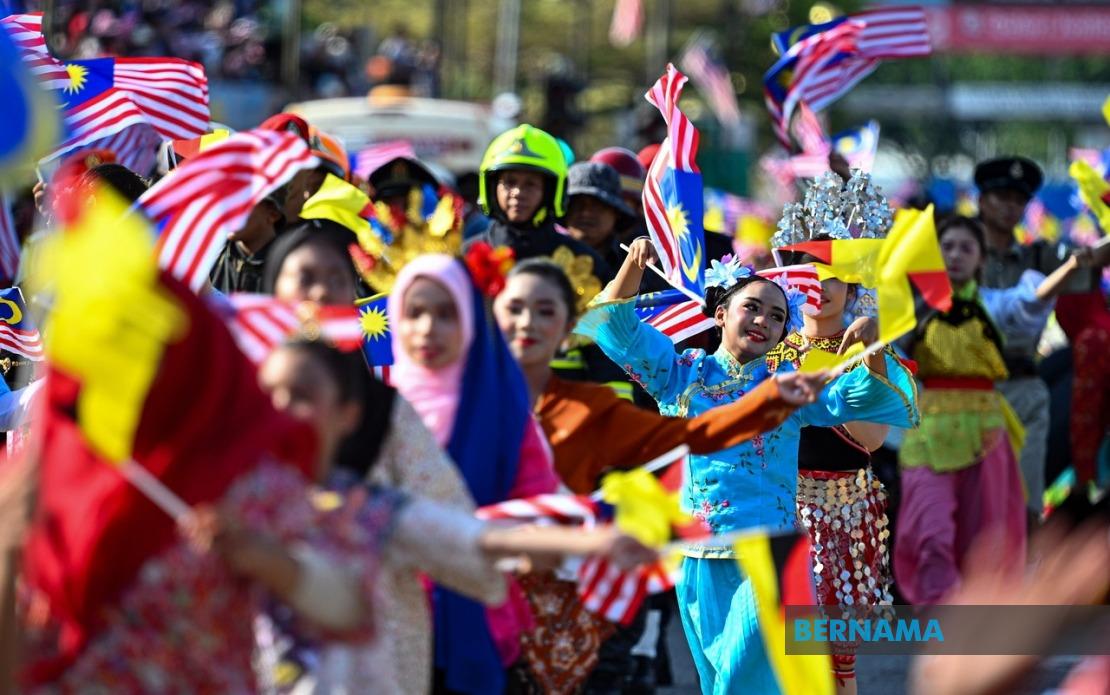
Seremban witnessed an outpouring of patriotic fervour on National Day as more than 30,000 people converged on Dataran Majlis Bandaraya Seremban, transforming the public space into a vibrant showcase of Malaysian unity. The diverse crowd—cutting across racial and community lines—began arriving well before dawn, with some spectators positioning themselves from 5.30 am onwards to secure vantage points for the day's proceedings. Menteri Besar Datuk Ismail Lasim interpreted the substantial turnout as a powerful affirmation of the public's commitment to commemorating the nation's independence journey, describing the scene as tangible evidence of citizens' deep affection for their country.
The presence of Tuanku Muhriz Tuanku Munawir, the Yang Dipertuan Besar of Negeri Sembilan, and Tunku Ampuan Besar Tuanku Aishah Rohani Tengku Besar Mahmud underscored the ceremonial importance of the occasion. The royal couple arrived shortly after 8.20 am and were formally received by Ismail, lending official gravitas to the proceedings and reinforcing the symbolic significance of National Day as a moment when all strata of Malaysian society unite in common purpose.
The parade itself represented a substantial logistical undertaking, with 82 contingents marshalling over 4,000 participants drawn from across the public and private sectors. Government departments, statutory authorities, municipal administrations, civil society organisations, educational institutions from primary schools through universities, and corporate entities all fielded representatives. This breadth of participation illustrated how National Day celebrations permeate virtually every institutional strand of Malaysian life, creating opportunities for citizens from different walks to express their civic identity collectively.
Military pageantry formed the ceremonial backbone of the event, with the Main Guard of Honour supplied by the 15th Battalion Royal Malay Regiment stationed in Senawang. The three-officer, 103-soldier contingent was commanded by Major Dr Muhammad Hazim Abdul Qhalib, while Lieutenant Ahmad Izzudin Abdul Kadir held the Colours, and Warrant Officer 1 Darul Azhar Mohamed performed the role of Regimental Sergeant Major. Musical accompaniment came from a combined military brass band comprising musicians from the 24th Battalion Royal Malay Regiment and the Malaysian Army Basic Training Centre, conducted by Drum Major Warrant Officer 2 Azwan Zakaria and performing patriotic selections including Sembah Tari, Aladom, Seruan Tentera and Tentera Benteng.
Menteri Besar Ismail acknowledged that this year's parade had been deliberately scaled back in terms of the number of contingents and military assets deployed, a precautionary decision rooted in concern about the haze phenomenon that periodically affects the region. Extended exposure to poor air quality, particularly for vulnerable populations such as children and the elderly, posed potential health risks that organisers sought to mitigate. Despite these reductions, the celebration maintained its essential character and drew no apparent disappointment from attendees, suggesting that the quality and character of the event resonated more powerfully than its sheer scale.
Defence and security agencies contributed prominently to the visual spectacle, with a parade of vehicles that included both contemporary operational assets and carefully curated historical exhibits. Vintage automobiles and restored bicycles from earlier decades proved particularly captivating for younger spectators, creating an educational dimension that complemented the patriotic messaging of the day. The Malaysian Armed Forces, Royal Malaysia Police, Immigration Department, Fire and Rescue Department, Health Ministry, Malaysian Civil Defence Force and Seremban City Council all fielded contingents, collectively demonstrating the institutional machinery through which the state protects and serves its citizens.
For many family groups present, attendance at National Day events represents an established ritual with profound personal significance. Siti Ruayiza Rebin, a 42-year-old housewife, explained that she has made it her practice to bring her three children—now aged 19, 15 and 12—to such celebrations since their early childhood, viewing the experience as formative civic education. Her deliberate approach to cultivating patriotic consciousness reflects a broader parental strategy in which participation in national commemorations serves as a vehicle for transmitting historical awareness and fostering appreciation for the achievements of preceding generations.
Other attendees emphasised similar educational motivations. Mohd Khairul Azmi, a 45-year-old private-sector worker who brought his two children aged five and seven, highlighted how the parade exposed youngsters to military hardware and security assets that rarely feature in their everyday experience. He and his family had arrived at 6 am to position themselves optimally for viewing, prioritising their children's ability to observe proceedings closely. This intergenerational transmission of national consciousness—whereby parents deliberately engineer opportunities for children to connect emotionally and intellectually with the nation's symbols and history—represents a critical mechanism through which patriotic attachment reproduces itself across generations.
The substantial attendance and positive public reception suggest that National Day celebrations in Negeri Sembilan continue to serve as effective mechanisms for social cohesion and national identity formation. Beyond the ceremonial formalities and military pageantry, the event functioned as an inclusive civic gathering where ordinary Malaysians from disparate backgrounds could congregate in common celebration. The early morning arrivals, the demographic diversity, the presence of families with young children, and the enthusiastic reception of historical and security assets all indicate deep public investment in the commemoration. For Malaysian readers navigating an increasingly complex and sometimes fractious political landscape, such scenes of spontaneous, multiracial gathering around shared national symbols carry particular resonance, offering tangible reminders of the bonds that unite the nation beneath its differences.

