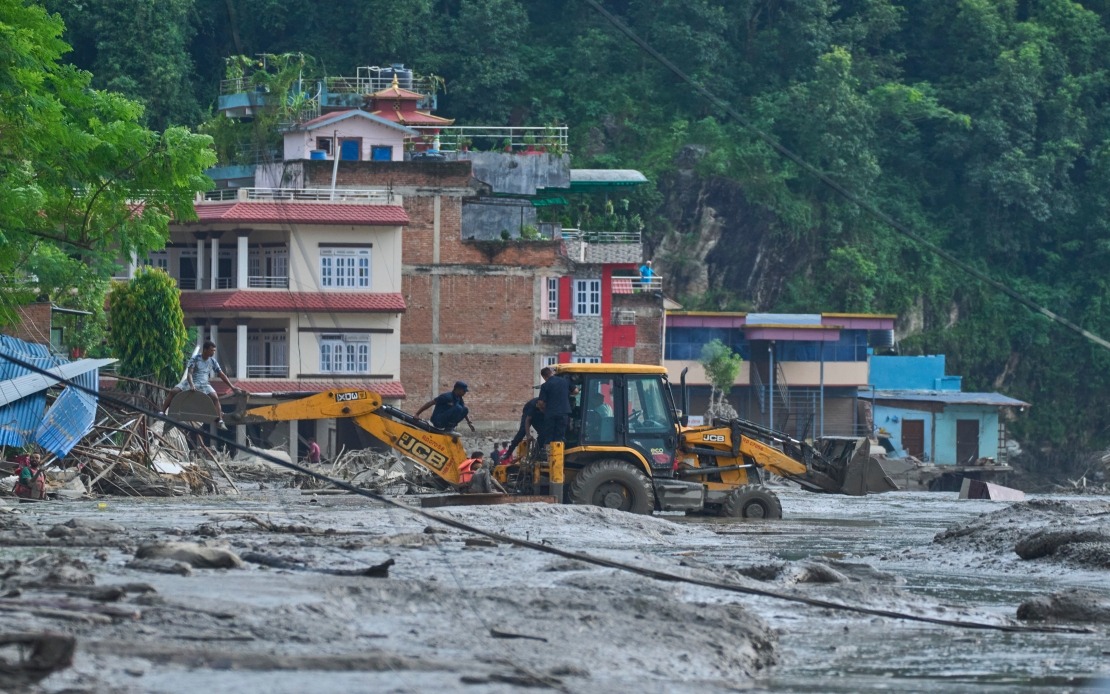
The Nepal-China border region faces a humanitarian crisis of unprecedented scale following catastrophic flash floods and mudslides that have claimed at least 160 lives and left more than 680 people missing, according to officials coordinating relief efforts in both countries. Nepalese rescue teams have recovered 157 bodies so far, whilst Chinese authorities report three confirmed deaths in the southern Tibet region with 265 individuals unaccounted for. The scale of disappearances underscores the ferocity of the natural disaster, which struck the Rasuwagadhi area and surrounding districts with little warning, catching tourists, migrant workers, and local residents in its path.
The Nepalese Prime Minister's Office has identified specific categories of missing persons that reveal the disaster's reach across multiple sectors. Among those unaccounted for are 44 military personnel, 28 police officers, 13 armed police members, and 60 civilian employees engaged in hydropower construction projects—reflecting how the region's economic activities became death traps when the disaster struck. The composition of missing tourists and travellers painted an international dimension to the tragedy: 391 foreign nationals and 93 Nepali citizens were initially reported missing, with individuals from Nepal, India, the United Kingdom, South Africa, Malaysia, Australia, and the Netherlands affected. South Korea's Foreign Ministry reported eight nationals unaccounted for, with another ten stranded in flood-affected areas, highlighting how the disaster disrupted regional travel networks and tourism flows across the Hindu Kush-Himalayan arc.
The physical destruction inflicted by the disaster reshaped the landscape and severed critical infrastructure connecting the two neighbouring nations. Nepalese government assessments documented the obliteration of at least 19 bridges, whilst 40 kilometres of roadway simply vanished beneath torrents of water and debris. Thirteen hydropower projects under development—representing substantial investment and employment for the region—suffered catastrophic damage, interrupting both economic activity and energy generation capacity. During a parliamentary briefing, Nepalese Foreign Minister Sishir Khanal characterised the destruction as comprehensive, noting that hydropower installations, government offices, and transportation networks were simultaneously erased. The disaster particularly ravaged the Rasuwa, Dhading, and Chitwan districts, areas already vulnerable to seasonal flooding but unprepared for the scale of this event.
On the Chinese side, the mudslide struck in the vicinity of Gyirong Port, a strategically significant border crossing in Xizang Autonomous Region, also known as Tibet. According to Xinhua News Agency reporting from Gyirong County's emergency management bureau in Xigaze City, the disaster comprehensively severed connectivity to the crossing: roads leading toward the port collapsed, communications infrastructure failed, and power supplies were interrupted. This isolation complicated international travel and trade, as Gyirong Port represents a critical crossing point for visitors bound for Mount Kailash and Lake Mansarovar, two of Asia's most significant pilgrimage and tourism destinations attracting thousands annually from across the region and beyond.
The Rasuwagadhi corridor where much of the destruction concentrated represents a vital junction in Himalayan tourism networks. Trekkers regularly transited through this zone to access the Langtang region, one of Nepal's premier trekking destinations, whilst others used the route as a transit point toward sacred sites in Tibet. The convergence of recreational tourism, pilgrimage travel, and commercial traffic rendered the area particularly vulnerable to disaster-related fatalities, as the flood struck during peak travel season when hundreds of individuals occupied lodges, rest stops, and mountain trails simultaneously.
Search and rescue operations mobilised across both borders within hours, representing a substantial commitment of military and civilian resources. Nepalese Foreign Minister Khanal outlined the deployment of comprehensive rescue capabilities: helicopters, drone surveillance systems, and specialised rafting teams drawn from Nepal Police, Armed Police Force, and Nepal Army coordinated efforts across flood-devastated zones. Rescue personnel recovered 54 individuals from inundated areas, though the remaining missing figures suggested that geographic isolation, terrain challenges, and the speed of water movements complicated systematic searches. Chinese President Xi Jinping issued directives ordering comprehensive search and rescue mobilisation, simultaneous evacuation of residents in danger zones, and priority medical treatment for the injured to minimise additional fatalities stemming from disaster-related injuries and complications.
Regional governments responded rapidly to demonstrate solidarity and provide material support. Indian Prime Minister Narendra Modi communicated with his Nepalese counterpart Balendra Shah, offering condolences and pledging humanitarian assistance. India subsequently dispatched ten tonnes of relief supplies, including disaster equipment and essential medicines, whilst Bihar state's chief minister in India's east implemented preventive measures—increasing embankment monitoring, intensifying night-time patrols, and preparing sensitive districts for potential flooding—recognising that monsoon-swollen rivers frequently threatened communities across borders during this season.
The disaster exposed the region's vulnerability to natural hazards concentrated in the Himalayan arc, where geological instability, steep terrain, and intense monsoon precipitation converge to create conditions for catastrophic flooding and landslide events. Climate patterns across South and East Asia during 2024 have produced unusual precipitation distributions, and the Nepal-China border region experienced weather conditions that triggered the disaster. For Malaysia and other Southeast Asian nations, the unfolding crisis illustrated how border regions sharing high-altitude terrain face shared disaster risks that demand coordinated international response frameworks and genuine cross-border cooperation mechanisms extending beyond rhetorical commitments.
The incident will likely prompt policy discussions regarding hydropower project siting in seismically and hydrologically active zones, tourism infrastructure resilience in remote mountain areas, and the adequacy of early warning systems for rapid-onset natural disasters. Both Nepal and China will confront substantial reconstruction requirements extending across transportation networks, power generation capacity, and tourism infrastructure, whilst the international missing persons situation demands sustained consular engagement and family notification protocols. Malaysian authorities monitoring the situation recognise that such disasters underscore the interconnectedness of regional development patterns and climate-related hazards affecting billions of people across the Greater Himalayan region, necessitating strengthened disaster preparedness and cross-border emergency response coordination that extends beyond bilateral arrangements to encompass multilateral frameworks addressing shared vulnerability.

