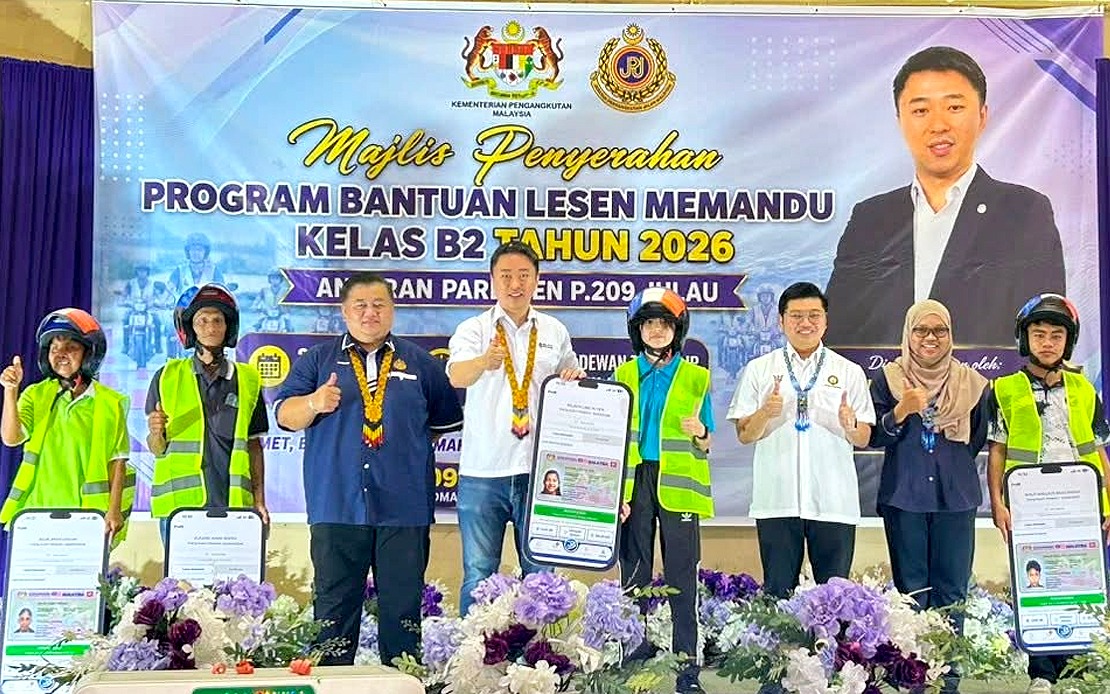
The closing ceremony of the 2026 Class B2 Driving Licence Assistance Programme at Julau Closed Stadium in Sarikei marked a significant milestone for rural communities in the constituency, with 885 participants successfully obtaining their Probationary Driving Licences and unlocking access to subsidised petrol for motorcycles. The initiative addresses a longstanding challenge faced by residents in remote areas who previously lacked the legal documentation required to purchase fuel at government-controlled rates, effectively bearing the full cost of rising fuel prices while relying on motorcycles as their primary transport. Julau MP Datuk Larry Sng Wei Shien, who also chairs the Malaysian Timber Industry Board, officiated the event alongside Sarawak Road Transport Department director Norizan Jili, underscoring the programme's significance to both state and federal authorities.
The human cost of lacking a valid licence became evident through participant testimonies. Bajik Undum, a 57-year-old farmer from Rumah Ajau in Ulu Kuntau, Pakan, had previously managed an orchard and transported her agricultural produce using a motorcycle without a licence, forcing her to purchase petrol at non-subsidised rates despite the financial strain. With fuel costs climbing steadily, this regulatory gap had created a compounding burden on her already modest livelihood. Now holding her Class B2 licence, Bajik can access the government subsidy scheme, a change she described as easing her daily financial pressures. As the oldest female participant in the programme, her case exemplifies how licensing gaps disproportionately affect older members of rural communities who may have been deterred by bureaucratic processes or limited access to licensing facilities in their remote locations.
The programme's reach extends across diverse occupational groups within the rural economy. Kudang Jenggi, the oldest male participant at 64 years old, works maintaining bird's nest houses in Bayong, Sarikei, a specialised agricultural role that requires regular mobility. His newfound ability to ride with a valid licence provides both legal protection and financial relief, as he can now purchase subsidised fuel rather than absorbing the full market price. The psychological dimension of holding legitimate documentation also matters—Kudang explicitly noted his reduced anxiety when passing roadblocks, a concern reflecting the enforcement environment in Malaysian highways. Daniel Padong, a 45-year-old smallholder working an oil palm plot in Ulu Amot, Pakan, similarly depends on his motorcycle for daily access to his farming operations, and the sharp recent rise in petrol costs had threateningly increased his operational expenses until the licensing programme opened subsidy access.
The Driving Licence Assistance Programme addresses a structural gap in rural development policy by recognising that transportation access fundamentally shapes economic participation. For residents of isolated constituencies like Julau, motorcycles serve not as leisure vehicles but as essential infrastructure connecting farms, markets, workplaces, and administrative centres. The inability to obtain subsidised fuel effectively imposed a stealth tax on rural economic activity, raising the cost base for agricultural production and small business operations. By facilitating access to Class B2 licences—the motorcycle category—the programme directly lowers transport costs for a population that depends heavily on two-wheeled vehicles, improving the competitiveness of rural smallholdings and informal enterprises.
The subsidy eligibility component warrants closer examination within Malaysia's broader fuel subsidy architecture. Government-subsidised fuel schemes exist partly to support rural communities and buffer the poor from global commodity price volatility, yet accessing these benefits requires documentary proof of identity and licensing status. Rural residents without formal identification or valid licences effectively exclusion from these welfare mechanisms, creating a documentation barrier superimposed over geographic disadvantage. The 885 participants now have access to this safety net, though the underlying question remains whether licensing requirements should be prerequisites for fuel subsidy benefits or whether alternative mechanisms might extend support more equitably.
Sarawak's engagement with this initiative reflects the state government's focus on rural development and transport infrastructure as economic enablers. Sarawak Road Transport Department involvement ensures that licensing processes comply with federal standards while accommodating rural populations with limited access to urban licensing centres. The Julau programme demonstrates scalable implementation of such assistance, suggesting potential replication across other rural parliamentary constituencies facing similar transport connectivity challenges. The data point of 885 participants completing the programme within a defined timeframe also provides a baseline for measuring rural licensing rates and identifying populations still outside formal transport regulation.
The implications extend beyond immediate fuel cost savings to encompass legal compliance and administrative integration. Motorcyclists without valid licences operate in a grey zone regarding insurance, accident liability, and enforcement action, exposing themselves and other road users to risks. Legalising their status through the assistance programme simultaneously improves road safety outcomes and brings informal transport activity within regulatory oversight. For insurers and enforcement agencies, higher licensing rates among rural populations improve data quality and enable more targeted safety interventions. The programme thus serves multiple policy objectives simultaneously—poverty alleviation through fuel subsidy access, road safety improvement, and administrative modernisation of rural communities.
Language and accessibility in the licensing process appears central to the programme's success among non-urban populations. Many rural residents, particularly older participants like Bajik and Kudang, may face literacy or language barriers when navigating formal bureaucratic procedures. The Driving Licence Assistance Programme presumably streamlined documentation requirements and provided support in comprehensible formats, enabling 885 participants to complete licensing within a concentrated timeframe. This approach contrasts with standard licensing processes that might deter rural applicants unfamiliar with urban bureaucratic norms. Future rural development initiatives might learn from this model regarding designing administrative processes responsive to the actual capabilities and constraints of intended beneficiaries.
The programme's timing during global fuel price volatility underscores its relevance. International oil market fluctuations disproportionately impact rural economies dependent on transport costs, particularly in agricultural regions where margins are thin and price transmission rapid. By securing subsidised fuel access for 885 additional households, the initiative provides temporary insulation from commodity shocks. However, sustainable rural development ultimately requires diversifying income sources and reducing transport dependencies rather than relying indefinitely on fuel subsidies. The licensing programme should thus be viewed as a foundation for further interventions—improved roads reducing travel distances, storage facilities minimising repeated trips, and value-added agriculture increasing per-unit margins.
Gender dimensions warrant acknowledgment given that Bajik, the oldest female participant, explicitly benefited from the programme's accessibility. Rural women engaged in agricultural marketing, orchard management, and smallholder farming often face compounded barriers including limited mobility documentation. Designing assistance programmes with gender-conscious features—transport to licensing centres, scheduling flexibility, documentation support—can meaningfully improve participation among female participants. The visible inclusion of women like Bajik in the programme's outcomes suggests that outreach efforts reached diverse demographic groups, though broader gender disaggregation of the 885 participants would clarify whether the programme achieved proportional representation.
Looking forward, the success of the Julau Class B2 Driving Licence Assistance Programme creates momentum for expanding similar initiatives across underserved constituencies. The 885 participants represent documented demand for licensing services in rural areas, suggesting similar cohorts exist elsewhere. Scaling the programme requires sustained funding for mobile licensing units, trained personnel, and administrative support in rural areas. Tracking longer-term outcomes—whether subsidised fuel access translates to measurable income changes, business expansion, or improved agricultural productivity—would strengthen the evidence base for continued investment. The programme demonstrates that licensing is not merely a legal formality but a practical gateway to economic participation and welfare access in rural Malaysia.

