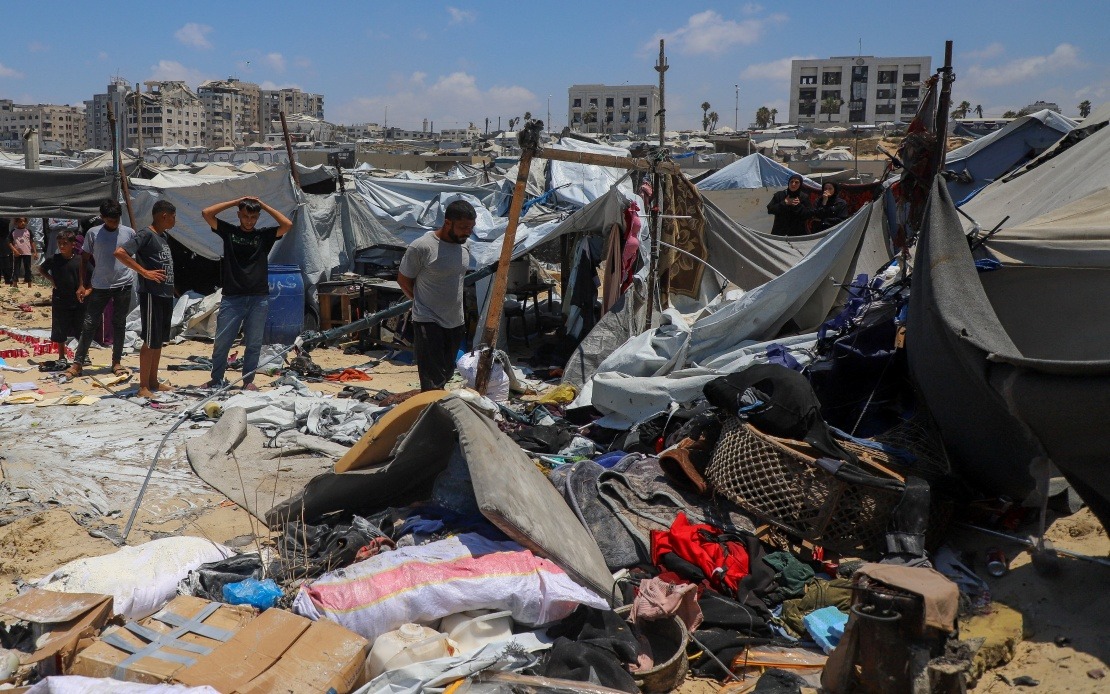
The scale of destruction across the Gaza Strip has reached catastrophic proportions, with Palestinian authorities estimating that more than 90 per cent of the enclave now lies in ruins following intensive Israeli military operations. According to a weekly situation report issued by the Palestinian Government Communication Centre under the Prime Minister's Office, the occupation forces have consolidated control over approximately 80 per cent of the war-devastated territory. The assessment, compiled from local sources and released on Monday, underscores the magnitude of the humanitarian crisis unfolding in one of the world's most densely populated regions.
During the week spanning June 29 to July 6, the intensity of Israeli military activities escalated significantly across multiple population centres including Khan Younis, Rafah, and Gaza City. Local medical authorities recorded eight Palestinian deaths during this seven-day period alone, though the actual toll of the conflict extends far beyond these documented figures. The escalation reflects a pattern of sustained military pressure across the enclave, with operations targeting both military objectives and civilian infrastructure with little distinction maintained between the two.
The destruction manifests in concrete ways that devastate Palestinian communities. Beyond the headline figures, the Palestinian report details systematic demolition of residential structures and the displacement of families from their homes through direct military action and bombardment. Shelling of civilian neighbourhoods has become routine, with entire residential areas rendered uninhabitable through the combination of direct strikes and structural damage that makes reconstruction impossible. This displacement compounds an existing humanitarian emergency, as Palestinian civilians have nowhere to relocate within the confined territory of Gaza.
The West Bank continues to experience its own cycle of military incursions and restrictions that parallel the Gaza campaign. Israeli occupation forces conducted widespread raids across Palestinian cities and towns during the reporting period, including Ramallah, Nablus, Hebron, Bethlehem, Jenin, Qalqilya, Tulkarem, and occupied Jerusalem. These operations involved systematic home invasions, arrests without judicial process, and movement restrictions that severely curtail Palestinian freedom of movement and economic activity. Road closures further fragmentize Palestinian communities and prevent the flow of commerce and humanitarian assistance.
Beyond formal military operations, Israeli settler militias have pursued a parallel campaign of harassment and violence against Palestinian civilians and their property. Recent incidents documented by Palestinian authorities included arson attacks on Palestinian-owned establishments, with a cafeteria in al-Lubban ash-Sharqiya deliberately set ablaze. Attacks on Palestinian shepherds grazing livestock east of Bethlehem, coupled with attempts to steal animals, reflect efforts to economically marginalize Palestinian agricultural communities. The blockade of main entrances to villages like Burqa demonstrates how physical barriers restrict Palestinian access to resources and markets.
The agricultural sector has emerged as a particular target of Israeli actions, with systematic destruction of Palestinian farming capacity in the occupied West Bank. The Palestinian Ministry of Agriculture documented a dramatic escalation in attacks on agricultural infrastructure and resources during the reporting week. The scale of damage recorded exceeds 2,559 olive trees that were either uprooted, burned, or otherwise damaged, concentrated primarily in the Salfit, Jenin, and Nablus governorates where Palestinian farming communities have maintained agricultural traditions for generations.
The economic impact of agricultural destruction extends beyond immediate crop losses. At least 125 farmers directly experienced losses of documented value reaching approximately US$11.78 million during this single week. This figure represents merely the quantifiable economic damage and does not account for the long-term devastation to farming infrastructure, soil degradation, and lost income streams for Palestinian families dependent on agriculture. For a population already constrained by occupation and blockade, such losses strike at subsistence livelihoods and food security.
For Malaysian and Southeast Asian observers, these developments carry significance beyond humanitarian concern. The situation in Palestine reflects broader patterns of territorial control, military occupation, and systematic restrictions on civilian populations that resonate with regional concerns about sovereignty and self-determination. Malaysia's longstanding position as an advocate for Palestinian rights within international forums means that escalating destruction and displacement directly relate to Malaysian foreign policy priorities and regional stability considerations.
The comprehensive nature of the destruction—affecting over 90 per cent of Gaza's built environment—suggests that reconstruction and humanitarian recovery will require international intervention at unprecedented scales. The concentration of Israeli control over 80 per cent of territory raises questions about the feasibility of Palestinian autonomous governance and reconstruction within the enclave. These structural constraints will shape the trajectory of Palestinian society for decades, influencing regional stability, humanitarian flows, and the broader geopolitical balance in the Middle East during a period already marked by significant volatility and competing interests.

