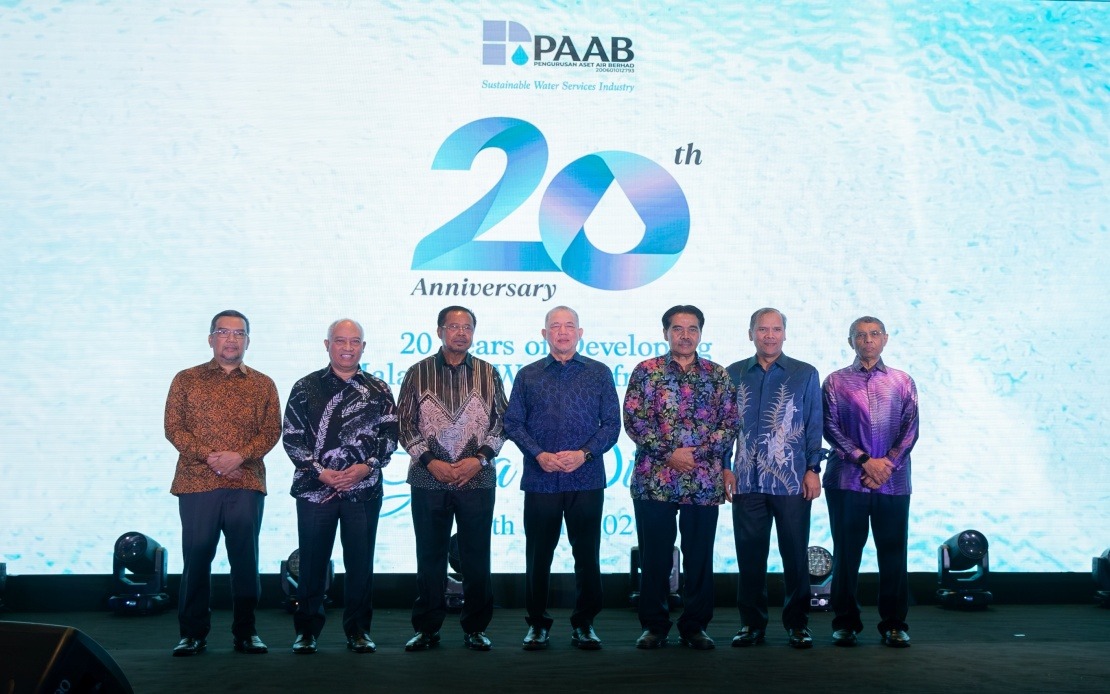
Pengurusan Aset Air Berhad (PAAB) reached a significant milestone this week as Malaysia's state-owned water asset manager celebrated two decades of restructuring the nation's water services industry. Since its establishment on May 5, 2006, as a wholly owned company of the Minister of Finance Incorporated, PAAB has emerged as a cornerstone institution in the country's efforts to modernise water infrastructure and secure supplies for millions of Malaysians across urban and rural areas.
The scale of PAAB's financial engagement with the water sector underscores the magnitude of the transformation effort underway. Over its 20-year lifespan, the agency has financed the assumption of water industry loans worth RM23.04 billion while simultaneously committing RM23.84 billion to capital expenditure on infrastructure development. Combined, these figures represent RM46.88 billion in financial commitments that have reshaped how Malaysia manages, treats, and distributes water to its population. This represents one of the largest sustained public infrastructure investment programmes in the country, rivalling spending in energy and transportation sectors.
The physical manifestations of PAAB's investment are now visible across the nation. As of December 2025, ten states have formally adopted the National Water Services Industry Restructuring Plan, a coordinated blueprint for transforming water supply systems. Within these participating states, completed projects include 21 newly constructed or upgraded water treatment plants with combined daily capacity reaching 2,085 million litres. Storage infrastructure has expanded with 42 storage tanks adding 783 million litres of holding capacity, while network modernisation has extended or rehabilitated 3,263 kilometres of pipeline across the country. These tangible assets form the backbone of efforts to improve water quality, reduce losses, and expand service coverage to previously underserved communities.
Deputy Prime Minister Datuk Seri Fadillah Yusof, who also holds the Energy Transition and Water Transformation portfolio, used the occasion to emphasise a critical vulnerability in Malaysia's water system that has long vexed policymakers and industry experts. Non-revenue water—the portion of treated water lost through leaks, theft, and measurement errors before reaching consumers—currently stands at approximately 40 per cent nationally. This figure represents an enormous and economically unjustifiable wastage that Fadillah insisted demands immediate remedial action rather than passive reliance on multi-decade planning horizons.
The deputy premier's intervention reflects growing frustration within government circles about the pace of addressing water loss, particularly as Malaysia positions itself as a regional hub for data-intensive industries such as semiconductor manufacturing and cryptocurrency mining operations. These sectors demand not merely adequate water supply but reliable, uninterrupted access to vast quantities of high-quality water for cooling systems and processing. The combination of population growth, industrial expansion, and climate variability creates a compounding pressure on water security that cannot be managed through traditional incremental approaches.
Fadillah articulated a striking contradiction in Malaysia's water strategy: substantial investment in adding treatment capacity while simultaneously accepting that nearly half of all treated water disappears before generating revenue or serving consumers. He stressed that resolving non-revenue water losses requires coordinated action spanning federal agencies and state governments simultaneously, moving beyond the typical fragmented approach where different actors pursue initiatives independently. Without such cohesion, he warned, the nation risks supply disruptions that could undermine both public welfare and economic competitiveness.
The structural complexity underlying these challenges became apparent through PAAB's explanation of its phased implementation roadmap. The organisation operates under a four-stage transformation programme extending to 2050: Migration (2008–2020) focused on transitioning to new operational structures, Stabilisation (2021–2030) aimed at making systems financially sustainable and operationally robust, Consolidation (2031–2040) seeking to achieve economies of scale and integrated management, and Full Cost Recovery (2041–2050) where water pricing fully reflects the true economic cost of supply. This 42-year timeline reflects the magnitude of institutional and financial transformation required, but also illustrates why immediate action on specific issues like non-revenue water cannot wait for long-term structural changes to materialise.
The allocation of RM23.84 billion in capital expenditure reveals the current distribution of PAAB's efforts across the project pipeline. RM8.33 billion has been deployed to completed facilities now transferred to operating companies, indicating steady progress in asset creation. However, RM1.84 billion remains tied up in projects under active construction, suggesting some pipeline management challenges, while RM13.67 billion sits in projects still in design and planning stages. This composition indicates that nearly 60 per cent of committed spending remains in earlier-stage development, implying significant execution risks and the possibility that completion timelines could extend further.
For Malaysian businesses and investors, PAAB's trajectory carries important implications. Companies operating in water-intensive sectors or those considering expansion into Malaysia need reliable projections of supply adequacy and cost stability. The organisation's explicit commitment to full cost recovery by 2050 signals that water tariffs will progressively increase as utilities transition to financially sustainable models. This transition, while necessary for system viability, could affect operational costs across food and beverage, manufacturing, hospitality, and data centre industries. Forward-looking enterprises should factor in gradual water cost escalation when evaluating long-term business cases and investment horizons in Malaysia.
PAAB chairman Datuk Seri Jaseni Maidinsa emphasised that the organisation's ultimate measure of success transcends financial metrics or asset accumulation. The true benchmark, he stated, lies in whether PAAB's investments translate into tangible improvements in water supply stability, quality, and accessibility for ordinary Malaysians. This perspective reflects a conscious shift in development thinking away from purely quantitative achievement measures toward outcomes that genuinely enhance public welfare. It also implicitly acknowledges that massive infrastructure spending has limited value if systems remain fragile or if populations continue experiencing supply disruptions.
Regionally, Malaysia's water sector restructuring offers instructive lessons for neighbouring Southeast Asian economies grappling with urbanisation, industrialisation, and climate challenges. The scale of investment, the institutional frameworks created, and the acknowledgment of non-revenue water as a critical priority demonstrate both the complexity of water management in developing economies and the willingness to commit substantial resources toward solutions. Countries like Thailand, Indonesia, and the Philippines continue wrestling with similar challenges, and Malaysia's experience—both successes and ongoing problems—provides a reference point for policy deliberation across the region.
Looking ahead, PAAB faces the dual challenge of maintaining investment momentum while accelerating solutions to acute problems like non-revenue water losses. The 20-year anniversary marks not an endpoint but rather the midpoint of a longer transformation journey extending to 2050. The coordination that Deputy PM Fadillah demanded will test whether Malaysia's governance structures can execute aligned strategies across multiple levels of government and institutional boundaries. Success on this front would position the country as a model for water security in a resource-constrained world; failure could perpetuate the paradox of heavy spending yielding inadequate outcomes that currently characterises Malaysian water management.

