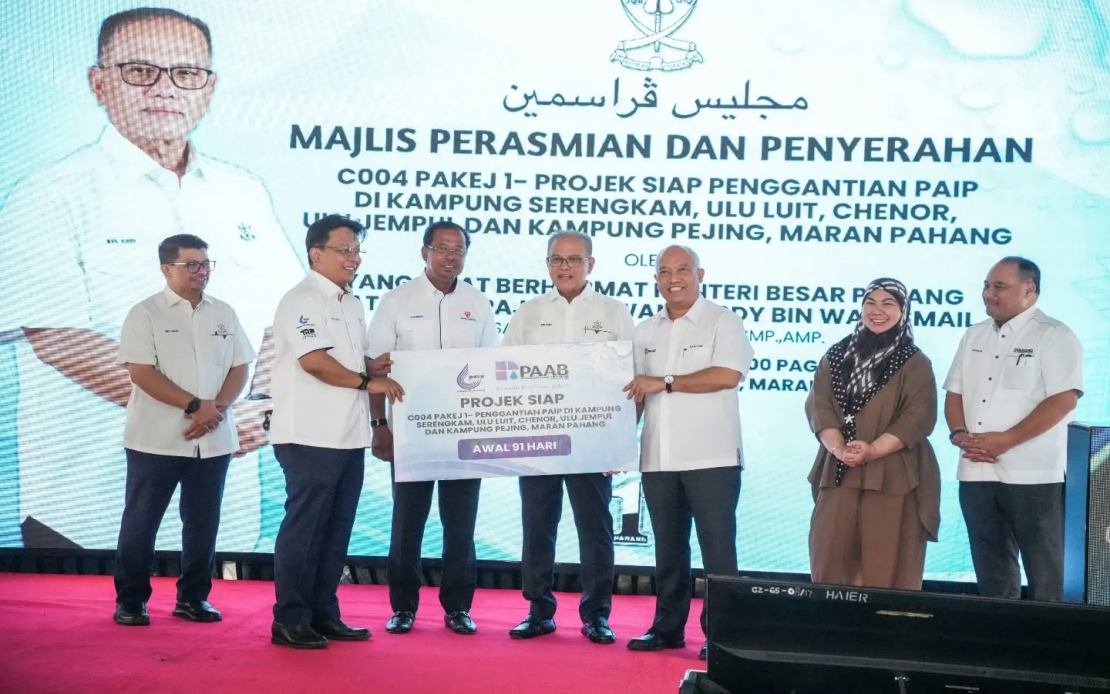
Residents of Maran in Pahang can finally breathe easier following the completion of a RM11.19 million water infrastructure overhaul that addresses chronic supply disruptions stretching back nearly two decades. Pengurusan Aset Air Berhad (PAAB) has fully funded the ambitious pipe replacement initiative, which was handed over at the Chenor Water Treatment Plant today in a ceremony officiated by Pahang Menteri Besar Datuk Seri Wan Rosdy Wan Ismail, marking a significant milestone in the state's efforts to modernise its ageing water networks.
The project delivered tangible results by replacing 29.6 kilometres of deteriorating pipes across multiple localities within the district. Communities in Kampung Serengkam, Ulu Luit, Pejing, Ulu Jempul and Chenor—with the Chenor sub-district being particularly hard-hit over the years—now benefit from refreshed infrastructure designed to withstand contemporary demand patterns. The scope of work reveals the extent of decay in Maran's distribution system; such comprehensive replacement efforts typically indicate widespread structural failures accumulated over decades of deferred maintenance.
What distinguishes this initiative from routine maintenance is its immediate and measurable impact on daily life for approximately 10,000 direct beneficiaries. Beyond simply restoring water to taps, the project addresses the cascading problems that ageing pipes create. Frequent burst pipes, which had become almost predictable seasonal occurrences for residents, have been virtually eliminated. The replacement programme also tackles non-revenue water loss—essentially water lost through leakage before reaching consumers—a chronic inefficiency that plagues water utilities across Southeast Asia and represents both financial drain and environmental waste.
Perhaps equally significant is the stabilisation of water pressure during periods of high consumption. Residents in tropical climates endure particular hardship during dry seasons and festive periods when demand spikes dramatically, often leading to cascading pressure drops that leave entire neighbourhoods without water for days. The upgraded system now maintains consistent pressure even during these peak demand windows, a quality-of-life improvement that extends beyond mere water availability to encompass dignity and livability. For families managing health needs or operating small businesses dependent on reliable water access, this reliability proves transformative.
The project's ahead-of-schedule completion within three months of target demonstrates operational competence worth noting in Malaysia's infrastructure landscape, where delays frequently plague major initiatives. This punctuality suggests proper project management, adequate resource allocation, and effective coordination among multiple stakeholders. Deputy Energy Transition and Water Transformation Minister Datuk Seri Abdul Rahman Mohamad and Deputy Economy Minister Datuk Mohd Shahar Abdullah's attendance underscores federal-level commitment to water sector transformation, positioning this Maran project within broader national ambitions to modernise infrastructure.
Beyond Maran's immediate benefits, PAAB has committed to expanding this developmental approach across Pahang's water systems over the coming three years through partnership with Pengurusan Air Pahang Berhad (PAIP). The collaboration encompasses multiple concurrent projects that collectively represent a comprehensive rethinking of the state's water infrastructure. A planned electrical system upgrade at the Jengka Utama Water Treatment Plant addresses supply disruptions affecting the Felda Jengka settlement, while a separate RM35.7 million initiative will replace 76.2 kilometres of ageing pipes in Jerantut and Lipis, serving communities around Pulau Tawar and Kuala Tahan. An additional RM13 million project targets Felda Keratong's 11-kilometre pipeline replacement to enhance Rompin's supply efficiency.
These stacked initiatives reveal strategic thinking rather than ad-hoc problem-solving. PAAB's allocation of RM1.17 billion across Pahang's water infrastructure as of July indicates serious financial commitment, though the breakdown of these funds tells an instructive story about Malaysia's development trajectory. With RM69.79 million already deployed in completed projects and RM66.94 million committed to active construction, the overwhelming majority—RM981.04 million—remains in planning and design phases. This distribution pattern suggests either ambitious future expansion or, more likely given Pahang's existing infrastructure challenges, substantial backlogs of identified but unfunded or unprioritised requirements awaiting implementation.
The constitutional framework governing PAAB's operations provides important context for understanding this initiative's significance. Established in 2006 under the Water Services Industry Act 2006, PAAB functions as the federal government's implementation instrument for the National Water Services Industry Restructuring Plan, wholly owned by Minister of Finance Incorporated and regulated by the Ministry of Energy Transition and Water Transformation (PETRA). This institutional architecture positions water infrastructure as a federal priority rather than leaving it entirely to state discretion, ensuring baseline standards and enabling coordinated investment across jurisdictions.
PAIP's execution role, formalised through the Pahang State Water Supply Services Restructuring Agreement signed in 2020, exemplifies the state-federal partnership model increasingly adopted across Malaysian infrastructure development. Rather than centralising all operations, this approach leverages state-level expertise and local knowledge while anchoring investment decisions and accountability within federal frameworks. For Malaysian readers, particularly those in states beyond Pahang, this model offers instructive precedent for addressing similar water challenges.
The resolution of Maran's decades-long water crisis carries broader implications for how Malaysia approaches infrastructure modernisation in secondary cities and towns. Unlike Klang Valley or Penang, where water supply challenges receive substantial media attention and political pressure, Maran's struggles largely proceeded without national prominence until PAAB's intervention. This suggests that systematic federal assessment is identifying critical gaps in secondary centres that might otherwise languish indefinitely. As climate variability increases pressure on water systems across Southeast Asia, investing in reliable distribution infrastructure becomes as important as securing raw water supply itself.
For Malaysian households beyond Pahang experiencing similar water disruptions—and such problems affect urban and rural communities throughout the country—the Maran project demonstrates that comprehensive solutions remain achievable through coordinated federal-state investment and disciplined project execution. The completion of this infrastructure overhaul, delivering after nearly two decades of community frustration, illustrates both the magnitude of accumulated deficits in Malaysia's water systems and the feasibility of addressing them when political will and financial resources align strategically.

